My first encounter with the Acarian Alón IV was at the 1992 Las Vegas WCES. I was doing the show report dealing with speakers, and there was already enough advance buzz about the Alón IV that I put it on my "Speakers I Must Listen To" list. And listen I did, at some length, and came away impressed with their open quality and well-defined soundstage. In discussing reviewing assignments with John Atkinson, I told him that the Alón IV was one of the speakers I wouldn't mind spending some time with. (The list also includes the WAMM, the MartinLogan Statement, and the Apogee Grand, but I'm not holding my breath.)
 And so it came to pass that on a cold day last July (footnote 1), Acarian Systems' President/Designer Carl Marchisotto—chief design engineer at Dahlquist for 15 years—and Marilyn Marchisotto, Acarian's Vice President, showed up on my doorstep with a pair of Alón IVs, ready to install them in my listening room, and bringing with them electronics and cables that Carl had found to be a good match for the speakers.
How did it work out? Read on.
Description & design
And so it came to pass that on a cold day last July (footnote 1), Acarian Systems' President/Designer Carl Marchisotto—chief design engineer at Dahlquist for 15 years—and Marilyn Marchisotto, Acarian's Vice President, showed up on my doorstep with a pair of Alón IVs, ready to install them in my listening room, and bringing with them electronics and cables that Carl had found to be a good match for the speakers.
How did it work out? Read on.
Description & design
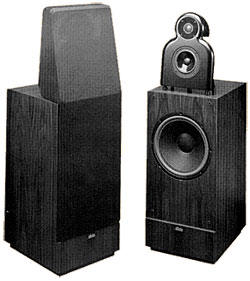
For a speaker weighing in at 105 lbs., the Alón IV looks fairly compact—that is, with the top cover removed. With its cover on, the Alón IV is visually much more imposing, looking like the WATT/Puppy's tall brother on steroids. This is a three-way design, employing a 12" woofer, 5" midrange, and a 1" metal-dome tweeter, all the drivers custom-made to Acarian Systems' specifications. The woofer has its own 2.8-ft3 infinite baffle enclosure of 1¼" laminated construction, with extensive bracing to control panel resonances. The midrange and tweeter are mounted on a separate, molded baffle with rounded edges, the baffle mounted at an angle to produce alignment of the drivers' centers and to improve the vertical dispersion pattern. The midrange driver operates without an enclosure, acting as a dipole; the tweeter has a dual-chamber enclosure, with a ring of absorbent material around the front to reduce diffraction, and an open-type phase plug to improve dispersion. The woofer crosses over to the midrange unit at 400Hz, with crossover to the tweeter at 3.5kHz. The crossover slopes vary between 6 and 12dB/octave, and are specifically designed for the drivers used in the Alón IV rather than following any of the classic curves. The crossover is hard-wired on three separate boards, and features air-core inductors and polypropylene capacitors. Each speaker is provided with six binding posts, to allow the recommended tri-wiring. Bi-wiring is considered a reduced-performance option; the Owner's Manual warns that with single-wiring the performance may deteriorate to "poor." Only one set of jumpers is provided, just to make sure you're not tempted to single-wire. A set of threaded spikes allows for firm mechanical grounding. The speaker is well-finished, in natural oak (the review samples), black oak, or rosewood veneer. The stylish aesthetics are by TAS's Robbii Wessen.
Are we having fun yet?
The Alón IV has recessed, thicker-than-usual binding posts; connecting some of the speaker cables involved much sweat, a few tears, and nearly some blood. I do wish that manufacturers of cables, speakers, and amplifiers would agree on a simple matter such as the thickness of the binding post and the size of the opening in a spade lug. For all "serious" auditioning, the speaker's top and bottom covers were removed, which produced a slightly more transparent sound. Although I've written a piece on how to tweak your audio system (see Vol.13 No.12, p.81), I'm not the sort of person who finds it thrilling to spend a Saturday afternoon listening to the effects of adjusting cartridge VTA by minute increments, or agonizing over what sort of string should be used to suspend speaker cables. Whenever I read a speaker review which states that the sound of the speaker changes from heavenly to horrible when you vary the speaker's position by ¼", I know this is not a speaker I'd like to have in my listening room. Ditto for a speaker that requires a king's ransom's worth of RoomTunes or Tube Traps arranged exactly the right way if it's not to sound dreadful. Fortunately, the Alón IVs proved to be relatively non-temperamental when it came to positioning and the need for room acoustical treatment. Carl Marchisotto suggested that they'd probably sound best just where I'd positioned my Quad/Cizek system, so that's where I put them. The sound was generally pretty good, but Carl thought it could be improved by taking out the RoomTunes that had been placed in the corners and in the middle of the wall behind the speakers. He was right: with the RoomTunes removed, there was a more even spread of sound. (The same RoomTunes arrangement had helped the Quad/Cizek system.)
With a further bit of tweaking over the next few weeks, I came up with a setup that seemed to provide an even better combination of smooth tonal balance, bass extension, spaciousness, and focus. The speakers are still more or less in the same position, along the longer wall of my 14' by 16' by 7½' listening room, with the front of each speaker 43" from the back wall, the left side of the left speaker 38" from the side wall, and the right side of the right speaker 32" from the side wall. The Listening Room computer program confirmed that in my room this position is just about ideal for minimizing standing waves and early reflections from the side walls (footnote 2). A 4' by 6' shag rug hangs on the wall behind the listening area, and the speakers are toed-in ever-so-slightly. A final touch was a RoomTune panel placed along each side wall, about a foot forward from the speaker, with the absorbent side facing the room, to catch some of the early reflections.
Sound
A HUGE soundstage. With a 92" center-to-center distance between speakers and about the same distance or less between the listener's ears and the center of each speaker, the soundstage is super-wide (although there's no problem with center-fill), and depth seems restricted only by the size of the recording venue. This was my favored listening position, but I should admit (if it's not already obvious) that I like a very wide soundstage; in most audio store demonstrations, I pull my chair closer to the speakers. Many speakers make it impossible to achieve this sort of stage width unless you're willing to put up with a hole in the middle; sitting this close also tends to highlight lobing effects and arrival-time differences between drivers, with potential imaging problems. The Alón IVs are unusual in giving you this "widescreen" effect while maintaining specificity of images within the soundstage. Individual images within the soundstage don't have quite the pinpoint "holographic" definition you get with the best minimonitors, but they're excellent by any other standard. (In a larger room, being able to sit farther from the speakers while maintaining a wide angle is likely to improve the imaging.) Similarly, depth is extensive and, unlike what one tends to get from dipoles or bipolar speakers, quite precisely layered. Opera recordings, like the Caballé/Carreras Tosca or the Pavarotti/Freni La Bohème, in which the "soundstage" literally represents sounds generated on stage, are ideal for demonstrating the Alón IVs' remarkable spatial qualities, but I find that a wide and deep soundstage enhances the enjoyment of all sorts of music, including audiophile favorites like the Weavers' Reunion At Carnegie Hall. (I understand that Corey Greenberg is willing to trade his entire Elvis collection for a mint copy of the original release of the Weavers album plus an autographed picture of Amanda McBroom.)
Footnote 1: This past July was the coldest and dampest in Ontario in 104 years. Footnote 2: The Listening Room saved me a lot of effort. I've always wondered whether I should try repositioning the speakers along the short wall, which would mean having to move tons of equipment, LPs, and CDs. The Listening Room told me that the new arrangement would likely be much less optimal, producing severe standing waves and dips in the frequency response due to boundary effects. This relatively inexpensive program, reviewed by TJN in Vol.13 No.12, is highly recommended to those who, like me, would rather let the computer do the work. The Listening Room is available from Sitting Duck Software, P.O. Box 130, Veneta, OR 97487, Tel: (503) 935-3982, for $47.50 (PC), $67.50 (Macintosh).
And so it came to pass that on a cold day last July (footnote 1), Acarian Systems' President/Designer Carl Marchisotto—chief design engineer at Dahlquist for 15 years—and Marilyn Marchisotto, Acarian's Vice President, showed up on my doorstep with a pair of Alón IVs, ready to install them in my listening room, and bringing with them electronics and cables that Carl had found to be a good match for the speakers.
How did it work out? Read on.
Description & design
For a speaker weighing in at 105 lbs., the Alón IV looks fairly compact—that is, with the top cover removed. With its cover on, the Alón IV is visually much more imposing, looking like the WATT/Puppy's tall brother on steroids. This is a three-way design, employing a 12" woofer, 5" midrange, and a 1" metal-dome tweeter, all the drivers custom-made to Acarian Systems' specifications. The woofer has its own 2.8-ft3 infinite baffle enclosure of 1¼" laminated construction, with extensive bracing to control panel resonances. The midrange and tweeter are mounted on a separate, molded baffle with rounded edges, the baffle mounted at an angle to produce alignment of the drivers' centers and to improve the vertical dispersion pattern. The midrange driver operates without an enclosure, acting as a dipole; the tweeter has a dual-chamber enclosure, with a ring of absorbent material around the front to reduce diffraction, and an open-type phase plug to improve dispersion. The woofer crosses over to the midrange unit at 400Hz, with crossover to the tweeter at 3.5kHz. The crossover slopes vary between 6 and 12dB/octave, and are specifically designed for the drivers used in the Alón IV rather than following any of the classic curves. The crossover is hard-wired on three separate boards, and features air-core inductors and polypropylene capacitors. Each speaker is provided with six binding posts, to allow the recommended tri-wiring. Bi-wiring is considered a reduced-performance option; the Owner's Manual warns that with single-wiring the performance may deteriorate to "poor." Only one set of jumpers is provided, just to make sure you're not tempted to single-wire. A set of threaded spikes allows for firm mechanical grounding. The speaker is well-finished, in natural oak (the review samples), black oak, or rosewood veneer. The stylish aesthetics are by TAS's Robbii Wessen.
The Alón IV has recessed, thicker-than-usual binding posts; connecting some of the speaker cables involved much sweat, a few tears, and nearly some blood. I do wish that manufacturers of cables, speakers, and amplifiers would agree on a simple matter such as the thickness of the binding post and the size of the opening in a spade lug. For all "serious" auditioning, the speaker's top and bottom covers were removed, which produced a slightly more transparent sound. Although I've written a piece on how to tweak your audio system (see Vol.13 No.12, p.81), I'm not the sort of person who finds it thrilling to spend a Saturday afternoon listening to the effects of adjusting cartridge VTA by minute increments, or agonizing over what sort of string should be used to suspend speaker cables. Whenever I read a speaker review which states that the sound of the speaker changes from heavenly to horrible when you vary the speaker's position by ¼", I know this is not a speaker I'd like to have in my listening room. Ditto for a speaker that requires a king's ransom's worth of RoomTunes or Tube Traps arranged exactly the right way if it's not to sound dreadful. Fortunately, the Alón IVs proved to be relatively non-temperamental when it came to positioning and the need for room acoustical treatment. Carl Marchisotto suggested that they'd probably sound best just where I'd positioned my Quad/Cizek system, so that's where I put them. The sound was generally pretty good, but Carl thought it could be improved by taking out the RoomTunes that had been placed in the corners and in the middle of the wall behind the speakers. He was right: with the RoomTunes removed, there was a more even spread of sound. (The same RoomTunes arrangement had helped the Quad/Cizek system.)
A HUGE soundstage. With a 92" center-to-center distance between speakers and about the same distance or less between the listener's ears and the center of each speaker, the soundstage is super-wide (although there's no problem with center-fill), and depth seems restricted only by the size of the recording venue. This was my favored listening position, but I should admit (if it's not already obvious) that I like a very wide soundstage; in most audio store demonstrations, I pull my chair closer to the speakers. Many speakers make it impossible to achieve this sort of stage width unless you're willing to put up with a hole in the middle; sitting this close also tends to highlight lobing effects and arrival-time differences between drivers, with potential imaging problems. The Alón IVs are unusual in giving you this "widescreen" effect while maintaining specificity of images within the soundstage. Individual images within the soundstage don't have quite the pinpoint "holographic" definition you get with the best minimonitors, but they're excellent by any other standard. (In a larger room, being able to sit farther from the speakers while maintaining a wide angle is likely to improve the imaging.) Similarly, depth is extensive and, unlike what one tends to get from dipoles or bipolar speakers, quite precisely layered. Opera recordings, like the Caballé/Carreras Tosca or the Pavarotti/Freni La Bohème, in which the "soundstage" literally represents sounds generated on stage, are ideal for demonstrating the Alón IVs' remarkable spatial qualities, but I find that a wide and deep soundstage enhances the enjoyment of all sorts of music, including audiophile favorites like the Weavers' Reunion At Carnegie Hall. (I understand that Corey Greenberg is willing to trade his entire Elvis collection for a mint copy of the original release of the Weavers album plus an autographed picture of Amanda McBroom.)
Footnote 1: This past July was the coldest and dampest in Ontario in 104 years. Footnote 2: The Listening Room saved me a lot of effort. I've always wondered whether I should try repositioning the speakers along the short wall, which would mean having to move tons of equipment, LPs, and CDs. The Listening Room told me that the new arrangement would likely be much less optimal, producing severe standing waves and dips in the frequency response due to boundary effects. This relatively inexpensive program, reviewed by TJN in Vol.13 No.12, is highly recommended to those who, like me, would rather let the computer do the work. The Listening Room is available from Sitting Duck Software, P.O. Box 130, Veneta, OR 97487, Tel: (503) 935-3982, for $47.50 (PC), $67.50 (Macintosh).