Bill Eggleston builds speakers because his father did. "My dad always told me that when he started, the only way you could get really good speakers was to build them yourself. We always had drivers and parts around, and I just began building my own so early I can't even remember. Much more important, my father passed on his wide-ranging approach to music. He listened to everything, and he taught me to be open-minded about music." 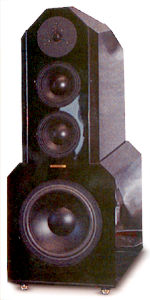 You could call the EgglestonWorks Andra loudspeaker Bill's love-letter to his dad. Maybe even to the whole family—the name honors Eggleston's sister. Recently, this $15,000/pair compact speaker system has been garnering a lot of praise from the press and, judging from the response at HI-FI '97, the public as well. The word is out: The Andra is no longer a family secret. The child is father to the man
EgglestonWorks was incorporated in 1992. Before that, Bill pursued speaker building as a hobby while he restored houses in Memphis, among other things. His decision to manufacture loudspeakers was based on his lifelong observation of the impact his father's hobby had on the household. "It seemed like there was always a war between having a pile of equipment in the living-room and having a neat, normal room, so I thought there might be a market for loudspeakers with fine furniture cabinetry—we had a model called the Heppelwhite, for instance. They weren't that well received by the industry, but a few people liked them when we showed them at a WCES. That's where I first met Peter [McGrath, now Bill's associate in EgglestonWorks]. "We learned a lot building those speakers. I used the same Morel midrange driver I voiced the Andra around, and I learned to never subcontract important elements such as the cabinetwork. The only way to maintain strict quality control is to build them in-house."
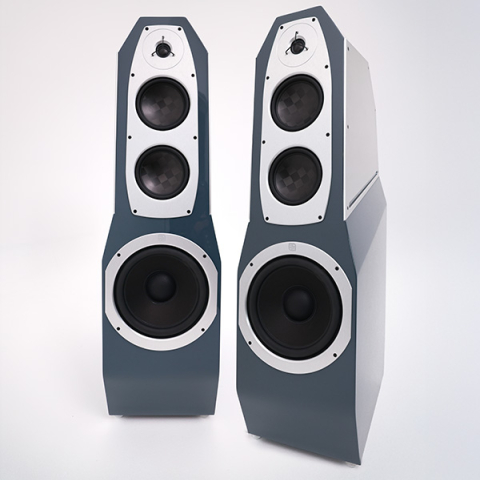
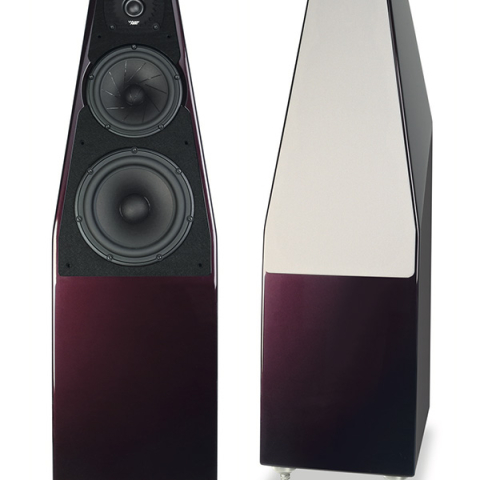
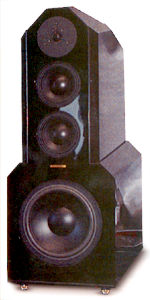
Eggleston embarked upon an ambitious project: to design a loudspeaker without constraint. "Actually, we had one constraint. The speaker was designed to be as small as possible, physically. It's very, very important to make the speakers as unobtrusive as possible. We weren't trying to make a design statement—we wanted a speaker that would fade out of your consciousness, leaving you free to concentrate on the music." I'm not entirely sure he succeeded. The speakers are compact, but I find them striking. They have slender baffles that flare slightly to just over 15" wide at the base, in order to accommodate the 12" woofers. This gives the Andra a wide-shouldered, slightly anthropomorphic mien—somewhat reminiscent of the icons that danced across the bottom of the screen in Space Invaders. Front, sides, and rear of the cabinet are finished in a seriously glossy black acrylic coating that seems to draw the light into it rather than throw it back. Above the "shoulders" and beneath the cambered top, the side panels are covered in 1¼" slabs of Italian granite whose speckled surface serves as a subtle contrast to the piano finish. Grilles are provided, but Eggleston expects most of his customers will decline to use them. The grilles are well designed and are even nice-looking—no extruded foam air-conditioner filters on the fronts of these babies! The grilles are stretched across steel frames; magnets buried beneath the laminate support the grille in use. This means that the baffle's finish remains unsullied by mounting hardware or Velcro strips—which may encourage even more Andra owners to play their speakers nude.
Overall, the Andra has a squat form-follows-function, no-nonsense appearance, combined with an understated elegance. Does it disappear into a room? Not hardly. But, I hasten to add, neither does it dominate its environment. I'd count that a success.
You could call the EgglestonWorks Andra loudspeaker Bill's love-letter to his dad. Maybe even to the whole family—the name honors Eggleston's sister. Recently, this $15,000/pair compact speaker system has been garnering a lot of praise from the press and, judging from the response at HI-FI '97, the public as well. The word is out: The Andra is no longer a family secret. The child is father to the man EgglestonWorks was incorporated in 1992. Before that, Bill pursued speaker building as a hobby while he restored houses in Memphis, among other things. His decision to manufacture loudspeakers was based on his lifelong observation of the impact his father's hobby had on the household. "It seemed like there was always a war between having a pile of equipment in the living-room and having a neat, normal room, so I thought there might be a market for loudspeakers with fine furniture cabinetry—we had a model called the Heppelwhite, for instance. They weren't that well received by the industry, but a few people liked them when we showed them at a WCES. That's where I first met Peter [McGrath, now Bill's associate in EgglestonWorks]. "We learned a lot building those speakers. I used the same Morel midrange driver I voiced the Andra around, and I learned to never subcontract important elements such as the cabinetwork. The only way to maintain strict quality control is to build them in-house."