That's right, that's no typo; the name of this speaker is the Thiel CS.5—not 1.5, not 8.5, just point five. The CS.5 is the smallest of Thiel's floorstanding CS (Coherent Source) loudspeaker family, and is likely to remain so—a name like CS.125, for example, is a bit unwieldy. If you're familiar with the rest of Thiel's CS line, then you can imagine what the CS.5 looks like: it resembles the other CS speakers, except it's smaller (footnote 1). And, being a typical smartypants 'ender (as in "high-ender"), I bet you think you know 'zactly how these sound, too, don't you? Well? I thought so. Park your preconceived notions out there on the porch, right next to mine, and we'll have a listen to these cute li'l fellers. Picture this
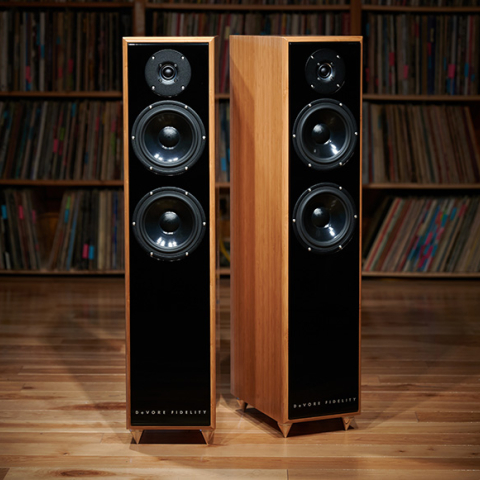
As I was saying, the CS.5 looks like a bigger Thiel that was left in the dryer too long. It has the same sloped-back front baffle as its bigger brethren, for most excellent time-alignment of the drivers—that's where part of the Coherent Source designation comes from. Thiel recommends you leave the removable black grille covering most of the face (except for the bottom 5" or so) on, so I did.
The quality of the cabinet construction, as far as is discernible by examining the outside, is top-rate. The 1" MDF cabinet passed the knuckle-rap test with flying colors (black'n'blue—they're very solid), and the white oak veneer on the pair I reviewed was a joy to behold. What? You don't like white oak? No problem; the CS.5 comes in 15 other veneers, priced accordingly. Not only that, but Thiel purchases only from "responsible" foresters, and they fund the planting of 10 trees for each one they use! Furthermore, their environmental issues white paper goes into detail about their other earth-friendly practices. I give 'em a green thumbs-up for that. The woofer, a 6½" treated paper cone in a die-cast magnesium chassis, has a 1"-diameter voice-coil and a long-gap/short-coil motor system that has a maximum travel of ¼" peak-to-peak. The crossover between the woofer and the tweeter, a 1" ferrofluid-cooled aluminum dome, is of the first-order, 6dB/octave family. Jim Thiel believes that the first-order crossover is the only type that can achieve phase coherence through the crossover region, because, as he tells it, the phase shifts for the two drivers oppose one another, thereby canceling. This only works because the first-order crossover keeps the phase shift to less than 90 degrees; phase shifts of greater than 90 degrees won't be canceled. Furthermore, the crossover network is carefully designed to ensure that the actual rolloff (the combined result of the inherent acoustic rolloff of the driver and that introduced by the crossover network) is a smooth 6dB/octave, which makes the crossover more complicated than one might think.
The deal, according to Thiel, is that their speakers, with these finely tuned first-order crossovers, are phase-coherent, avoid time smear, allow for uniform frequency and power responses, and, coupled with proper time alignment, provide accurate reproduction of all waveforms. The result? Well golly Bob howdy—you've got a Coherent Source! The binding posts are a pair (that's right—biwiring isn't an option) of the ubiquitous color-coded, plastic-knobbed five-way jobbies, located at the very bottom of the back of the cabinet. While this may be an interior decorator's dream (the whole backside of the cabinet is covered with your favorite veneer), I found it to be a royal pain. It's really inconvenient for spade lugs, leaving bananas as your best connector bet. Also, if you've got some of that tres chic steel-wool carpeting, you run a very high risk of shorting your amp on a regular basis—like every time you turn it on.
Footnote 1: Actually, it's not that much smaller than the next-in-the-line CS1.5, which is only ½" wider, 1¾" taller, and of equal depth.
As I was saying, the CS.5 looks like a bigger Thiel that was left in the dryer too long. It has the same sloped-back front baffle as its bigger brethren, for most excellent time-alignment of the drivers—that's where part of the Coherent Source designation comes from. Thiel recommends you leave the removable black grille covering most of the face (except for the bottom 5" or so) on, so I did.
Footnote 1: Actually, it's not that much smaller than the next-in-the-line CS1.5, which is only ½" wider, 1¾" taller, and of equal depth.