| Columns Retired Columns & Blogs |

ProAc Response 2.5 loudspeaker
ProAc's designer Stuart Tyler sounded casual—almost bemused—when I spoke with him recently about the new 2.5, a floorstanding, two-way ported box in the middle price slot ($4500/pair) of his Response series. While answering my pressing queries about the crossover point, driver materials, cabinet construction, and other reviewer obsessions, his body language said, "Does any of that really matter with these speakers? You know what the real story is here."
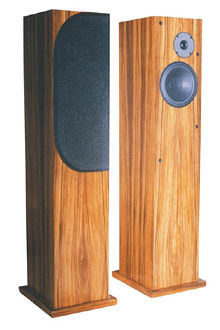 Tyler's a successful veteran of this game. His designs are well accepted in both the audiophile and professional sound worlds (a major achievement in my book), so I wasn't expecting any rookie tics: evangelical fervor, nervousness, handwringing excuses, dissing competitors' products, or obsequiousness—one or some of which reviewers sometimes experience.
"Matter-of-fact" was what I figured I'd get from Tyler—a day at the office—but what I got was a guy who knew he'd come up with one of his best designs, and would think so no matter what I might think or write. Not that there was a trace of arrogance or a hint of boast in Tyler's words. It was a subtle communication, one which traveled well over the 3500-mile telephone wire. That kind of confidence comes from a lot of time and a great deal of experience.
Aside from the diminutive and controversial Tablette, which has received mixed reviews, Tyler's designs have garnered almost universal praise in the audiophile press. And you'll find ProAcs at Paisley Park and Sony Studios, in mastering suites like Greg Calbi's at Masterdisk, under the arms of freelance recording engineers like Joe Ferla, and even in the home of Guns'n'Roses guitarist Slash. That last may work against ProAc in your eyes, given what loud music does to most rock musicians' hearing, but at least the guy doesn't reside in Al (the Egg and I) Kooper land!
Of course, I couldn't tell Tyler exactly what I thought of the 2.5s, but I suspect my bias was showing too—I had few questions that would lead him to suspect I was having any kind of trouble setting them up and getting really great sound.
Tower Records
Tyler's goal was to create a loudspeaker with a bigger soundstage and deeper bass than the already superb-sounding Response 2—which, of all the loudspeakers I've reviewed, remains one of my favorites. [The 2 has been recently upgraded to the Response 2s. The original was reviewed in Stereophile back in July 1992, Vol.15 No.7.—Ed.] When I auditioned the older 2, it cost about three grand. The price is now up to $3200/pair. Add some substantial stands and you're pushing four for a loudspeaker which, while impressive at the bottom for its size, doesn't sink down deep with balls intact—if that's what you must have.
How much "more" do you get for the extra $1500 you'll pay for a pair of 2.5s over the 2ses (really about $500 extra, when you subtract the cost of the stands you'll no longer need)? Well, before we get to the numbers and the superlatives, if a company is going to charge $4500 for a pair of two-way boxes, the designer had bloody well better offer some bottom end you can chew on, or make it a work of art like the Sonus Faber line. The 2.5 is handsome, even elegant, but though it does have bass you can chew on, it's not a work of art.
I can't spew large gobs of words about the design—it's generally similar to the other Response towers. All of the innovations are in the driver construction, and especially in the skill of the designer in "voicing" the system's balance. Tyler told me that one of the most difficult parts of the process is matching the woofer and tweeter—how far down you take the tweeter, and how high up you let the woofer go. Sometimes, slightly different values of components used in changing such balances result in clearly audible and significant, but not measurable, differences.
So the poop on the 2.5 is basic: a two-way, rear-ported box (the vent is 27" from the floor) with a new 7" carbon-fiber–impregnated paper-cone woofer made by Scan-Speak to ProAc's specs, and a ¾" Scan-Speak fabric-domed tweeter similar to the one used on the Response 2, but with a different ferrofluid that offers better power handling and somewhat lower sensitivity (the 2.5 is rated at 86dB). As with the 2s, the 2.5's tweeter is offset toward the center of the soundstage to reduce the effects of sidewall reflections.
While the 2.5 looks like a 2s integrated into a floorstanding wooden box, the new woofer, which Tyler says is the result of six months of work with Scan-Speak, is, as they say, a miracle of modern science, and results in substantially improved performance. Tyler says the new driver has the midrange qualities he was looking for, plus it has "more going for it" at the bottom end.
There's a nine-element crossover network mounted on a special fiberglass board soldered on both sides. The finely machined and quite substantial bi-wirable/bi-ampable rhodium-plated speaker terminals bolt directly to the board and make physical and electrical contact through both sides and center of the board, and are through-hole soldered. Hookup wire is the same 500-strand oxygen-free copper cable used in all ProAc products, sourced from a British company the name of which Tyler prefers to keep to himself.
The braced and damped box, which varies in thickness to reduce standing waves, is stuffed with a bonded acetic fiber fill used extensively in loudspeakers 20 years ago, according to Tyler, but not much today because it's more difficult to fit in the cabinet due to its unruly, "woolly" nature. Its big advantage, according to Tyler, is better sound.
In other words, this carefully conceived and constructed, $4500/pair, two-way, ported box distinguishes itself by its attention to detail, rather than with radically new "technology" or construction techniques. Give that to the marketing people, or give them another speaker I saw advertised recently: a bipolar tower design in which two mids frame an aluminum-domed tweeter, all three drivers mounted both front and back, plus a sidemounted, 15" powered (300W) subwoofer—all for $3000/pair. Which would be easier to sell? Well, if sound quality is what you're interested in, probably the ProAcs (though I haven't heard the other).
Musicland
Once I'd screwed the wooden bases to the cherrywood-veneered bottoms of the boxes (no side is left unfinished—even the ones that end up not showing) and threaded in the spiked feet, I had these petite (41" by 10" by 8.75"), exquisitely veneered towers settled into their best-sounding positions in record time: I put them precisely where the Audio Physic Virgos I reviewed last September had been.
Despite being more than satisfied with the results, I moved them around a bit just to see what would happen; that was nothing better or even as good, so they ended up where they began. In my listening room, that means I sit with the speakers about 6½' from my listening position and about 8' apart. Joachim Gerhard's setup strategy works. (See the Virgo review, Vol.18 No.9, p.121.) If you own moving-coil loudspeakers, do yourself a favor and try it.
His Master's Voice
Well, how about this: using my Radio Shack sound-pressure level (spl) meter amd the 1/3-octave warble tones on Stereophile's Test CD 3 (STPH 006-2) available from Stereophile, or send me five bucks and I'll dub a cassette for you—just want to make sure you're reading this JA—the Response 2.5s measured ±2dB from 250Hz down to (are you ready for this?) 31.5Hz! They were down only 3dB at 25Hz and –7dB at 20Hz. That's plenty of audible and palpable energy at 20Hz. All from a small two-way box with a 7" midrange/woofer! And I thought my room couldn't reproduce low bass!
NEXT: Page 2 »
 | |||||||||||

|
|
| |||||||||
- Log in or register to post comments








| Loudspeakers Amplification Digital Sources | |
Analog Sources Accessories Featured | |
Music Columns Retired Columns | |
Show Reports | |
Features Latest News Community | |
Resources Subscriptions |
 © 2024 Stereophile
AVTech Media Americas Inc., USA
All rights reserved