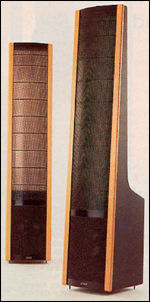
"Wow! What's that?" asked the pizza delivery boy, peering over my shoulder at the slender, 5'-tall Martin-Logan SL3 visible behind me. 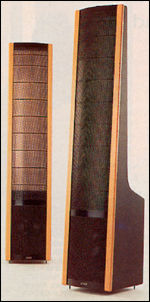 "It's a new loudspeaker." "No way! It's bee-you-tee-full." I nodded, but this was old news. For weeks, everyone new to the household had been pointing out that these lean speakers, with their nearly transparent panels flanked by blond oak rails, were gorgeous, striking, sculptural, far and away too handsome to be practical...in short, nothing at all like any hi-fi gear they'd ever seen. The SL3's smooth wood finish seems to invite caresses. Nearly everybody who walks by them pauses to stroke them sensuously—I have to admit, I'm getting jealous of all the frottage they've received. "Yeah, they're cute as kittens and smoother than peau de soie," I'm tempted to shout, "But what about me?"
Fortunately, I've learned not to ask such questions. Instead, I smile, cue up a CD, and start playing music through them. And always get the same response. "I knew you were kidding about these being speakers. Where's the music really coming from?" Sometimes you just can't win. Martin-Logan has produced a speaker that draws universal raves for its cosmetics and performs one of the best disappearing acts in audio, and the public refuses to believe their eyes and ears. So let me just say this once and get it over with: "Yes, they're speakers. They really are gorgeous. And yes, the music really is coming from them, hard as it is to believe. Yes, they really do sound as good as they look. Okay? Okay? OKAY?" Excuse me. I don't know what came over me. Hybrid vigor
"It's a new loudspeaker." "No way! It's bee-you-tee-full." I nodded, but this was old news. For weeks, everyone new to the household had been pointing out that these lean speakers, with their nearly transparent panels flanked by blond oak rails, were gorgeous, striking, sculptural, far and away too handsome to be practical...in short, nothing at all like any hi-fi gear they'd ever seen. The SL3's smooth wood finish seems to invite caresses. Nearly everybody who walks by them pauses to stroke them sensuously—I have to admit, I'm getting jealous of all the frottage they've received. "Yeah, they're cute as kittens and smoother than peau de soie," I'm tempted to shout, "But what about me?"
Fortunately, I've learned not to ask such questions. Instead, I smile, cue up a CD, and start playing music through them. And always get the same response. "I knew you were kidding about these being speakers. Where's the music really coming from?" Sometimes you just can't win. Martin-Logan has produced a speaker that draws universal raves for its cosmetics and performs one of the best disappearing acts in audio, and the public refuses to believe their eyes and ears. So let me just say this once and get it over with: "Yes, they're speakers. They really are gorgeous. And yes, the music really is coming from them, hard as it is to believe. Yes, they really do sound as good as they look. Okay? Okay? OKAY?" Excuse me. I don't know what came over me. Hybrid vigor
The SL3 is the successor to Martin-Logan's Sequel, launched in 1987 (Lew Lipnick reviewed the original in Vol.11 No.12; JA weighed in on the Sequel II in Vol.12 No.8). I asked Martin-Logan's founder, Gayle Sanders, why the SL3 wasn't the Sequel III. He responded, "So many of its components have been upgraded or changed that we felt we should call it something else—it's less a continuation than a departure." Based on the evidence of people's reactions at my house, not everyone is familiar with either of the original Sequels, so I'll describe the SL3 and highlight its departures from its predecessors.
The SL3 is 64" tall, but only 13" wide and 14" deep at the base. The 10" dynamic woofer is contained in a 20"-tall sealed-box enclosure that forms the base of the loudspeaker; the 48"-tall electrostatic element is mounted to its front, soaring above it. The perforated black stators and transparent electrostatic diaphragm are curved in a 30-degree arc that bulges gently in front of the thin wooden rails framing the loudspeaker's face (footnote 1). The result is one of the most elegantly stylish facades in audio—and, since you can see through the electrostatic driver, the effect approaches the ethereal.
Footnote 1: An electrostatic speaker contains three elements: the stators, the diaphragm, and the spacers that separate them. The diaphragm sits between the two stators; the spacers hold the stators away from the diaphragm, allowing it to move freely back and forth between them. The stators, which are essentially electrodes, are energized with high-voltage signals equal in strength but opposite in polarity. These charges attract and repel the resistively charged diaphragm according to the modulation of the musical signal.
"It's a new loudspeaker." "No way! It's bee-you-tee-full." I nodded, but this was old news. For weeks, everyone new to the household had been pointing out that these lean speakers, with their nearly transparent panels flanked by blond oak rails, were gorgeous, striking, sculptural, far and away too handsome to be practical...in short, nothing at all like any hi-fi gear they'd ever seen. The SL3's smooth wood finish seems to invite caresses. Nearly everybody who walks by them pauses to stroke them sensuously—I have to admit, I'm getting jealous of all the frottage they've received. "Yeah, they're cute as kittens and smoother than peau de soie," I'm tempted to shout, "But what about me?" The SL3 is the successor to Martin-Logan's Sequel, launched in 1987 (Lew Lipnick reviewed the original in Vol.11 No.12; JA weighed in on the Sequel II in Vol.12 No.8). I asked Martin-Logan's founder, Gayle Sanders, why the SL3 wasn't the Sequel III. He responded, "So many of its components have been upgraded or changed that we felt we should call it something else—it's less a continuation than a departure." Based on the evidence of people's reactions at my house, not everyone is familiar with either of the original Sequels, so I'll describe the SL3 and highlight its departures from its predecessors.
Footnote 1: An electrostatic speaker contains three elements: the stators, the diaphragm, and the spacers that separate them. The diaphragm sits between the two stators; the spacers hold the stators away from the diaphragm, allowing it to move freely back and forth between them. The stators, which are essentially electrodes, are energized with high-voltage signals equal in strength but opposite in polarity. These charges attract and repel the resistively charged diaphragm according to the modulation of the musical signal.