After establishing a reputation for building small, magnificent-looking, very expensive, stand-mounted loudspeakers, the Italian manufacturer Sonus Faber has hit the ground running. First came the moderately priced ($3500/pair) floorstanding Concerto Grand Pianos, and now the company's "statement" loudspeaker, the Amati Homage--a $20,000/pair visual stunner that earns its keep almost by looks and touch alone. 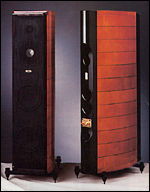 The Amati Homage is Sonus Faber designer Franco Serblin's moment of truth: a fairly large, floorstanding, almost-full-range speaker (the low-frequency response is rated to 24Hz) meant to be without sonic, structural, or aesthetic compromise. But while everything Serblin has learned about building and voicing loudspeakers has been incorporated in the Amati's design, there's more to come. The Amati is the second of three "homages" to Cremona-based violin makers. The first was the Guarneri ($9500/pair including stands), issued in 1993 and reviewed for Stereophile by Martin Colloms in the July 1994 issue. Whatever Serblin's planning for Stradivari, hold on to your gold card. Game plan
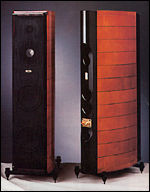
Serblin's first goal was to design as resonance-free a structure as he could, for a three-way speaker that would extend further down in frequency than any he'd yet built. The cabinet's lutelike shape was inspired by a drawing by Stradivari. (Sonus Faber holds an international patent on the design.) Such looks are dramatic and make good brochure copy, but what do they have to do with loudspeaker design? Plenty, it seems—the Amati Homage's magnificent form follows its function. The lutelike shape eliminates parallel cabinet walls—especially the back wall—and helps control or eliminate standing waves. The curved side walls add tremendous structural rigidity. According to Serblin, the tapered form eases the transmission of the speaker's back wave to the ports and results in cleaner energy evacuation. When you think about it, the funnel shape makes complete sense: there's very little internal surface for the wave to bounce off of.
Like those of other premium SF speakers, the Amati's side walls are constructed of slats of wood, each slat built up of 21 sheets of varying thicknesses of maple laminated with a high-viscosity polymeric glue. Between each slat is an inlay of solid maple, aniline-dyed black. The slats are heat- and pressure-curved in a device that looks like a boat-hull former. The cabinet's top and bottom are of thick, solid maple. All drive-units perch forward of the cabinet edges, with the midrange and tweeter angled back from the bass drivers. The sculpted and partly angled front baffle is of 11/2" MDF covered in stippled leather. Aside from looking handsome, the leather provides topical damping, and is not only the gasket material for the drivers but a means of breaking up and diffracting energy along the baffle surface. The ported back piece is sculpted from a solid piece of aniline-dyed Balkan maple with a closer grain than the side walls. Additional internal resonance control is provided by strategically placed copper/lead structures and subcabinetry. Each driver has its own chamber; though there are dual woofer ports, the two woofers' backwaves fire into a common chamber and out both ports, which are located almost halfway up the back. The midrange driver is also ported. The cabinet is richly finished: hand-applied stain and seven coats of special varnish result in a deep, lustrous, glasslike finish. Each speaker weighs a solid 150 lbs.
The finished product is simply one of the most stunning-looking large loudspeakers ever built by anyone. Upright caskets, refrigerators on spikes, Robbie the Robot—all those big speakers look silly next to the Amati.
The Amati Homage is Sonus Faber designer Franco Serblin's moment of truth: a fairly large, floorstanding, almost-full-range speaker (the low-frequency response is rated to 24Hz) meant to be without sonic, structural, or aesthetic compromise. But while everything Serblin has learned about building and voicing loudspeakers has been incorporated in the Amati's design, there's more to come. The Amati is the second of three "homages" to Cremona-based violin makers. The first was the Guarneri ($9500/pair including stands), issued in 1993 and reviewed for Stereophile by Martin Colloms in the July 1994 issue. Whatever Serblin's planning for Stradivari, hold on to your gold card. Game plan Serblin's first goal was to design as resonance-free a structure as he could, for a three-way speaker that would extend further down in frequency than any he'd yet built. The cabinet's lutelike shape was inspired by a drawing by Stradivari. (Sonus Faber holds an international patent on the design.) Such looks are dramatic and make good brochure copy, but what do they have to do with loudspeaker design? Plenty, it seems—the Amati Homage's magnificent form follows its function. The lutelike shape eliminates parallel cabinet walls—especially the back wall—and helps control or eliminate standing waves. The curved side walls add tremendous structural rigidity. According to Serblin, the tapered form eases the transmission of the speaker's back wave to the ports and results in cleaner energy evacuation. When you think about it, the funnel shape makes complete sense: there's very little internal surface for the wave to bounce off of.