Despite displaying its products at nearly every CES since 1985, Merlin remains essentially unknown in the US. Problems have plagued the company in this country: key suppliers have gone under, marketing efforts have lacked focus, and the principals of the company seemed to have gotten caught up in audio politics.
 Overseas, however, it's been a different story. Merlin has apparently achieved success in Germany, Japan, Korea, Austria, Norway, and Indonesia. More than 85% of Merlin's products leave the US—the company sells in more foreign countries than it has US dealers. Merlin products have received superlative reviews abroad, but success has been built on a number of things besides pure performance. Non-US audiophiles appreciate such things as fit and finish, separate level controls for the midrange and tweeter drivers, an easy impedance load (described by Merlin's Bobby Palkovic as "non-bizarre"), high sensitivity (90dB/W/m), fittings for either three or four spiked feet per speaker, and built-in mass-loading.
In America, though, all that counts is sonic performance. That's the focus of this review.
Excalibur
Overseas, however, it's been a different story. Merlin has apparently achieved success in Germany, Japan, Korea, Austria, Norway, and Indonesia. More than 85% of Merlin's products leave the US—the company sells in more foreign countries than it has US dealers. Merlin products have received superlative reviews abroad, but success has been built on a number of things besides pure performance. Non-US audiophiles appreciate such things as fit and finish, separate level controls for the midrange and tweeter drivers, an easy impedance load (described by Merlin's Bobby Palkovic as "non-bizarre"), high sensitivity (90dB/W/m), fittings for either three or four spiked feet per speaker, and built-in mass-loading.
In America, though, all that counts is sonic performance. That's the focus of this review.
Excalibur
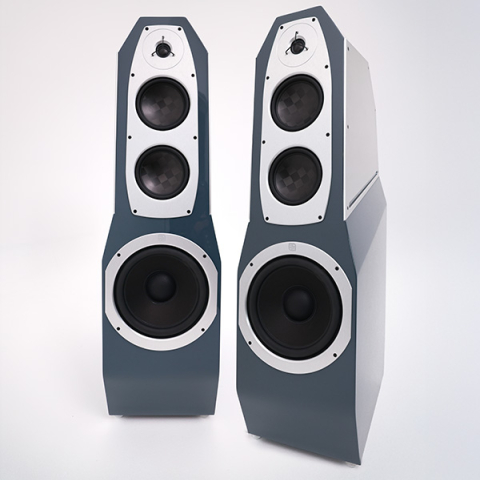
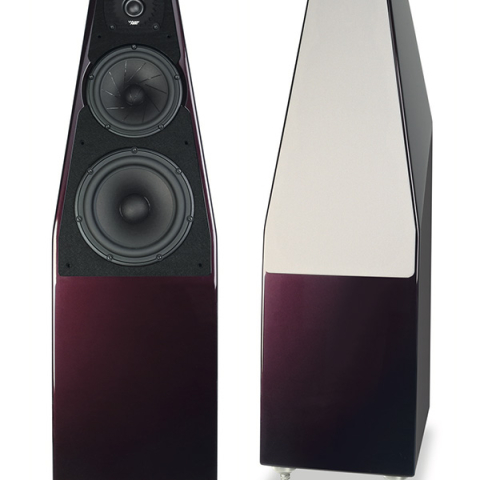
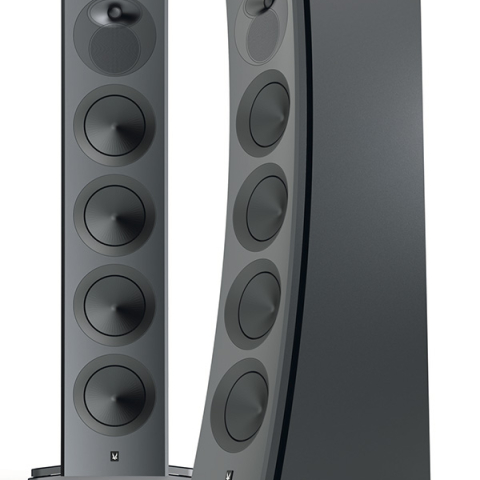
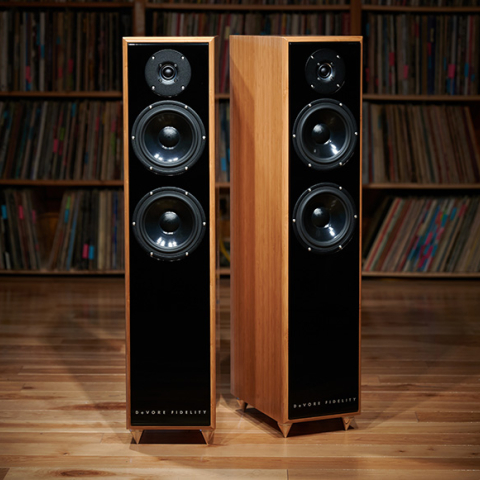
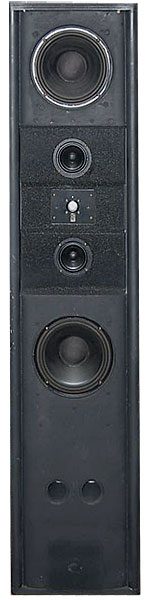
Merlin's new Excalibur II is huge: 65" high and 210 lbs heavy. It's made even more ominous-looking by the permanently fixed, wraparound grillecloth that covers both sides and the front of the speaker. The top, bottom, and back are finished with lovely golden oak plates. Under the grillecloth round, wooden support corner poles run the height of the cabinet. Like every pair of IIs, mine arrived with engraved terminal panels noting that this pair was made specifically for its owner: "Handcrafted for Jack English," it read. Inside is a three-way, five-driver "disappearing point source"—ie, the drive-units are vertically in-line and symmetrical about the centrally placed tweeter. I was somewhat surprised that the 1" aluminum-dome tweeter is placed above the ear height of the typical seated listener (ie, 42" from the floor). Spaced equally above and below the tweeter are 4.5" midrange units bracketed by a pair of 8" woofers, each woofer in its own ported bin. The upper woofer fires out of two ports at the rear, the lower woofer from two ports at the front. The drivers are closer together than in Merlin's earlier flagship, the Signature Four, a change calculated to improve driver integration for a listener seated closer to the speakers.
The full-height cabinet inside the grillecloth is made of a complex resin compound resembling strengthened egg crates. The intent of this radical departure from the cabinet-building philosophies of virtually all other speaker manufacturers is to offer a cabinet that is rigid yet slightly compliant. As I understand it, the design goal was to allow the cabinet to dissipate resonances at lower levels over a much wider frequency range instead of settling for a small number of resonant frequencies much higher in amplitude. This approach remains open to further discussion and broader experimentation.
Hidden inside the Excalibur II are numerous braces, brackets, and foam liners, plus 70 lbs of sand for mass-loading. Banished from earlier models are protective wire screens over the drivers (hooray!). The crossover transition points are specified at 500Hz and 3kHz, and first-order, 6dB/octave slopes were selected to smooth out driver-to-driver tonal transitions and to minimize phase anomalies. Other features include Cardas internal wiring, German Acoustics spiked feet made of steel, and dual Edison Price copper binding posts. And, after endless hours of listening, Merlin decided to use three different types of solder at critical points, none of it silver-based.
Good parts
After huffing and puffing for a couple of hours to get these 210-lb speakers (250 lbs each in their shipping crates) into the house, unpacked, and set up in my listening room, I wasn't about to walk away. Break-in requirements or not, I was determined to do some serious listening. My expectations were not high; many foreign reviewers have remarked on the long break-in time necessary for various Merlin speakers, and my own experience with the company's earlier Signature Fours had forewarned me.
I opted for Dean Peer's splendid Ucross CD (Redstone RR91012), which John Atkinson had called a "stunning outing for solo bass guitar" (Vol.16 No.2, p.101). Much to my surprise, the Excaliburs far exceeded my conservative hopes. The bass was very dynamic, powerful, and open. My only complaint was that it was somewhat slow, and, to the sides of the listening position, less well-defined. There was a realistic image of a solo performer at center stage behind the speakers. There was also an ample sense of air and spaciousness surrounding Peer's bass. Individual notes could clearly be heard, vibrating and decaying in real physical space. On cuts such as "Tommy," the power and authority of the Excaliburs came to the fore. Right out of the box, they significantly exceeded both my sonic expectations and my memory of the Signature Fours.
A recording I'd listened to often with the Fours was the Original Cast performance of The Phantom of the Opera (Polydor 831 273-2). The recording of the organ that represents the Phantom contains plenty of bass information, but, unlike on the Peer recording, a host of other things are going on. The Excaliburs clearly surpassed the Fours with their powerful, open, dynamic bass. Contrasts between loud and soft passages were dramatic, the speakers moving vast amounts of air and exciting all sorts of things in my listening room. It wasn't the quantity or extension that had changed, but the quality of the bass and the resolving power of the Excaliburs at higher volume levels. They were consistently cleaner and airier, which resulted in much better reproduction of low-frequency ambient cues.
Overseas, however, it's been a different story. Merlin has apparently achieved success in Germany, Japan, Korea, Austria, Norway, and Indonesia. More than 85% of Merlin's products leave the US—the company sells in more foreign countries than it has US dealers. Merlin products have received superlative reviews abroad, but success has been built on a number of things besides pure performance. Non-US audiophiles appreciate such things as fit and finish, separate level controls for the midrange and tweeter drivers, an easy impedance load (described by Merlin's Bobby Palkovic as "non-bizarre"), high sensitivity (90dB/W/m), fittings for either three or four spiked feet per speaker, and built-in mass-loading.
In America, though, all that counts is sonic performance. That's the focus of this review.
Excalibur
Merlin's new Excalibur II is huge: 65" high and 210 lbs heavy. It's made even more ominous-looking by the permanently fixed, wraparound grillecloth that covers both sides and the front of the speaker. The top, bottom, and back are finished with lovely golden oak plates. Under the grillecloth round, wooden support corner poles run the height of the cabinet. Like every pair of IIs, mine arrived with engraved terminal panels noting that this pair was made specifically for its owner: "Handcrafted for Jack English," it read. Inside is a three-way, five-driver "disappearing point source"—ie, the drive-units are vertically in-line and symmetrical about the centrally placed tweeter. I was somewhat surprised that the 1" aluminum-dome tweeter is placed above the ear height of the typical seated listener (ie, 42" from the floor). Spaced equally above and below the tweeter are 4.5" midrange units bracketed by a pair of 8" woofers, each woofer in its own ported bin. The upper woofer fires out of two ports at the rear, the lower woofer from two ports at the front. The drivers are closer together than in Merlin's earlier flagship, the Signature Four, a change calculated to improve driver integration for a listener seated closer to the speakers.
After huffing and puffing for a couple of hours to get these 210-lb speakers (250 lbs each in their shipping crates) into the house, unpacked, and set up in my listening room, I wasn't about to walk away. Break-in requirements or not, I was determined to do some serious listening. My expectations were not high; many foreign reviewers have remarked on the long break-in time necessary for various Merlin speakers, and my own experience with the company's earlier Signature Fours had forewarned me.