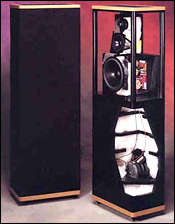
High-end-audio manufacturers are both more and less adventurous than their more mainstream contemporaries. While mainstream-audio manufacturers will almost invariably change their models every year, the changes are more often than not cosmetic—at least in between successive models. High-end manufacturers, on the other hand, will keep the same model in the line for several years, but make cosmetically invisible refinements along the way. 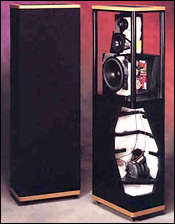 Vandersteen has been one of the most conservative companies in that respect; the original Model 2 underwent only one significant cosmetic change in over a decade, yet was sonically updated several times in that span. Now, two years after its introduction, we have the first modification to the Model 3 (originally reviewed by JA in Vol.16 No.3, p.140): the 3A. In most physical respects, the Vandersteen Model 3A is identical to its predecessor. A cutaway photo reveals four drivers and three separate sub-enclosures—the bottom of which is the largest, for the rear-facing 10" driver that Vandersteen refers to as an "Active Acoustic Coupler." It is, as the name implies, actively driven [though it shares some of the characteristics of a passive radiator—Ed.]. Since the AAC is designed to cover primarily the range below 35Hz, I would be inclined to call it an integral subwoofer; but perhaps Vandersteen chose to give it another designation to distinguish it from the company's dedicated, outboard subwoofers. Stacked atop this acoustic-coupler enclosure are one enclosure for the 8" woofer, and another for the midrange and tweeter. The baffles for each of these front-facing drivers are individually sized to minimize diffraction problems. As in other Vandersteen designs, the 3A has a relatively solid top piece above the tweeter to complete the external cabinet design and anchor the four dowel corners that give shape to the grillecloth "sock" covering all of this internal cabinetwork. Though the large cutout in this top is clearly designed to minimize cavity resonances, I continue to be concerned—as I was with the 2Ce—that this top piece might be reflecting energy from the tweeter (thus defeating some of the care that went into the anti-diffraction efforts elsewhere). Nothing in my listening, however, indicated to me that this might be a problem.
Vandersteen's 4.5" midrange driver is the same as that used in the earlier Model 3, and is designed specifically to minimize reflections from the driver's support structure—the magnet and frame—at the back of the cone. The magnet is made of neodymium, which, because of its magnetic efficiency, can be very small relative to its strength; the basket, or frame, is as small as possible, while still providing adequate support for the magnet and cone. Both this midrange driver and the 3A's metal-alloy dome tweeter are assembled for Vandersteen by Vifa in Denmark. Consistent with Vandersteen's design philosophy, the 3A uses first-order crossovers throughout. Since the correct vertical listening axis is invariably more critical with such a design, detailed instructions are provided to enable the user to tilt back the loudspeaker by an appropriate amount—a function of both the listener's distance from the loudspeaker and the height of his or her ears. A brace extends from the back of the cabinet to allow the user to properly set the tilt-back by adding spacers to the furnished spikes. The 3A is furnished with a standard brace; we were also sent a heavier-duty, optional Sound Anchor brace ($200), which attaches not only to the bottom of the cabinet but to the rear as well, just above the acoustic coupler. It may therefore also act to further brace the cabinet, though no such claim is made in the owner's manual.
Vandersteen has been one of the most conservative companies in that respect; the original Model 2 underwent only one significant cosmetic change in over a decade, yet was sonically updated several times in that span. Now, two years after its introduction, we have the first modification to the Model 3 (originally reviewed by JA in Vol.16 No.3, p.140): the 3A. In most physical respects, the Vandersteen Model 3A is identical to its predecessor. A cutaway photo reveals four drivers and three separate sub-enclosures—the bottom of which is the largest, for the rear-facing 10" driver that Vandersteen refers to as an "Active Acoustic Coupler." It is, as the name implies, actively driven [though it shares some of the characteristics of a passive radiator—Ed.]. Since the AAC is designed to cover primarily the range below 35Hz, I would be inclined to call it an integral subwoofer; but perhaps Vandersteen chose to give it another designation to distinguish it from the company's dedicated, outboard subwoofers. Stacked atop this acoustic-coupler enclosure are one enclosure for the 8" woofer, and another for the midrange and tweeter. The baffles for each of these front-facing drivers are individually sized to minimize diffraction problems. As in other Vandersteen designs, the 3A has a relatively solid top piece above the tweeter to complete the external cabinet design and anchor the four dowel corners that give shape to the grillecloth "sock" covering all of this internal cabinetwork. Though the large cutout in this top is clearly designed to minimize cavity resonances, I continue to be concerned—as I was with the 2Ce—that this top piece might be reflecting energy from the tweeter (thus defeating some of the care that went into the anti-diffraction efforts elsewhere). Nothing in my listening, however, indicated to me that this might be a problem.
Vandersteen's 4.5" midrange driver is the same as that used in the earlier Model 3, and is designed specifically to minimize reflections from the driver's support structure—the magnet and frame—at the back of the cone. The magnet is made of neodymium, which, because of its magnetic efficiency, can be very small relative to its strength; the basket, or frame, is as small as possible, while still providing adequate support for the magnet and cone. Both this midrange driver and the 3A's metal-alloy dome tweeter are assembled for Vandersteen by Vifa in Denmark. Consistent with Vandersteen's design philosophy, the 3A uses first-order crossovers throughout. Since the correct vertical listening axis is invariably more critical with such a design, detailed instructions are provided to enable the user to tilt back the loudspeaker by an appropriate amount—a function of both the listener's distance from the loudspeaker and the height of his or her ears. A brace extends from the back of the cabinet to allow the user to properly set the tilt-back by adding spacers to the furnished spikes. The 3A is furnished with a standard brace; we were also sent a heavier-duty, optional Sound Anchor brace ($200), which attaches not only to the bottom of the cabinet but to the rear as well, just above the acoustic coupler. It may therefore also act to further brace the cabinet, though no such claim is made in the owner's manual.
Vandersteen has been one of the most conservative companies in that respect; the original Model 2 underwent only one significant cosmetic change in over a decade, yet was sonically updated several times in that span. Now, two years after its introduction, we have the first modification to the Model 3 (originally reviewed by JA in Vol.16 No.3, p.140): the 3A. In most physical respects, the Vandersteen Model 3A is identical to its predecessor. A cutaway photo reveals four drivers and three separate sub-enclosures—the bottom of which is the largest, for the rear-facing 10" driver that Vandersteen refers to as an "Active Acoustic Coupler." It is, as the name implies, actively driven [though it shares some of the characteristics of a passive radiator—Ed.]. Since the AAC is designed to cover primarily the range below 35Hz, I would be inclined to call it an integral subwoofer; but perhaps Vandersteen chose to give it another designation to distinguish it from the company's dedicated, outboard subwoofers. Stacked atop this acoustic-coupler enclosure are one enclosure for the 8" woofer, and another for the midrange and tweeter. The baffles for each of these front-facing drivers are individually sized to minimize diffraction problems. As in other Vandersteen designs, the 3A has a relatively solid top piece above the tweeter to complete the external cabinet design and anchor the four dowel corners that give shape to the grillecloth "sock" covering all of this internal cabinetwork. Though the large cutout in this top is clearly designed to minimize cavity resonances, I continue to be concerned—as I was with the 2Ce—that this top piece might be reflecting energy from the tweeter (thus defeating some of the care that went into the anti-diffraction efforts elsewhere). Nothing in my listening, however, indicated to me that this might be a problem.