| Columns Retired Columns & Blogs |

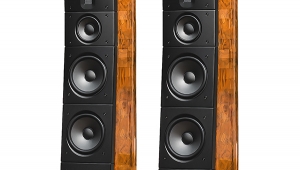
Vandersteen Quatro Wood loudspeaker
Richard Vandersteen was in good form at the 20th-anniversary seminar held by retailer Advanced Audio on November 11, 2006. When asked about his priorities in loudspeaker design, he sat erect in the seat next to me and thundered, "I will not [slams table with open hand] spend one red cent on cosmetics that I could have put into improving the sound of a loudspeaker!"
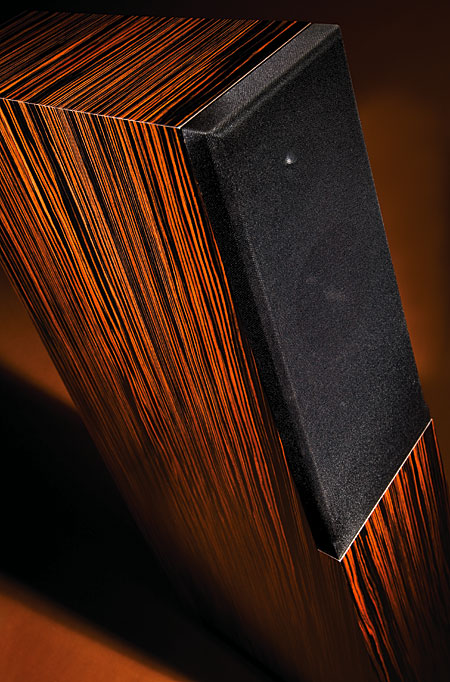
On one hand, I wasn't shocked. Vandersteen has long been known for his iconoclastic opinions on audio design —views that have led him to wrap his speakers in plain-looking "socks" rather than in exotic veneers. "I just don't think people have a clue what sonic price they are paying for having that acoustically reflective wood next to the drivers," he told me.
On the other hand, hadn't he just sent me a pair of his Quatro loudspeakers that were —how should I put this —clad in veneer?
"Well, our dealers begged me to make a version of the Quatro that looked more upscale," Vandersteen said. "I thought I could do it for a slightly higher price, so I just took a pair of Quatros off the line, squared off the edges, and wrapped them in veneer. We took it into the sound room, and it was just not the same loudspeaker. All that beautiful shiny veneer so close to the drivers had a catastrophic effect —I've known that for years, which is why we build speakers the way we do.
"Now we had a speaker that cost $1500 more and didn't sound as good as the fabric option. Initially, I added the new composite phenolic-epoxy plinth, which wasn't enough in itself, then I upgraded the tweeter, and we kept tweaking it until it was a little bit better everywhere than the fabric one —because I just wasn't going to charge more for a speaker that didn't deliver more. Ultimately, we got a speaker that was noticeably better, but it wasn't a $1500 upgrade, it was $3700."
That means the Quatro Wood sells for $10,700/pair. Some speaker manufacturers won't even cross the street for that little money.
The field has sight, and the wood a sharp ear
The Quatro Wood is based on the Quatro, which Michael Fremer reviewed in July 2006. It's still a first-order, four-way design that includes an internal subwoofer with a 250W amp and two 8" carbon-loaded cellulose-cone drivers. The midbass and lower midrange (100 –900Hz) are handled by the same 6.5" woven-fiber cone driver Vandersteen designed for the fabric Quatro, but the upper midrange and low treble (900Hz –5kHz) and upper frequencies (5kHz to "beyond 30kHz") are handled by drivers based on those in the Vandersteen 5A.
The midrange driver is Vandersteen's patented 4.5" open-basket design, featuring a woven composite driver and cylindrical alnico-magnet structure —which allows Vandersteen to vent much of its rear wave into "a transmission line to prevent those reflections from interfering with the direct sound." The driver's chassis is invested metal, as opposed to the regular Quatro's filled nylon—which, Vandersteen remarks, "delivers a bigger sonic dividend than you'd expect."
The 1" ceramic-coated, alloy-dome tweeter is a tuned dual-chamber design, also transmission-line loaded. Vandersteen says he chose that acoustic damping and a precision phase plug to extend its high frequencies "past audibility without the excessive ringing associated with open or underdamped metal-dome tweeters."
The other critical difference is that composite phenolic epoxy plinth, which Vandersteen says is unbelievably inert —and ungodly expensive. "A 4' by 8' sheet costs $1000, and then it has to be milled like aluminum, although at even slower speeds."
The Quatro Wood shares the Quatro's adjustable EQ network and its battery-biased, passive high-pass filter, but since Vandersteen claims most people don't understand this approach, I should perhaps speak of it a bit more.
The Quatro has a terminal strip on its rear panel that accepts two sets of speaker cables. (Another example of Richard Vandersteen's refusal to bow to convention: "I've tested all the expensive binding posts and [terminal strips] still sounds best.") One set feeds the subwoofer and mid-bass (everything below 900Hz); the other feeds 900Hz and above. However, unlike conventional designers, Vandersteen rolls off the bass below 100Hz with a passive, first-order filter that sits between preamp and amplifier. The balanced module costs $795; the single-ended version goes for $695.
"The ultimate advantage of using a high-pass filter is increased transparency in general, because you're getting the deep bass out of the amplifier and the midrange and HF drivers," Vandersteen said. "Now, if I'd put only a powered sub in there, the 6.5" driver would be flopping around like crazy because it's getting all the bass —not to mention the [intermodulation] and the heating up the voice-coil, which leads to thermal compression —and it's just a big old can of worms. You're putting power into a driver that just can't respond to it. Now put a high-pass filter in there, and you clean all of that up."
The powered subwoofer, which is fed from the passive woofer terminals, thus has to be re-equalized to get back that mid- and low-bass energy. It actually incorporates an 11-band equalizer, to allow the best integration to be obtained with the owner's room acoustics.
Without touch we are but hunks of wood
The Quatros are a tad more complicated to set up than most loudspeakers. Fortunately, your audio dealer should be the one having to do that job. The high-pass filters need to be set for your amplifier's input impedance via internal DIP switches. The speakers are then located within the room for optimal midrange coherence, and the woofer's 11-band EQ is calibrated using an SPL meter and Vandertones, a CD Vandersteen supplies his dealers. In this two-person process, one participant sits in the sweet spot with the meter and the other dials in each of the EQ bands on the speakers' rear panels. Each speaker is tuned separately. After adjusting the EQ, you tune in the amount of bass reproduced with the woofers' level controls. Vandersteen says that customers who buy the Quatros used and have no Vandersteen dealer to set them up can substitute the warble tones on Editor's Choice (CD, Stereophile STPH016-2) for Vandertones; the owner's manual posted on his website has the instructions.
The final setup chore is adjusting the speakers' rake, so the signal is time and phase coherent at the listening position. "For time- and phase-aligned designs, the vertical height of the drivers in relation to the listening position is vital," Vandersteen said. "You can have a huge horizontal window if you address the tilt correctly. We believe that waveform preservation is crucial."
To communicate the subtlest universal truths by means of wood, metal, and vibrating air
As Art Dudley is wont to say, Jethro H. Tull! Vandersteen wasn't kidding about that huge horizontal window, as I discovered on listening to Paavo Järvi and the Cincinnati Symphony Orchestra's recording of Elgar's Enigma Variations (SACD, Telarc SACD-60660). The soundstage was immense —both wide and deep. Not only was the CSO's bass section hefty and solid, but the acoustic of Music Hall was almost frighteningly detailed —a sure sign of clean deep-bass response, in my experience.
NEXT: Page 2 »
 | |||||||||||

|
|
| |||||||||
- Log in or register to post comments





| Loudspeakers Amplification Digital Sources | |
Analog Sources Accessories Featured | |
Music Columns Retired Columns | |
Show Reports | |
Features Latest News Community | |
Resources Subscriptions |
 © 2024 Stereophile
AVTech Media Americas Inc., USA
All rights reserved