It may surprise some readers to learn that all of the contributors to Stereophile do not get the chance to hear, at our leisure and in familiar circumstances, everything that passes through the magazine's portals. Not that we wouldn't like to, but there just isn't time. Nor are the logistics always right. I was therefore probably as intrigued as the average reader by LA's glowing report on the $5000/pair Mirage M-1 in the June 1989 issue. The M-1s had been on the market long enough for me to have heard them on several occasions, of course, but generally at shows and not under the best of conditions. I did get to hear them briefly at LA's later that same summer, but the hustle and bustle of a Stereophile Writers' Conference party isn't the optimum place for value judgments.
 If you wait long enough, though, these sorts of things have a way of evening themselves out. Not in the guise of the M-1, but in that of the M-3, Mirage's follow-up to their successful flagship. Similar concept, smaller (and less expensive) cabinet. Mirage Jr. and I arrived in Santa Fe at roughly the same time, and I immediately volunteered to do the review. Good move.
Like its larger brother, the M-3 is designated by Mirage to be a bipolar (not dipolar) design. Those who have read LA's original review will understand the distinction. They may take a brief break at this point. Others should stay on board for...
Radiation Theory 10 (footnote 1)
If you wait long enough, though, these sorts of things have a way of evening themselves out. Not in the guise of the M-1, but in that of the M-3, Mirage's follow-up to their successful flagship. Similar concept, smaller (and less expensive) cabinet. Mirage Jr. and I arrived in Santa Fe at roughly the same time, and I immediately volunteered to do the review. Good move.
Like its larger brother, the M-3 is designated by Mirage to be a bipolar (not dipolar) design. Those who have read LA's original review will understand the distinction. They may take a brief break at this point. Others should stay on board for...
Radiation Theory 10 (footnote 1)
All right, class—pop quiz time. Question: What is the correct radiation pattern for a loudspeaker system? You have ten minutes.
Finished? Swap papers for corrections.
The correct answer is that no one truly knows. That is not to say that plenty of people don't think they know, and have convincing and workable theories to explain their beliefs. Some are passionate devotees of one concept or another. The variety of possible radiation patterns is, of course, on a continuum from totally unidirectional (where all frequencies radiate on a single beam of infinitely narrow width and height) to totally omnidirectional. Both extremes are physical impossibilities, but both are interesting concepts. In the first, the audible consequence would be very much like the anechoic experience—assuming you could get and keep your ears in the beams. In the second, we would have what has been called the "ideal" pulsating sphere—which really isn't. It would only be ideal if it could radiate sound from each point on its surface in a fashion exactly analogous to the way in which the sound impinged on the microphone—to each separate point on its surface. And perhaps it would not be ideal even then, because of basic limitations in the two-channel reproduction process. More on this in a moment.
In the real world we generally see serious designs covered by three major classes of radiation patterns: directional, forward radiators (whose frontal dispersions may vary widely from design to design but usually stop short of 180°); dipole radiators—generally the broad class of panel loudspeakers, usually ribbon or electrostatic, having radiation from the front and the rear (which are out of phase with each other) and little from the sides (because of cancellation of those out-of-phase front and rear signals at the panel's edge); and multi-directional radiators—which cover a broad area from serious attempts at effective omnidirectionality to various unusual dispersion patterns.
Why is it not possible to say which is right? First of all, because two-channel stereo is, of itself, an artificial construct, the most practical model we have come up with in our crude attempts to record and reproduce the real thing—capable of providing a convincing and pleasing simulation, but totally incapable of truly replicating the original. Second, and perhaps more important, we have never been able to establish, much less enforce, standards for true symmetry between the recording and reproduction of sound for the home, particularly with respect to the initial (microphone and microphone placement) and final (loudspeaker, loudspeaker placement, and room) transduction ends of the process (footnote 2). In the resulting (literal) chaos, loudspeaker designers fight a continual battle to produce designs which will most convincingly create an illusion of the real thing in the mind of the listener. It's no wonder that there's so little agreement on the "right" way to do it.
The design Kevin Voecks (footnote 3) conceived for Mirage's flagship M-1 project, and which Ian Paisley brought to fruition when KV left Mirage, was dubbed a bipole radiator. It was, in effect, a cross between a dipole and a multi-directional loudspeaker. It actually shared with dipole designs only the fact that it radiated roughly equal energy front and rear. Beyond that, it became more a multi-directional design: a "pulsating column" (to use LA's phrase) having its front- and rear-radiated energy in-phase, thus also having considerably more side-radiation than a dipole. And unlike most present-day dipoles (with a few exceptions), the M-1 was an all–dynamic-driver design, with separate woofer, midrange, and tweeter complements front and back.
Design
The M-1 was and is, however, large, heavy, and expensive—as flagship designs are prone to be. In creating the new, more affordable M-3, designer Ian Paisley began by replacing the twin 8" woofers of the M-1 with a single 10" design. The cone material was the same (mineral-filled polypropylene), the surround changed to Butyl rubber in place of the Nitrile/PVC surrounds of the M-1's woofers. The cabinet remained a reflex, but its size was considerably reduced—and made less complex (the M-1's finished side panels are removable, the M-3's are not). Its weight was also lessened, though it was and still is a hefty 130 lbs, with 0.75"-thick walls. Heavy internal bracing was also specified for the M-3, as in the M-1. The midrange drivers remained identical to those in the M-1, and are still mounted back-to-back in their own sealed subenclosure. The ferrofluid-damped, soft-dome tweeters of the M-3 differ from those of the M-1 in several respects, including dome shape (the M-1 tweeter is a special hyperbolic design, the M-3 a more conventional dome), voice-coil material (the Kapton bobbin of the M-1 provides better power-handling capability), and dome coating and surround (those of the M-1 are said to be superior). The M-1's tweeter is designed and built in-house by Mirage, as are all the drivers for both the M-1 and the M-3, while that of the M-3 is designed and assembled by Mirage from parts sourced in Canada and Japan.
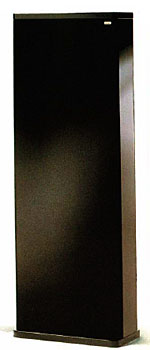
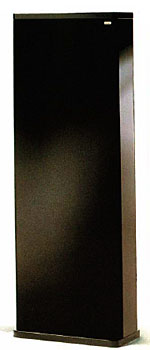
The driver mountings in the M-3 are designed for minimum diffraction, the left and right loudspeakers are "handed," as JA would put it (mirror-imaged, with the drivers slightly offset toward the center of the soundstage), and the grille cloth is designed to be left in place (it's not easily removed). The high-quality cabinet finish is in the same basic (gloss) black (footnote 4) as its big brother; in fact, in appearance the M-3 looks precisely like a scaled-down M-1. The reduction in dimensions is not all that large in any one direction (footnote 5), but the overall look is, in my opinion, far more domestic and less imposing. (The M-1 may not have been intimidating in LA's manse, but it certainly was in my far smaller listening space.)
The M-3 shares with the M-1 a complex crossover network with 28 premium parts. Fast rolloffs are the rule here: 12dB/octave (electrical) high- and low-pass at the 400Hz crossover point; 12dB/octave low-pass and 18dB/octave high-pass (again, the electrical response) at the 2.2kHz point. Bi-wiring (or bi-amping) is provided for. Although it lacks the bipolar, dual woofers of the M-1, the front and rear-facing midranges and tweeters of the M-3, combined with the essentially omnidirectional nature of the woofer, preserve in the smaller design the bipolar operation of the M-1.
Footnote: 1 Not to be confused with Nuclear Energy 102. Footnote 2: While the net result is not necessarily more (or even as) realistic—for other reasons—in the film-sound world, it can be argued that better standards exist there, as Lucasfilm's Tom Holman argues in my interview with him in the October 1990 issue.
Footnote 3: Then of Mirage, now of Snell Acoustics.
Footnote 4: The finish is not quite of grand-piano quality, however. Close inspection revealed a very uniform fine orange-peel texture.
Footnote 5: M-1: 59.8" H by 19.3" W by 9.5" D. M-3: 52.5" H by 18.1" W by 8.3" D.
If you wait long enough, though, these sorts of things have a way of evening themselves out. Not in the guise of the M-1, but in that of the M-3, Mirage's follow-up to their successful flagship. Similar concept, smaller (and less expensive) cabinet. Mirage Jr. and I arrived in Santa Fe at roughly the same time, and I immediately volunteered to do the review. Good move.
Like its larger brother, the M-3 is designated by Mirage to be a bipolar (not dipolar) design. Those who have read LA's original review will understand the distinction. They may take a brief break at this point. Others should stay on board for...
Radiation Theory 10 (footnote 1)
All right, class—pop quiz time. Question: What is the correct radiation pattern for a loudspeaker system? You have ten minutes.
The M-1 was and is, however, large, heavy, and expensive—as flagship designs are prone to be. In creating the new, more affordable M-3, designer Ian Paisley began by replacing the twin 8" woofers of the M-1 with a single 10" design. The cone material was the same (mineral-filled polypropylene), the surround changed to Butyl rubber in place of the Nitrile/PVC surrounds of the M-1's woofers. The cabinet remained a reflex, but its size was considerably reduced—and made less complex (the M-1's finished side panels are removable, the M-3's are not). Its weight was also lessened, though it was and still is a hefty 130 lbs, with 0.75"-thick walls. Heavy internal bracing was also specified for the M-3, as in the M-1. The midrange drivers remained identical to those in the M-1, and are still mounted back-to-back in their own sealed subenclosure. The ferrofluid-damped, soft-dome tweeters of the M-3 differ from those of the M-1 in several respects, including dome shape (the M-1 tweeter is a special hyperbolic design, the M-3 a more conventional dome), voice-coil material (the Kapton bobbin of the M-1 provides better power-handling capability), and dome coating and surround (those of the M-1 are said to be superior). The M-1's tweeter is designed and built in-house by Mirage, as are all the drivers for both the M-1 and the M-3, while that of the M-3 is designed and assembled by Mirage from parts sourced in Canada and Japan.
Footnote: 1 Not to be confused with Nuclear Energy 102. Footnote 2: While the net result is not necessarily more (or even as) realistic—for other reasons—in the film-sound world, it can be argued that better standards exist there, as Lucasfilm's Tom Holman argues in my interview with him in the October 1990 issue.