| Columns Retired Columns & Blogs |

I was looking for copyright and/or patent info on "Streamlength" and found none (only a TM).
Please reply with more info on this issue as necessary. Thx!
The rules have changed today
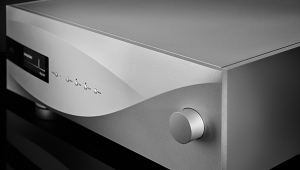
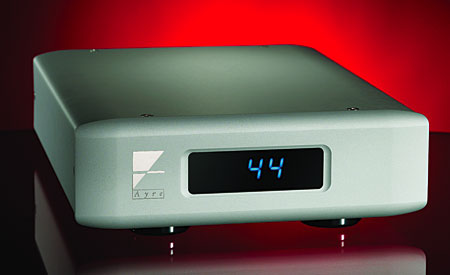
What makes the QB-9 different? I'll just hit the high points here. (For the full particulars, see Ayre's white paper.)
To achieve the maximum resolution, a D/A converter must use a high-precision clock circuit running at a fixed frequency to control the timing of the conversion of each digital sample to an analog voltage. By contrast, almost all USB DACs operate in what's called adaptive USB mode, which means having to use a variable-frequency clock rather than a fixed-frequency master clock. For various reasons, a computer cannot maintain perfect timing of the data packets it sends a DAC via USB. Most adaptive USB DACs are based on one of Burr-Brown's PCM270x family of chips. The BB chip typically changes the master-clock frequency to match the average sampling frequency of the data it receives—hence the "adaptive." The drawback to this, says Ayre (and which John Atkinson's measurements of other USB DACs seem to confirm), is that adaptive USB DACs tend to have high levels of jitter. Also, the BB receiver chip maxes out at a resolution of 16 bits and a 48kHz sample rate.
The USB standards documents also list a mode of operation called "asynchronous." This is not to be confused with Asynchronous Sample Rate Converters; asynchronous USB operation is called that because the DAC's master clock isn't synchronized to any clocks within the computer. Instead, the DAC is controlled by a high-precision fixed-frequency clock, and, to match this clock, the DAC controls the flow of data packets from the computer to a buffer upstream of the D/A converter chips. The BB 270x chips can be run only in adaptive mode, but Texas Instruments' TAS1020B USB interface chip, which incorporates an onboard microcontroller and a memory buffer, can operate in asynchronous mode, and will also accommodate sample rates up to 96kHz and word lengths of 24 bits.
For the QB-9, Ayre has licensed the asynchronous technology developed by Wavelength's Gordon Rankin for the TAS1020B chip. In his life B.A. (Before Audio), Rankin was chief engineer at what he coyly refers to as "the sixth largest manufacturer of PCs in the world." He spent nearly two years developing the software for the microcontroller that allows the TAS1020B to work in "asynchronous" mode with both PCs and Macs, using only the native drivers included in their operating systems. Rankin's software for the TI chip is marketed as Streamlength; Ayre is the first company to license it.
The QB-9 marries Streamlength to the Ayre ethos of zero feedback and fully balanced operation, not to mention Ayre's new minimum-phase digital reconstruction filter, implemented in a Field-Programmable Gate Array (see my Follow-Up on the Ayre C-5xeMP, July 2009, p.98). Ayre also isolates the USB receiver section from the rest of the audio circuitry with opto-isolators, to prevent any noise generated by the source computer and its host of clocks from polluting the audio signal.
Basically, the QB-9 has a single input—USB, duh—and analog outputs: one set each, balanced and single-ended. A small set of switches on the rear panel offer a choice of four operating configurations. The first is Ayre's usual Measure/Listen digital filter option (I tend to prefer Listen). The second is Power Mode, which lets you choose between the QB-9 powering on when it detects the computer powering on, or powering up only when it detects incoming data. Another switch lets you turn off the front panel's display. The fourth switch has no function as yet, but is there in case Ayre thinks up something else for the QB-9 to do.
My soul has been psychedelicized
Setting up the QB-9 in my main system wasn't as plug'n'play as I'd envisioned. Details mattered—maxing out the RAM on my G4 iBook made a huge difference to the sound, as did matching the sample rates on the computer and DAC. I'd hoped the QB-9 would sort through my 44.1, 48, 88.2, and 96kHz music files and just play each at its native sample rate. Well, it did—but my iBook wasn't so versatile. I could change the sample rate in the latter's Audio MIDI setup, but it wouldn't "take" unless I closed and reopened iTunes. Also, iTunes doesn't support FLAC, so I had to convert FLAC files to AIF with a bit of freeware called Max.
Technically speaking, none of these are the QB-9's "shortcomings"; they're native to the current state of iTunes. Windows-optimized music streaming programs are apparently more forgiving. Ayre offers on its website pages dedicated to tweaking different operating systems from Apple and Microsoft.
 | |||||||||||

|
|
| |||||||||
COMMENTS
I was looking for copyright and/or patent info on "Streamlength" and found none (only a TM).
Please reply with more info on this issue as necessary. Thx!



| Loudspeakers Amplification Digital Sources | |
Analog Sources Accessories Featured | |
Music Columns Retired Columns | |
Show Reports | |
Features Latest News Community | |
Resources Subscriptions |
 © 2024 Stereophile