It's hard to know what the best strategy is for digital upgrades. Maybe you bought your first CD player when you became convinced that the format was going to succeed, and it seemed that players were about as good as they were going to get. Some time later, you tried one of the new outboard digital processors, and the sonic improvement was such that you just had to have it. Then you replaced the player itself with a CD transport, so you could benefit from improvements in servo control and digital output circuitry. At this point you were generally happy with your digital front-end—until you read about how 16-bit DACs (which is what your processor had) were old hat now that 20-bit DACs were available. But alas, your processor couldn't be upgraded, and was worth maybe 30% of what you'd paid for it. So you took a loss and bought a new-generation digital processor, and things were fine and dandy...for a while.
 Now the rallying cry is "24-bit/96kHz!" It's possible to spend several thousand dollars on a digital processor that could become obsolete as rapidly as do today's cutting-edge computers. SACD and DVD-Audio are about to duke it out in the marketplace, and it's too soon to predict how this epic fight will turn out. The CD will likely continue as the dominant format for at least the next few years, so it makes sense to have your CD playback optimized. You'd like your CD playback equipment to be as up to date as possible, but you'd also like to stay in the moderate price range, so you won't lose too much in the inevitable next round of obsolescence.
The Bel Canto DAC 1 was designed for people like you.
Description & Design
Now the rallying cry is "24-bit/96kHz!" It's possible to spend several thousand dollars on a digital processor that could become obsolete as rapidly as do today's cutting-edge computers. SACD and DVD-Audio are about to duke it out in the marketplace, and it's too soon to predict how this epic fight will turn out. The CD will likely continue as the dominant format for at least the next few years, so it makes sense to have your CD playback optimized. You'd like your CD playback equipment to be as up to date as possible, but you'd also like to stay in the moderate price range, so you won't lose too much in the inevitable next round of obsolescence.
The Bel Canto DAC 1 was designed for people like you.
Description & Design
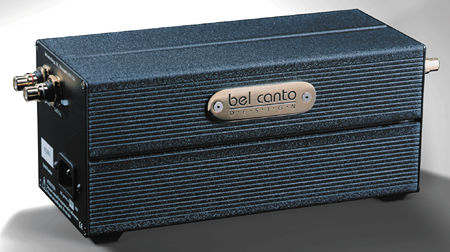
If what you're looking for is a piece of equipment that will impress your audiophile friends with its milled-from-solid titanium case and array of flashing lights, the DAC 1 will not satisfy. It's a smallish black box, albeit with a classy gold-plated "Bel Canto Design" metal plate on the side. At one end are the inputs (one S/PDIF, one TosLink), at the other the analog outputs (RCA coax). There's an LED that changes from red to green when the DAC 1 locks on to a digital datastream, and a pushbutton inverts absolute phase.
As described in the "User's Guide," and in more detail in a white paper on the Bel Canto website, designing the DAC 1 involved attempts to reduce four sources of error in D/A conversion:
1) timing jitter in the DAC clock
2) quantization noise in the D/A conversion process
3) time-domain smearing
4) distortion from electromagnetic interference (EMI)
Without going into the technical details—which I understand at only a very general level—the DAC 1's design involves use of the popular Crystal CS8420 sample-rate converter chip, which converts all input sources to 96kHz and adds 8 bits of dither to bring the data depth up to 24 bits (unless the source is already 24/96), then sends this "upsampled" data to the Burr-Brown PCM1704 24/96 DAC. A crystal oscillator provides a buffered clock output that controls both the sample-rate converter and the DAC, thus reducing jitter. A slow-rolloff digital filter set at 48kHz produces what Bel Canto claims is a more "analog-like" impulse response than the 22kHz brick-wall digital filters used in some other processors.
EMI—which, as Bel Canto uses the term, includes radio-frequency interference (RFI)—has long been recognized as a significant source of distortion, and Bel Canto's white paper on the DAC 1 points out that the problems start with the radiation of high-frequency clock and data signals. "Radiation requires an antenna, which is any unshielded wire of sufficient length." It now becomes clear that the DAC 1 is made small not to save money (or not just to save money) on chassis costs, but because its design calls for short signal paths. Critical clock and data line lengths are a fraction of an inch, and the DAC 1's small size allows it to be placed close to the preamp or data source, requiring only very short cables. (The DAC 1 is also available in an "internal" version that can be part of a Bel Canto preamp or integrated amp.)
On the analog side, the DAC 1 uses all Caddock resistors and polypropylene film and foil capacitors, with separate power supplies (including separate transformers) for the analog and digital sections, and star grounding. The analog section's S/N ratio is said to be equivalent to 20-bit performance.
Getting Started
Connecting the DAC 1 is simplicity itself—the only decision is whether the coaxial S/PDIF or TosLink input should be used. And because my PS Audio Lambda II transport has no TosLink output, I didn't even have to make that decision. Linked by the excellent Kimber Illuminations D-60 coax, the Lambda II/DAC 1 pairing worked well except in one respect: with every CD, when the first track started playing, and whenever I changed tracks manually, there was a slight pop through the speakers. I've used this transport with a number of digital processors, and this has never happened, which made me suspect the DAC 1 was the source of the problem. However, when I used the Rotel RCD-991 as the transport, the pop was gone. I discussed the issue with John Stronczer, designer of the DAC 1, who acknowledged that with some transports they've found this sort of interaction, which, he said, indicated momentary loss of lock. He suggested that I try one of the late-generation DVD players and use its TosLink output, which they've found to work better in this application than most CD transports. He also sent me a new sample of the DAC 1 that incorporated the latest revision of the CS8420, which was said to have better locking performance. Indeed, the new sample of the DAC 1 did not produce the pop when used in combination with the Lambda II (or any other transport I had on hand).
I was intrigued by Stronczer's suggestion to use the TosLink connection from a DVD player. The collective audiophile wisdom on TosLink is that it's inferior to coax S/PDIF, having lower bandwidth and being more prone to jitter. Stronczer admits that TosLink has relatively high jitter, but says that this does not present a problem with the DAC 1 because of this processor's ability to reject jitter. He likes the fact that TosLink can get rid of ground loops, and feels that the large (16MB) storage buffer built into DVD players is an effective way of suppressing low-frequency jitter components from the datastream that comes off the disc. In any case, I felt compelled to check out the suitability of a DVD player/TosLink as a source.
The DVD player in regular use in my home-theater system is a Sony DVP-S7000, a first-generation player; so I borrowed a Pioneer DV-09, a current top-of-the-line model. The first comparison I made was between the TosLink (AudioQuest OptiLink 2) and coax S/PDIF (Kimber Illuminations D-60) outputs of the DV-09, playing Chesky's familiar Jazz Sampler & Audiophile Test CD (JD37). The sound with the TosLink connection was fine in general terms, but compared to the coax it seemed subdued, slightly muffled, and subjectively slower. Comparing the DV-09 and the Lambda II, both using the coax outputs, there was not much difference; if anything, the Lambda II was a bit more detailed. I used the Lambda II for most of my subsequent auditioning of the DAC 1.
Now the rallying cry is "24-bit/96kHz!" It's possible to spend several thousand dollars on a digital processor that could become obsolete as rapidly as do today's cutting-edge computers. SACD and DVD-Audio are about to duke it out in the marketplace, and it's too soon to predict how this epic fight will turn out. The CD will likely continue as the dominant format for at least the next few years, so it makes sense to have your CD playback optimized. You'd like your CD playback equipment to be as up to date as possible, but you'd also like to stay in the moderate price range, so you won't lose too much in the inevitable next round of obsolescence.
The Bel Canto DAC 1 was designed for people like you.
Description & Design
If what you're looking for is a piece of equipment that will impress your audiophile friends with its milled-from-solid titanium case and array of flashing lights, the DAC 1 will not satisfy. It's a smallish black box, albeit with a classy gold-plated "Bel Canto Design" metal plate on the side. At one end are the inputs (one S/PDIF, one TosLink), at the other the analog outputs (RCA coax). There's an LED that changes from red to green when the DAC 1 locks on to a digital datastream, and a pushbutton inverts absolute phase.
Connecting the DAC 1 is simplicity itself—the only decision is whether the coaxial S/PDIF or TosLink input should be used. And because my PS Audio Lambda II transport has no TosLink output, I didn't even have to make that decision. Linked by the excellent Kimber Illuminations D-60 coax, the Lambda II/DAC 1 pairing worked well except in one respect: with every CD, when the first track started playing, and whenever I changed tracks manually, there was a slight pop through the speakers. I've used this transport with a number of digital processors, and this has never happened, which made me suspect the DAC 1 was the source of the problem. However, when I used the Rotel RCD-991 as the transport, the pop was gone. I discussed the issue with John Stronczer, designer of the DAC 1, who acknowledged that with some transports they've found this sort of interaction, which, he said, indicated momentary loss of lock. He suggested that I try one of the late-generation DVD players and use its TosLink output, which they've found to work better in this application than most CD transports. He also sent me a new sample of the DAC 1 that incorporated the latest revision of the CS8420, which was said to have better locking performance. Indeed, the new sample of the DAC 1 did not produce the pop when used in combination with the Lambda II (or any other transport I had on hand).