On May 21, 2008, five months after purchasing my very first turntable (a Rega Research P3-24), I decided that my obsession with LPs had grown to the extent that I could no longer function without a good record-cleaning machine. I'd done some research and found that the device best suited to my life and wallet was VPI's time-honored HW-16.5. I was certain, anxious, determined. But that morning, when I gave VPI a call, the line was busy. When I called again in the afternoon, the line was busy. When I called again in the evening, the line was busy.
When someone finally answered my call, I was surprised—partly because I'd grown so accustomed to hearing that busy signal, but mostly because the person on the other end of the line sounded so familiar. She was kind, candid, and her tone almost immediately took on the warm, concerned, slightly overbearing touch of a mom—my favorite kind of person. This was Sheila Weisfeld—cofounder, with her husband, Harry, of VPI Industries. We talked and talked. After a while, I wondered if Sheila was more interested in sharing stories about her sons than in selling me a record-cleaning machine.
Turned out that her first, Jonathan, had been killed in a car accident 13 years earlier. Jonathan and I would have been about the same age; like me, he'd wanted to be a musician. After Jonathan's death, VPI shut its doors for a month. Sheila dedicated herself to promoting safety-awareness programs and to helping her younger son, Mathew, find his way through the family's loss. Harry holed up in the basement for two years, perfecting a design that he and Jonathan had started together: a tonearm that, in honor of Jonathan, would be named the JMW Memorial. In our January 1997 issue, Michael Fremer called the tonearm "a triumph of industrial design" with a sound that was "intoxicating, almost magical."
Loss had inspired beauty.
Sheila, I figured, had taken a liking to me. (I'm great with moms.) But before we said goodbye, she expressed her displeasure with my choice of turntable. She was gentle, diplomatic, and unambiguous. "Perhaps you'd like me to loan you a turntable? Your call!"
My call? I was reminded of my own mom, always offering more of my favorite meal: I was too full to accept, but couldn't bear insulting her. I explained to Sheila, as tactfully as I could, that while I'd always been fascinated by and attracted to VPI's turntables, they were out of my price range. Plus, I had no idea how to set up a turntable. The Rega made setup relatively easy, but a 'table like VPI's entry-level Scout ($1800, with JMW-9T tonearm) was too intimidating.
"Can I take you up on the offer in a few months? By this fall, I might be able to give a VPI the attention it deserves."
"Whatever makes you happy."
Whatever makes me happy? I could almost see her smile.
When my conversation with Sheila was over, I immediately missed her. After speaking with her for just a few minutes, I felt I'd known her all my life. This was Sheila's effect on people. It's no surprise that her line was so often busy.
Days passed, spring turned to fall, one winter blurred into another, and I never again called Sheila. I figured we'd renew our discussion in person, at a Consumer Electronics Show or some other event.
In June 2011, when Sheila Weisfeld was diagnosed with stage-four pancreatic cancer, the doctors told her she had three months to live. She responded by going on long trips to Australia and to Texas; travel made her happy. Having surpassed the doctors' expectations, Sheila next planned to attend the January 2012 CES, where she would say goodbye to friends and colleagues and accept Stereophile's award for Analog Source Component of 2011, for VPI's Classic 3 turntable. She didn't make it. On December 16, 2011, Sheila Weisfeld passed away. I never got to meet her.
At CES, I handed our award to Mathew Weisfeld, who mentioned that he'd be taking on more responsibility at VPI. In April, at the New York Audio & AV Show, Mathew handed me a business card, explained that he was leaving his teaching job to work full-time with his dad, and introduced VPI's newest turntable, the Traveler. Dedicated to Sheila Weisfeld and meant to appeal to a younger generation of music lovers, the Traveler was designed for easy setup, would be available in a range of fun colors, and would cost $1299 without phono cartridge—almost exactly the price of my Rega P3-24 without phono cartridge.
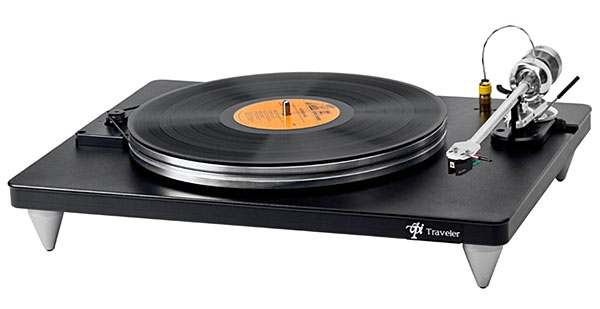
The VPI Traveler
On the flight home from the 2012 CES, 27-year-old Mathew Weisfeld reached into the pocket on the seat back in front of him, pulled out a paper bag, and sketched a design for an attractive, user-friendly turntable that even his friends could afford. The 'table's size and shape would be very important. It would have to be sleek, small enough to fit on a standard equipment rack, and at least somewhat portable. With a footprint of about 16.5" wide by 12" deep, the Traveler easily fit on the top shelf of my Polycrystal equipment rack, and left room for my VPI Crosscheck turntable level and Hunt EDA record-cleaning brush. Mathew Weisfeld boasts that he carried an early-production sample of the Traveler to the recent Newport Beach Show in his luggage. But at a hefty 24 lbs and standing about 5" tall, the Traveler is significantly heavier and bulkier than my Rega. While I wouldn't think twice about schlepping the Rega over to Uncle Omar's house for a listening session, I doubt I'd be able to tuck the Traveler under one arm and go.
 The Traveler's chassis is made of 3/16"-thick aluminum and ½"-thick Delrin, the latter a commercial name for polyoxymethylene (POM), a thermoplastic attractive for its high rigidity, low friction, and outstanding dimensional stability. Harry Weisfeld explained that, in the Traveler, this combination of aluminum and Delrin creates a very quiet, self-damping structure while allowing all parts of the turntable to be perfectly aligned for smooth, controlled operation. The 'table's aluminum top plate extends just beyond the Delrin foundation, and comes standard in a range of colors that includes red, white, blue, and silver. (Other options may be available in the future; photos on VPI's website show Travelers in pink and gold.) My sample came in VPI's standard black finish and exhibited some cosmetic imperfections on the chassis' underside—due perhaps to being hauled around in luggage, or to the usual strains of shipping. The instruction manual recommends using the Panel Magic or Stainless Steel Magic cleaning products to eliminate any odd markings from the Traveler's surface.
The Traveler's machined aluminum platter is damped with a stainless-steel disc and has an integral cloth mat. As in the VPI Classic, the Traveler's motor is built into the chassis. While it might seem counterintuitive to place a vibration-inducing motor in direct contact with a vibration-sensitive chassis, VPI believes that a properly integrated motor provides steadier and more efficient speed control. Unlike my Rega and many low-cost turntables driven by DC motors, the Traveler's AC synchronous motor runs on the stable 60Hz line frequency, and is said to be immune to voltage variances. I asked Harry Weisfeld to explain.
"An AC motor knows where it is. A DC motor knows where it was."
I asked Harry Weisfeld to explain.
"An AC synchronous motor reads the line frequency coming from the wall, which, in the US, will always be 60Hz. The motor's rotational speed (600rpm, in the case of the Traveler) is set by the line frequency. You can vary the voltage from 70 to 140V, and the speed will still be 600rpm. If you slow the platter down with your finger, the motor will fight you to get back to the correct speed of 600rpm—it's a known, fixed item."
Using a record brush on a spinning LP, I noticed that the Traveler paid little attention to the downward pressure exerted on its platter, but continued to run smoothly, unperturbed. This is not at all the case with my Rega, which can be slowed to a near stop with the slightest touch. According to Weisfeld, AC motors are more sensitive to music's timing and, therefore, sound more dynamic and compelling.
And DC motors?
"A DC motor is very quiet, very easy to integrate into a turntable, passes CE and UL regulations with no problem, and is cost-effective. But what speed does it run at? [A DC motor] needs a feedback loop to maintain speed accuracy, and that causes a time delay when the [rotational] speed is changed by groove velocity."
The Traveler's main platter bearing comprises a high-tolerance Thomson shaft, a chrome-hardened steel ball, and a thrust plate of polyetheretherketone (PEEK), an extremely durable thermoplastic with outstanding creep resistance—perfect for high-stress applications. Hinting at a potential upgrade, Weisfeld claims that the Traveler's motor and bearing assembly can easily handle the Classic 3's substantial 20-lb platter.
The Traveler's chassis is made of 3/16"-thick aluminum and ½"-thick Delrin, the latter a commercial name for polyoxymethylene (POM), a thermoplastic attractive for its high rigidity, low friction, and outstanding dimensional stability. Harry Weisfeld explained that, in the Traveler, this combination of aluminum and Delrin creates a very quiet, self-damping structure while allowing all parts of the turntable to be perfectly aligned for smooth, controlled operation. The 'table's aluminum top plate extends just beyond the Delrin foundation, and comes standard in a range of colors that includes red, white, blue, and silver. (Other options may be available in the future; photos on VPI's website show Travelers in pink and gold.) My sample came in VPI's standard black finish and exhibited some cosmetic imperfections on the chassis' underside—due perhaps to being hauled around in luggage, or to the usual strains of shipping. The instruction manual recommends using the Panel Magic or Stainless Steel Magic cleaning products to eliminate any odd markings from the Traveler's surface.
The Traveler's machined aluminum platter is damped with a stainless-steel disc and has an integral cloth mat. As in the VPI Classic, the Traveler's motor is built into the chassis. While it might seem counterintuitive to place a vibration-inducing motor in direct contact with a vibration-sensitive chassis, VPI believes that a properly integrated motor provides steadier and more efficient speed control. Unlike my Rega and many low-cost turntables driven by DC motors, the Traveler's AC synchronous motor runs on the stable 60Hz line frequency, and is said to be immune to voltage variances. I asked Harry Weisfeld to explain.
"An AC motor knows where it is. A DC motor knows where it was."
I asked Harry Weisfeld to explain.
"An AC synchronous motor reads the line frequency coming from the wall, which, in the US, will always be 60Hz. The motor's rotational speed (600rpm, in the case of the Traveler) is set by the line frequency. You can vary the voltage from 70 to 140V, and the speed will still be 600rpm. If you slow the platter down with your finger, the motor will fight you to get back to the correct speed of 600rpm—it's a known, fixed item."
Using a record brush on a spinning LP, I noticed that the Traveler paid little attention to the downward pressure exerted on its platter, but continued to run smoothly, unperturbed. This is not at all the case with my Rega, which can be slowed to a near stop with the slightest touch. According to Weisfeld, AC motors are more sensitive to music's timing and, therefore, sound more dynamic and compelling.
And DC motors?
"A DC motor is very quiet, very easy to integrate into a turntable, passes CE and UL regulations with no problem, and is cost-effective. But what speed does it run at? [A DC motor] needs a feedback loop to maintain speed accuracy, and that causes a time delay when the [rotational] speed is changed by groove velocity."
The Traveler's main platter bearing comprises a high-tolerance Thomson shaft, a chrome-hardened steel ball, and a thrust plate of polyetheretherketone (PEEK), an extremely durable thermoplastic with outstanding creep resistance—perfect for high-stress applications. Hinting at a potential upgrade, Weisfeld claims that the Traveler's motor and bearing assembly can easily handle the Classic 3's substantial 20-lb platter.
On the flight home from the 2012 CES, 27-year-old Mathew Weisfeld reached into the pocket on the seat back in front of him, pulled out a paper bag, and sketched a design for an attractive, user-friendly turntable that even his friends could afford. The 'table's size and shape would be very important. It would have to be sleek, small enough to fit on a standard equipment rack, and at least somewhat portable. With a footprint of about 16.5" wide by 12" deep, the Traveler easily fit on the top shelf of my Polycrystal equipment rack, and left room for my VPI Crosscheck turntable level and Hunt EDA record-cleaning brush. Mathew Weisfeld boasts that he carried an early-production sample of the Traveler to the recent Newport Beach Show in his luggage. But at a hefty 24 lbs and standing about 5" tall, the Traveler is significantly heavier and bulkier than my Rega. While I wouldn't think twice about schlepping the Rega over to Uncle Omar's house for a listening session, I doubt I'd be able to tuck the Traveler under one arm and go.
The Traveler's chassis is made of 3/16"-thick aluminum and ½"-thick Delrin, the latter a commercial name for polyoxymethylene (POM), a thermoplastic attractive for its high rigidity, low friction, and outstanding dimensional stability. Harry Weisfeld explained that, in the Traveler, this combination of aluminum and Delrin creates a very quiet, self-damping structure while allowing all parts of the turntable to be perfectly aligned for smooth, controlled operation. The 'table's aluminum top plate extends just beyond the Delrin foundation, and comes standard in a range of colors that includes red, white, blue, and silver. (Other options may be available in the future; photos on VPI's website show Travelers in pink and gold.) My sample came in VPI's standard black finish and exhibited some cosmetic imperfections on the chassis' underside—due perhaps to being hauled around in luggage, or to the usual strains of shipping. The instruction manual recommends using the Panel Magic or Stainless Steel Magic cleaning products to eliminate any odd markings from the Traveler's surface.
The Traveler's machined aluminum platter is damped with a stainless-steel disc and has an integral cloth mat. As in the VPI Classic, the Traveler's motor is built into the chassis. While it might seem counterintuitive to place a vibration-inducing motor in direct contact with a vibration-sensitive chassis, VPI believes that a properly integrated motor provides steadier and more efficient speed control. Unlike my Rega and many low-cost turntables driven by DC motors, the Traveler's AC synchronous motor runs on the stable 60Hz line frequency, and is said to be immune to voltage variances. I asked Harry Weisfeld to explain.
"An AC motor knows where it is. A DC motor knows where it was."
I asked Harry Weisfeld to explain.
"An AC synchronous motor reads the line frequency coming from the wall, which, in the US, will always be 60Hz. The motor's rotational speed (600rpm, in the case of the Traveler) is set by the line frequency. You can vary the voltage from 70 to 140V, and the speed will still be 600rpm. If you slow the platter down with your finger, the motor will fight you to get back to the correct speed of 600rpm—it's a known, fixed item."