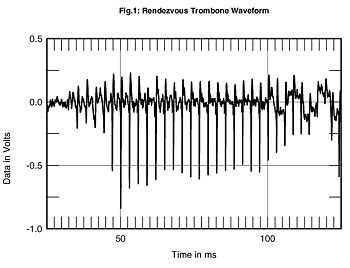
Accordingly, I prepared several four-channel submixes. The first featured the drums and bass guitar, with some digital equalization provided by a Z-Systems RDP-1. For the bass guitar, I mainly used the DI track, adding a bit of presence-region bite with the RDP-1. (While Jerome had liked the recorded sound of his bass, he wished for a bit more "woody" character to its sound.) I also experimented with some reverberation for his bass guitar solos. As well as the stereo drum tracks, I kept the spot snare drum track separate, to allow some flexibility in balancing the final drum sound. Half of the remaining submixes involved treating the stereo vibraphone tracks with varying amounts of digital reverberation from a Lexicon PCM-90. This operates with 18-bit resolution, so by passing the vibes' data through the Lexicon at full level, and subsequently backing off the level of the vibes in the mix by 12dB, I would preserve the session tape's 20-bit resolution. The Lexicon offers enormous flexibility when it comes to choosing the character of its reverb algorithms, so I spent some time matching the nature of its sound to that of the Salina church. Treating the sax and trombone submixes proved rather more complex. The trombone waveform in particular is both wildly asymmetrical (fig.1) and has sharp, spikey transients that dramatically increase the instrument's peak/mean ratio without making it sound very loud. It is always a challenge for recordists to capture the "body" of the trombone's tone without the instrument sounding too spitty.
 A degree of compression was called for in order to reduce the instruments' dynamic range, yet good-sounding compressors and limiters are analog devices. While the vibes, drums, and bass-guitar tracks remained in the digital domain throughout the mixing process, I would have to convert the horn tracks to analog, process them in the analog domain, then redigitize them. To further complicate matters, this redigitization would have to use exactly the same word clock as the data recorded weeks before in Salina so that, when the submixes were all realigned in the digital audio workstation, they would all have exactly the same number of samples from beginning to end. (Digital word clocks need be only very slightly adrift to produce some very strange sonic artifacts.) The compressor/limiter I ended up using was the Manley ELOP. This tubed device uses an encapsulated LED/light-sensitive resistor combination in a sidechain to progressively reduce the main signal-path gain as the signal level increases above a user-selectable threshold. The Manley proved remarkably intuitive to use: varying its threshold and gain controls, it took very little time to achieve a useful amount of compression, yet without any audible "ducking" or "breathing." Without any gain reduction, the ELOP also appeared to be very transparent.
A degree of compression was called for in order to reduce the instruments' dynamic range, yet good-sounding compressors and limiters are analog devices. While the vibes, drums, and bass-guitar tracks remained in the digital domain throughout the mixing process, I would have to convert the horn tracks to analog, process them in the analog domain, then redigitize them. To further complicate matters, this redigitization would have to use exactly the same word clock as the data recorded weeks before in Salina so that, when the submixes were all realigned in the digital audio workstation, they would all have exactly the same number of samples from beginning to end. (Digital word clocks need be only very slightly adrift to produce some very strange sonic artifacts.) The compressor/limiter I ended up using was the Manley ELOP. This tubed device uses an encapsulated LED/light-sensitive resistor combination in a sidechain to progressively reduce the main signal-path gain as the signal level increases above a user-selectable threshold. The Manley proved remarkably intuitive to use: varying its threshold and gain controls, it took very little time to achieve a useful amount of compression, yet without any audible "ducking" or "breathing." Without any gain reduction, the ELOP also appeared to be very transparent.