| Columns Retired Columns & Blogs |

Thiel CS2.3 Loudspeaker Measurements part 3
In the time domain, the Thiel's performance is, as expected, superb. The impulse response (fig.7) indicates time-coherent performance, as does the step response (fig.8). The sharp spike at the leading edge of the step will be partly due to the measuring microphone's own slightly exaggerated top octave. However, it also implies that the acoustic center of the tweeter section of the coaxial drive-unit is just a little in front of that of the midrange section, which is puzzling considering that they share a common voice-coil.
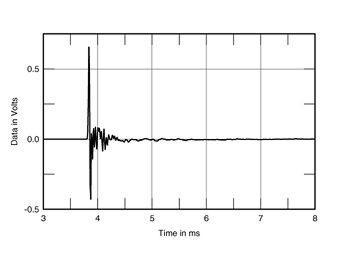
Fig.7 Thiel CS2.3, impulse response on tweeter axis at 50" (5ms time window, 30kHz bandwidth).

Fig.8 Thiel CS2.3, step response on tweeter axis at 50" (5ms time window, 30kHz bandwidth).
Fig.9 shows the cumulative spectral-decay plot calculated from the CS2.3's impulse response. Though this is clean through the treble and midrange, there is a noticeable ridge of delayed energy present at the bottom of the tweeter's passband. But again, this measurement was taken at the close 50" mike distance, and might not be representative of the speaker's behavior at a greater distance, where the drive-units will be better integrated.

Fig.9 Thiel CS2.3, cumulative spectral-decay plot at 50" (0.15ms risetime).
Before you jump to conclusions from these somewhat idiosyncratic measurements, it is important to note that a relatively large three-way design with a first-order crossover stretches the limits of what it is possible to measure with an in-room, quasi-anechoic test setup. The interaction between speaker, microphone, room, and measurement technique is considerably more complex than it would be, for example, with a small two-way featuring a fourth-order crossover. As always, the proof of the design is in the listening, and in that respect I note that BD had relatively few criticisms to make.—John Atkinson
 | |||||||||||

|
|
| |||||||||
- Log in or register to post comments






| Loudspeakers Amplification Digital Sources | |
Analog Sources Accessories Featured | |
Music Columns Retired Columns | |
Show Reports | |
Features Latest News Community | |
Resources Subscriptions |
 © 2024 Stereophile
AVTech Media Americas Inc., USA
All rights reserved