| Columns Retired Columns & Blogs |

Rives Audio PARC 3-Band Parametric Equalizer Page 4
A second way to appreciate the PARC EQ was to listen to music of great size and complexity, such as Mahler's Symphony 6 (Michael Tilson Thomas, San Francisco Symphony, San Francisco Symphony 0001). I realized that, although there was no sapping of the orchestra's power and energy, there was a greatly enhanced facility to hear more of what was going on within the orchestra. PRaT (Pace, Rhythm and Timing) fans will appreciate what PARC does to delineate the pulse and meter of the music. I was motivated by this to dissect the effects of the various corrections, and again found that the audible improvements were proportional to frequency. Indeed, if I removed or substantially moderated the attenuation in the lowest band on both channels, the perceived clarity of detail was retained, along with a restoration of some weight in the most massive sounds; eg, the "blows of fate" in the final movement of the Sixth. What this confirms is that the measurements and the corrections they imply are only a starting point; as ever, one must rely on critical listening to fine-tune the system.
The only operational problem I had in using the PARC was excessive noise with its balanced outputs feeding the bridged, balanced inputs of the Bel Canto eVo6 power amplifier. I had no problems with the other amps using balanced connections, nor with any amp using unbalanced connections, including the bridged eVo6. Rives informed me that they were aware of this problem—it's related to the low input impedance of some balanced inputs—and have already corrected it in current-production PARCs.
Alternatives to PARC
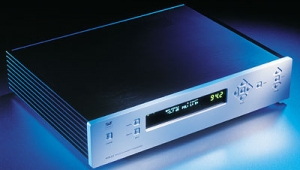
Although the PARC was designed as an analog device to be applied equally well to systems with analog or digital sources by insertion at the power-amp input, the trusty Z-Systems rdp-1 Digital Parametric Equalizer can apply the same filters in the digital domain. It was no sweat to transfer the PARC's filter parameters to the rdp-1.
As you might have predicted, the acoustic results were identical. However, the overall reduction in LF amplitude due to interaction between the low-Q/high-attenuation filters (on the left channel particularly) could be compensated for with the rdp-1's shelf filters. In addition, the rdp-1's six available bands and gain capability permit even finer tuning. For example, it could deal with the 302Hz bump in the right channel as well as the sharp suckouts in both channels. However, I could not use the Z-Systems with SACD or DVD-Audio discs—as of this moment, those sources' digital outputs are not available—nor could I use it with my turntable without adding a high-quality A/D converter to the system. This confirms Rives' contention that an analog device has greater applicability, at least for the present.
I wish I could have compared the PARC directly to the TacT RCS, a much more ambitious device. The TacT did its intended job, but it requires a PC for setup and works only with digitized signals. Also, I had been less than blown away by its A/D and D/A stages, although the DSP certainly did its job in improving my system's performance without relocation or divorce.
The TacT's most important contributions were in the same low-frequency range as the PARC's; higher-frequency corrections were like "flavoring to taste" rather than objective improvement. I expect to soon get my hands on TacT's improved RCS 2.2X for a Follow-Up.
Conclusions
While one should optimize room acoustics and speaker placement before trying the PARC, it can still accomplish a lot. I was surprised how successful and satisfying the PARC was in applying attenuation with precision. It provides an alternative to impractically large acoustic absorbers by attenuating resonant frequencies in a more selective fashion. To a degree, it also frees you to place the speakers for better imaging and midrange while helping with the bass.
I have no criticism of the PARC's audible performance. It is relatively simple to set up and use, and, once configured, can be left permanently in the preamp-amp link until a change in the system requires its attention. At least 24% of us should be thinking about getting a PARC right now.
NEXT: Specifications »
 | |||||||||||

|
|
| |||||||||
- Log in or register to post comments










| Loudspeakers Amplification Digital Sources | |
Analog Sources Accessories Featured | |
Music Columns Retired Columns | |
Show Reports | |
Features Latest News Community | |
Resources Subscriptions |
 © 2024 Stereophile
AVTech Media Americas Inc., USA
All rights reserved