| Columns Retired Columns & Blogs |

These abominations are some of the worst speakers i have ever heard. That they are sold, let alone that the 'manufacturer' asks $15,000 per pair for theses abominations, is an insult to the human race.

Fig.7 Revel Salon, vertical response family at 50", from back to front: responses 15 degrees-5 degrees above HF axis; reference response; responses 5 degrees-15 degrees below HF axis.
However, the high-order crossover means that the Salon cannot be time-coherent, as shown by its step response on the tweeter axis (fig.8). The tweeter output arrives first at the microphone, followed by the outputs of the midrange unit, then the upper woofer, then the three lower woofers. It is arguable whether time coherence is necessary or not. Certainly, LG's very positive reaction to the Revel's resolution of detail and its imaging accuracy was not negatively affected by the speaker's time-domain behavior.
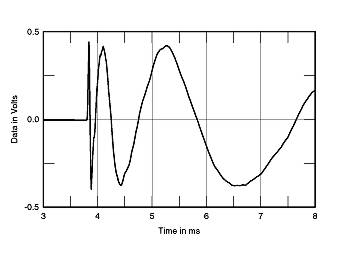
Fig.8 Revel Salon, step response on tweeter axis at 50" (5ms time window, 30kHz bandwidth).
The Salon's waterfall plot (fig.9) was not as clean as I had expected. I suspect that some of the HF hash present in the floor of this graph is due to early reflections of the tweeter's output from the tops of the speaker's side cheeks. There is a hint of delayed energy just below the on-axis notch in the presence region, but this is probably too subtle to introduce any coloration.

Fig.9 Revel Salon, cumulative spectral-decay plot at 50" (0.15ms risetime).
Another finely engineered loudspeaker design from Kevin Voecks and his team.—John Atkinson
 | |||||||||||

|
|
| |||||||||
COMMENTS
@Ornello :
You must not be familiar with Harmon Audio Group's testing facilities and procedures, and, you also must not have heard these speakers working properly. Either you heard some bad quality clones, or there was something terribly wrong with some other piece of equipment in the chain, or, very bad source material.
Because not only do these speakers measure exceptionally well from an entirely objective perspective, they also have EXCELLENT sound quality both from my perspective as a person who listened to them while working for a COMPETITOR -and- from the perspective of a panel of expert trained listeners working at the parent company.
Even if these speakers did not suit your personal preference [for non-neutral sound], I don't believe you honestly could have listened to them and come away with an opinion that the were not at least "generally excellent"!
In 2003 I went to all the major high end audio boutiques in Manhattan and auditioned several of their finest (and some more modest) speakers at each store. The Madrigal Revel Salon Ultimas stood out as clearly superior to every other pair we heard over that period of a couple days that we spend listening to the best the competition had to offer. Every other pair had at least some minor unpleasant quality to their sound, these were the only ones where nothing stood out as an obvious imperfection to their ability to accurately and dynamically reproduce recorded music.

If you did not like the sound of them, maybe there was some other part of the system that was producing noise that you did not like. I know they can reveal sonics in cables, DAC filters, room acoustics, and pre-amp. They also throw a large magnetic field that can interact with close-by (i.e. between the speakers) electronics.
I own Yamaha NS-1000M speakers. Prior to that I owned Rogers Studio 1s. Either of these trounce the Revels.

I got lucky enough to get a pair to and these speakers live up to their reputation bigtime. I'm generally disappointed by hi-end loudspeakers because my mid-fi electronics tend to translate into harsh, ultra revealing noise that's not musical, in fact I was in the process of upgrading my electronics when I found these and drivin by an anthem 225I and kimber 4tc wire these are the most impressive and musical speakers i've had and I can finally say my home system sounds as good as the systems I hear at the hifi stores. I'm sure better electronics will produce better sound but it's nice that they sound great as is. previous speakers, revel f52, VA beethoven, kef 107/2, 105/3, Dyn audience 80. The 107/2 are full range but can't compare to the salon.
Dear Ornello,
I also own Yamaha's NS1000 and I am familier with the Salon2. I think the design strategies of both speakers are not that different. Recent measurements on NS1000 drivers show that the big mid driver has exceptional dispertion even at 5K. Distortion levels at around 1KHz are extremely low, like no cone driver can give. The Yamaha's sound extremely detailed without dynamic compression. The Salon2 sounds like that too, a bit less detailed in the mids and a bit more modern (laid back). And if you haven't upgraded some filter components then I believe the Salons can sound better then the yamaha's.
The Salons were and still are a high-end bargain, if your amp can handle the low impedance. If you can't afford them, buy second hand Yamaha's and recap the filters.
You're passionate about your taste i'll give you that, but why hang around here and slam one speaker in favor of another when both are out of production? I read the review of the ns1000 and tbh I would take the dq10 they compared it to over a speaker that will make 5% of my recordings magical and the other 95% unlistenable, been there, done that.




| Loudspeakers Amplification Digital Sources | |
Analog Sources Accessories Featured | |
Music Columns Retired Columns | |
Show Reports | |
Features Latest News Community | |
Resources Subscriptions |
 © 2024 Stereophile