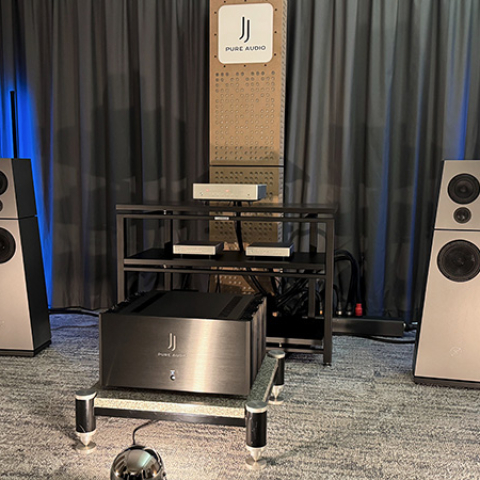
The local AC-power waveform delivered to residential customers is heavily distorted, particularly in terms of truncated peaks. The heavy clipping of the AC-power waveform results in fairly high levels of harmonic distortion of the AC sinewave. I use a PS Audio Power Plant (AC-power regeneration device) to power my source components and preamplifier; my power-amplifiers have to fend for themselves...
Reader Gus Kund wants to know if the power where you live is so bad that you've had to deal with it?

- Login or register to post comments

Are you sure it's not your system, Gus? I realize that we live in an age where many people throw their money away on power conditioners that can cost upwards of $20k. It's always a good idea to carefully check one's components first. You would be quite surprised at the deficits which surface in the amp and preamp sections of many audio systems.

I live in an older part of Spokane—1900-1920 vintage homes. The power is a little dirty/noisy and fluctuates between 120V & 125V with some spikes. I solved my power problems by installing PS Audio Noise Harvesters in my listening room and purchasing a PS Audio Power Plant Premier. THD went from 4.2-4.7% to .2%; voltage went from fluctuating between 120V & 125V to a clean, noise-free 120V all the time. The PPP regenerates more than enough power to power my entire system. More importantly, I heard the difference. The background is blacker, cleaner with more clarity and detail in the music. The music seemed to come alive in new ways. The spike and surge protection the PPP provides are a bonus.

I live in what can be charitably labeled "an RFI enriched neighborhood." I had no idea how bad it was until I installed eight parallel line filters in the outlets of my small (1184 sq ft) house. That cleared up a lot of noise on the AC power lines and started an equipment and cable upgrade binge that hasn't quite stopped after four years.

Living in an apartment building creates serious problems for AC power, as all apartments with their noisy electrical equipment are on the same AC line. For my audio system, I installed a PS Audio (PSA)AC outlet connecting to a PSA Ultimate Outlet (UO) via a selfmade AC power cord,the UO connected to a Power Plant Premier via a PSA xStream Plus powercord. The audio equipment gets its power from the PPP via PSA Plus power cords. The system sounds good to excellent. This is still variable as the AC power still varies of quality. Hey, I almost forgot the three Noise Harvesters in three different outlets.

Only real issue is clicks and pops from appliance and (especially fluorescent) light switching within the house, and occasional off-hours (usually early AM) voltage transients. California. Clicks and pops really bother only one older amp, not all of them (three systems counting the computer). Bigger problem is with static discharge due to carpet and low humidity.

... or seems to be. How would one know they are having system performance degradation from AC power problems? Duh? If I need to ask, I have no problems. Duh? I do have AC filters but none have a voltage meter to watch. D'oh! What other problems exist, noise in the AC passed through to contaminate the music, I don't hear anything like that. I do have solid-state components and CD/SACD sources, that may not be high-rez enough to add, uhm, reveal, hum and hiss from the power line. D'oh! I do know there are several nuclear power plants on the local grid, is the power from them not as good as say coal fired power generators, can you hear the difference? Gotta be coal for Coltrane, is that true? The worst power-related problem I have now is the silence caused when the power is out. Seriously, I'm sorry if you have power related problems, but help me out a bit, I just don't know what they are. I can imagine that low voltage is a bad problem, the local utility not providing the product they are supposed to is a terrible situation to live with. I can only imagine some of the damage to components, and then they are not liable for it, that is horrendous. I'm interested in learning more.

I have resorted to using my own regenerated power most of the time. It's a very simple use of storage batteries and high quality sine wave inverters. The battery banks are kept charged with charged with inexpensive automatic battery chargers, augmented by solar and wind power. Two 600W sine wave inverters feed high capacity extention cords and that's what runs my stereo. We notised a big reduction of noise and a very refined high frequency sound. The most expensive part is the batteries and the solar pannels and wind turbine. This set-up can be installed in two days, with a little help.The bonus is when the electric company has an outage, we still have music and lights. For less than two or at the most three grand, it's a lot of fun and green too.

When I installed a power regenerator about six years ago, a considerable amount of grunge disappeared and has never returned. I use it to power my low voltage gear. We also have brownouts and blackouts, so I a have a computer grade USB ahead of it. If doing it now, I would get a PurePower unit that combines both USP and regenerator.

Day-to-day, it doesn't affect my playback—no discernable noise on the lines. But there's been the occasional power out, brown out or spike that has hit my components causing anything from a slight pop/hiccup to actual power down/reboot and settings lost. Yikes! Really need to get a better surge-suppression system. Maybe a good UPS.

Audiophiles are particular with contaminated power lines as these can be heard. Many products are sold to rectify this problem. Electricity flows perhaps hundreds or thousands of miles before it gets to your home and gathers grits and grunts along the way. Many products offer solutions by cleaning up the power lines. The question is the effectiveness and the cost involved. Use our ears to judge the effectiveness of these products and settle down to enjoy music.
- All Headphones Ship Free!
Shop a Huge Selection of Top Quality
Headphones at Great Prices!
www.Headphones.com
| Loudspeakers Amplification Digital Sources | Analog Sources Accessories Featured | Music Columns Features | Show Reports | Show Reports |
Recommended Components Blogs Latest News Community |
Shop Resources Subscriptions |