| Columns Retired Columns & Blogs |

Radio Shack Optimus CD-3400 portable CD player Measurements part 2
The CD-3400 appeared to have some positive linearity error at low signal levels (fig.5), but I believe the measurement is dominated by noise. A player's noise adds energy to the DAC's output, making it appear as though the player has an increasingly positive error as the signal level decreases. Because the CD-3400 uses a 1-bit DAC (which has inherently low linearity error), I suspect that the CD-3400's intrinsic linearity is better than that shown in fig.5. Moreover, the gradually increasing positive "error" as the signal level drops suggests that noise is swamping the DAC's output signal.

Fig.5 RadioShack Optimus CD-3400, left-channel departure from linearity (2dB/vertical div.).
Fig.6, the waveform of an undithered, 1kHz sinewave at -90dB, provides further evidence that the CD-3400's low-level performance is noise-limited. The signal is swamped by audioband noise, making it difficult to make out the stepped waveshape. Our standard noise-modulation test (fig.7) reveals some shifting of the noise floor as a function of input level, along with a slightly changing spectral balance of the noise as the input signal changes.
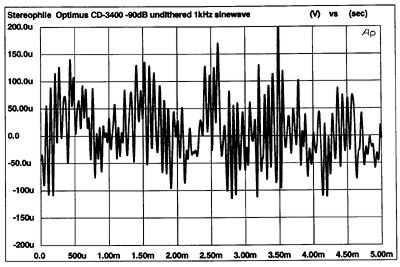
Fig.6 RadioShack Optimus CD-3400, waveform of undithered 1kHz sinewave at -90.31dBFS.

Fig.7 RadioShack Optimus CD-3400, noise modulation, -60 to -100dBFS (10dB/vertical div.).
Looking at the CD-3400's intermodulation spectrum when the player was decoding a full-scale mix of 19kHz and 20kHz (fig.8) showed very few intermodulation products, and those were of low amplitude. The 1kHz difference product (20kHz minus 19kHz) almost reaches -90dB, while the presence of the peak at 24.1kHz indicates only moderate ultrasonic analog filtering.

Fig.8 RadioShack Optimus CD-3400, HF intermodulation spectrum, DC-22kHz, 19+20kHz at 0dBFS (linear frequency scale, 20dB/vertical div.).
The CD-3400's bench performance was only fair in the context of most of the products I test, but acceptable considering that it costs about ten times less than the average digital processor. Moreover, it had better technical performance than some poorly engineered high-end products. There is, however, nothing in the measurements that would indicate its high sonic performance-to-price ratio.—Robert Harley
NEXT: More measurements »
 | |||||||||||

|
|
| |||||||||
- Log in or register to post comments









| Loudspeakers Amplification Digital Sources | |
Analog Sources Accessories Featured | |
Music Columns Retired Columns | |
Show Reports | |
Features Latest News Community | |
Resources Subscriptions |
 © 2024 Stereophile
AVTech Media Americas Inc., USA
All rights reserved