PSB Imagine T loudspeaker Playing With Ports
In the images of the rear of the Imagine T in PSB's literature and on their website, the upper port is shown stopped with a removable plug. Sure enough, the review samples arrived so plugged, along with a brief note explaining the situation: "the port cover can be used to adjust the bass tuning of the Imagine models where room problems at low frequencies (in the 100Hz region) occur....We invite the listener to try plugging any one or multiple ports to better integrate the system in their room.... Please experiment....Additional Port Covers can be acquired for a nominal fee." That's about the only guidance offered; otherwise, the user is pretty much on his or her own.
I mentioned this to Paul Barton when I spoke with him at the 2009 Consumer Electronics Show, and he agreed that some more help would be a good idea. I think that a short list of specific and easily obtained recordings that have lots of energy in the frequencies most affected by each combination of open and/or closed ports would be of great help to the general user.
In the absence of such guidance, I experimented with one Imagine T at a time, supplementing my listening with measurements using the XTZ Room Analyzer, which provides quick and reliable displays of a system's response below 250Hz. Only one plug per Imagine T is provided, so I used the plug from the other speaker so that I could try each speaker by itself with one, neither, or both ports plugged.
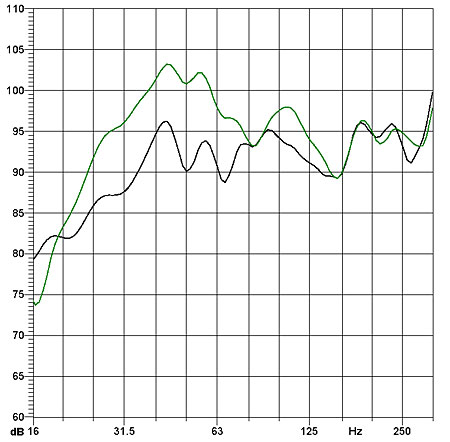
With only its upper port plugged, the right speaker showed a frequency response (upper green trace in fig.1) from 250 down to 50Hz that was characterized by a depression of about 5dB from 120 to 180Hz, a small bump at 100Hz, and bumps of +78dB in the vicinity of 4555Hz, below which the response rolled off smoothly. That depression was presumably a room effect; to cure it, I had to move the speaker to a place where, unfortunately, the pair's imaging then suffered. John Atkinson's measurements should confirm that this is not a characteristic of the Imagine T. However, this particular profile resulted in a lack of midbass warmth and a bit of boom at the bottom. The Imagine T seemed a bit lightweight, with poorly defined bass detail.
Fig.1 PSB Imagine T, right channel, in-room 1/6-octave smoothed response with upper port plugged, lower port open (green trace) and with both ports plugged (black trace) 16315Hz (5dB/vertical div.).
Plugging only the lower port broadened the midbass suckout, which now extended down to 100Hz. With both ports unplugged, the original suckout was accompanied by a broad elevation of +5dB from 45 to 100Hz. Obviously, I was going in the wrong direction! When I plugged both ports, however, the response remained within ±2.5dB limits (with 1/6-octave smoothing) down to 40Hz, and rolled off at about 12dB/octave below that (lower black trace in fig.1). The response now lacked the extra oomph from the bumps below 50Hz that it had with only the upper port plugged, but I quickly appreciated the improved articulation in the low frequencies. This was the port configuration my ears preferred, with or without a subwoofer switched in.
Not every buyer of a pair of Imagine Ts will need to order a second pair of port plugsthese results are specific to my room and the speakers' positions in it. For example, in that room, the left speaker's responses (not shown) were quite different from those of the right with every port configuration. Although the marginally flattest response, on paper, for the left speaker was also with both its ports plugged, I preferred its sound with only the lower port closed. Thus, I ended up using a total of three plugs: two in the right speaker, one in the left.
I recommend that, before experimenting, you listen to your new pair of Imagine Ts as shipped. Then, one speaker at a time, listen to (and, if possible, measure) each of the four possibilities with recordings of solo cello or solo guitar before deciding whether to order one or two more plugs. I know that most readers won't have a suitable measurement tool, but their ears should provide calibration enough.Kalman Rubinson
- Login or register to post comments
- All Headphones Ship Free!
Shop a Huge Selection of Top Quality
Headphones at Great Prices!
www.Headphones.com
| Loudspeakers Amplification Digital Sources | Analog Sources Accessories Featured | Music Columns Features | Show Reports | Show Reports | Blogs Latest News Community | Shop Resources Subscriptions |