| Columns Retired Columns & Blogs |

ProAc Response 3.8 loudspeaker Measurements part 2
Fig.5 shows the 3.8's horizontal dispersion, referenced to the tweeter axis. (The off-axis behavior on the tweeter side of the asymmetrical baffle is shown at the front of this graph.) The narrow directivity in the top audio octave can be seen in fig.5 as well, as can a narrow off-axis notch on the tweeter edge of the baffle. There's actually an excess of energy off of the other (badge) edge of the baffle in this region, which will make the speaker sound too bright if the room's side walls are close and reflective. In the vertical plane (fig.6), the drive-units' polarities have sensibly been arranged to place the inevitable crossover notch above the 43"-high tweeter axis.

Fig.5 ProAc Response 3.8, lateral response family at 50", normalized to response on tweeter axis, from back to front: differences in response 90 degrees-5 degrees off-axis on badge edge of baffle, reference response, differences in response 5 degrees-90 degrees off-axis on inside (tweeter) edge.

Fig.6 ProAc Response 3.8, vertical response family at 50", from back to front: differences in response 15 degrees-5 degrees above tweeter axis, reference response, differences in response 5 degrees-15 degrees below tweeter axis.
In the time domain, the step response (fig.7) reveals the tweeter and woofers to be connected with the same positive acoustic polarity, while the cumulative spectral-decay or waterfall plot (fig.8) implies a clean, grain-free presentation.
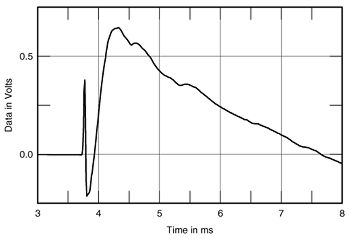
Fig.7 ProAc Response 3.8, step response on tweeter axis at 50" (5ms time window, 30kHz bandwidth).

Fig.8 ProAc Response 3.8, cumulative spectral-decay plot at 50" (0.15ms risetime).
Other than its bass tuning and horizontal mid-treble dispersion, which might make room optimization a little trickier than usual, the Response 3.8 is a well-engineered design with, as LG has pointed out, an impressive pedigree.—John Atkinson
 | |||||||||||

|
|
| |||||||||
- Log in or register to post comments









| Loudspeakers Amplification Digital Sources | |
Analog Sources Accessories Featured | |
Music Columns Retired Columns | |
Show Reports | |
Features Latest News Community | |
Resources Subscriptions |
 © 2024 Stereophile
AVTech Media Americas Inc., USA
All rights reserved