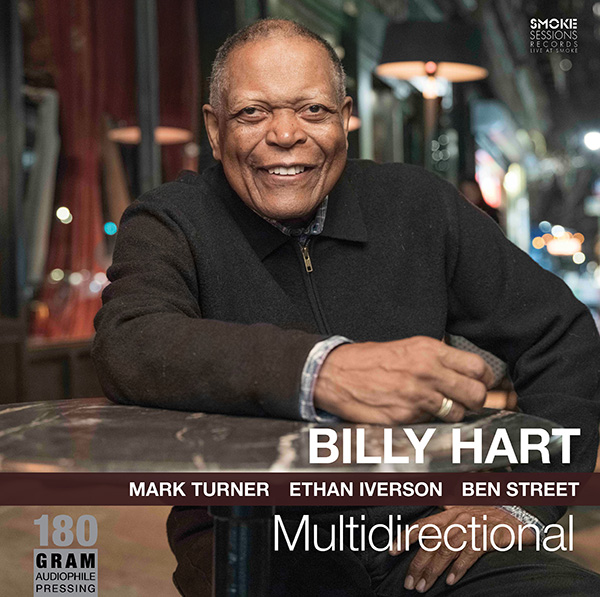
Billy Hart: Multidirectional
Hart, drums; Mark Turner, tenor saxophone; Ethan Iverson, piano; Ben Street, bass
Smoke Sessions SSR-2505 (CD; available as LP). 2025. Paul Stache, prod.; Stache, Richard Bernard, engs.
Performance ****½
Sonics **** Billy Hart's quartet started in 2004. In 20+ years, it has quietly become one of the best small ensembles in jazz. It has taken Hart almost all his 85 years to be recognized as a national treasure. He is a master of a drum language he invented, one that knows a thousand ways to swing. An unusual aspect of this quartet is that the leader, Hart, is one of the great sidemen in jazz, and two of the sidemen, Mark Turner and Ethan Iverson, are prominent leaders on the current scene. Turner's career has recently hit critical mass. He seems to be everywhere. Fellow tenor saxophonist Ravi Coltrane has said of him, "I think Mark Turner is one of the most important players to come along in the last 20 years, easily the most influential." Iverson was a founding member of The Bad Plus, one of the most popular jazz groups of the 21st century. Ben Street is an A-list bassist.
Hart's quartet overflows with talent, but what is truly special is how, together, they sound selfless, dedicated to a shared aesthetic purpose. Their version of John Coltrane's "Giant Steps" is a stunning collective act of imagination. The piece is notoriously difficult, an obstacle course of chords in different keys. Musicians are expected to play it fast, like Coltrane. Iverson starts it with a hesitant, brooding piano solo (no one does that on "Giant Steps"), and Turner constructs his own bold, beautiful treatise upon those famous chord progressions. There is other killing stuff here, like the wildly diverse "Song for Balkis," with another epic Turner solo, and the ballad "Showdown," where Turner turns almost tender.
Multidirectional is the quartet's first live album. Live, you hear how this tight band can play loose in person and create sheer, raw excitement in a room full of fortunate people.—Thomas Conrad
 John O'Gallagher: Ancestral
John O'Gallagher, alto saxophone; Ben Monder, guitar; Andrew Cyrille, Billy Hart, drums
Whirlwind (LP, CD, Digital). 2025. Michael Janisch, John O'Gallagher, prods.; David Amlen, André Fernandes, engs.
Performance ****
Sonics *****
Together, Andrew Cyrille and Billy Hart, born a year and about 250 miles apart, seem collectively to have been the drummer on every progressive jazz album that didn't include the recently departed Jack DeJohnette. They also share this: Both have reemerged as leaders in the last decade-plus, courtesy of the ECM label.
Sixty-three years after their recording debuts, the two drummers came together in the studio for the first time to make this album, Ancestral. The leader is alto saxophonist John O'Gallagher; Ben Monder joined on guitar. O'Gallagher and Monder were born around the time the elders here were starting their jazz careers.
The mix is so crisp that you can hear every detail, down to the different angles at which the two drummers hit their cymbals. On the one postbop number, "Under The Wire," saxophone and guitar bounce between the drums like pixels in a game of Pong, while on "Alter of the Ancestors" (the ancestors are John Coltrane and Rashied Ali), O'Gallagher is ecstatically enveloped by roiling percussion.
The best tracks are the most abstract—the ones that free up Cyrille and Hart from strictures of timekeeping and allow them to become colorists. At those moments, Monder's effects contrast with the acoustic reverberations of the kits in intriguing ways: Listen for example for the effect toward the end of "Profess." On the ballad "Tug," O'Gallagher's alto sounds like a Middle Eastern mizmar. Monder's lines turn "Quixotica" into a precious lullaby.
Credit O'Gallagher's egolessness: the album's finest moment doesn't even involve him. "Contact" highlights Monder in all his improvised glory; it recalls his own 2010 ECM album, Amorphae, which included duets with Cyrille. Here, it's even grander thanks to Hart's added touch.—Andrey Henkin
 Thomas Strønen's Time Is A Blind Guide: Off Stillness
Strønen, drums; four others
ECM 2842 (auditioned in WAV; available as CD). 2025. Manfred Eicher, prod.; Peer Espen Ursfjord, eng.
Performance ****
Sonics ****½
Serious jazz listeners have long pondered, how is it that we know "the ECM sound" when we hear it, even though its iterations are so diverse? What is the common thread that runs through it? Surely it has to do with a certain rapt, encompassing atmosphere and the relationship between lyric intensity and silence.
Over the last 20 years, Thomas Strønen, as leader, co-leader, and sideman on the ECM label, has established himself as one of the most creative drummers in Europe. The band he calls Time Is a Blind Guide has now made three albums. Its instrumentation is unusual: violin, cello, bass, piano, and drums. The three albums are different from each other. Yet all three are quintessential examples of the ECM sound.
Håkon Aase's violin and Leo Svensson Sander's cello give this ensemble its rich, resonant sonic signature. A Strønen composition like "Season" begins slowly, as Aase and Sander gradually find meaningful ways to intersect. Beneath them is the darkness of Ole Morten Vågan's bass. The smallest details are vivid. Only strings can give a melody such depth of yearning.
Strønen the composer has a light touch. Strønen the drummer is an instigator. On pieces like "Memories of Paul" (for two Pauls, Motian and Bley), his stirrings insert rhythmic relativism into this meticulous music. Energy waxes and wanes. The pianist here, Ayumi Tanaka, picks her spots. "Fall" is mostly the muted colors and fine-grained textures of Aase and Sander. But Tanaka's bright piano keeps appearing, spilling across the song like movements in a dream. In music this spare and implicit, every gesture is chosen.
Off Stillness has the living, lucid, intimate sound associated with a facility ECM has used for 55 years: Rainbow Studio in Oslo, Norway.—Thomas Conrad
 Peter McEachern Quintet: Streamin'
McEachern, trombone; four others
TRRcollective TRRC091 (CD). 2025. McEachern, prod.; Graham Stone, eng.
Performance ****
Sonics ****½
We live in an era of nonstop experimentation in jazz. There has never been a time when so many players pushed the envelope of jazz form, including the 1960s when there was an aggressive avant-garde.
Streamin' is an exception to all that. It does not break new ground. It sits squarely in the center of the great hard bop tradition. But it contains so much creativity and commitment that it reaffirms the vitality of its genre. Hard bop, after all, is the foundation for much of today's leading-edge music. As a style, it has proven inexhaustible.
Peter McEachern is an accomplished trombonist with a small discography. He made excellent personnel choices for Streamin'. Noah Preminger is a badass who has exciting ideas and an exhilarating clarion tenor saxophone sound. Pianist Julian Shore is a rising star who recently released an important trio album, Sub Rosa. Michael Sarin is a respected veteran drummer, and Zwelakhe-Duma Bell Le Pere is a promising new bassist. Streamin' is full of McEachern tunes, like "Theo Mac," that are so infectious they could have come off a classic vintage Blue Note album. When Preminger and Shore solo, they sound totally credible in the funk-jazz mode, but with 21st century inflections. McEachern makes you think of trombonists like Curtis Fuller and Grachan Moncur III. He has that bluster. He sounds like he might knock you down if you got in his way.
The only two tracks not composed by McEachern turn out to be highlights. Sarin's ballad "La Grinta" opens with rich ensemble counterpoint, flows into heartfelt solos by Preminger and McEachern, then returns to counterpoint. "Aku," by Mario Pavone, is a mysterious brief ceremony and a feature for Le Pere. Watch for his name.
Streamin', engineered by Graham Stone, is a reference-quality studio recording of a small jazz ensemble.—Thomas Conrad
Hart, drums; Mark Turner, tenor saxophone; Ethan Iverson, piano; Ben Street, bass
Smoke Sessions SSR-2505 (CD; available as LP). 2025. Paul Stache, prod.; Stache, Richard Bernard, engs.
Performance ****½
Sonics **** Billy Hart's quartet started in 2004. In 20+ years, it has quietly become one of the best small ensembles in jazz. It has taken Hart almost all his 85 years to be recognized as a national treasure. He is a master of a drum language he invented, one that knows a thousand ways to swing. An unusual aspect of this quartet is that the leader, Hart, is one of the great sidemen in jazz, and two of the sidemen, Mark Turner and Ethan Iverson, are prominent leaders on the current scene. Turner's career has recently hit critical mass. He seems to be everywhere. Fellow tenor saxophonist Ravi Coltrane has said of him, "I think Mark Turner is one of the most important players to come along in the last 20 years, easily the most influential." Iverson was a founding member of The Bad Plus, one of the most popular jazz groups of the 21st century. Ben Street is an A-list bassist.
John O'Gallagher: AncestralJohn O'Gallagher, alto saxophone; Ben Monder, guitar; Andrew Cyrille, Billy Hart, drums
Whirlwind (LP, CD, Digital). 2025. Michael Janisch, John O'Gallagher, prods.; David Amlen, André Fernandes, engs.
Performance ****
Sonics *****
Thomas Strønen's Time Is A Blind Guide: Off StillnessStrønen, drums; four others
ECM 2842 (auditioned in WAV; available as CD). 2025. Manfred Eicher, prod.; Peer Espen Ursfjord, eng.
Performance ****
Sonics ****½
Peter McEachern Quintet: Streamin'McEachern, trombone; four others
TRRcollective TRRC091 (CD). 2025. McEachern, prod.; Graham Stone, eng.
Performance ****
Sonics ****½