| Columns Retired Columns & Blogs |

EgglestonWorks Andra loudspeaker Page 2
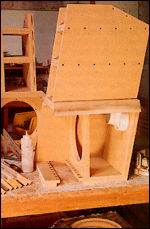
But don't assume for a moment that the cabinet is all glamor. This is one seriously solid speaker box. Assembly begins when two 4' by 8', 5/8"-thick sheets of MDF are hand-laminated together using a viscoelastic-damping industrial adhesive called Swedac. Swedac has a measured effect upon the absorption of vibration—Eggleston claims a solid 1.25" sheet of MDF has merely 1/10 the vibration loss of the two laminated sheets incorporating the adhesive. The laminated MDF is then milled on CNC machinery before the hand joinery commences. This, Eggleston points out, allows the company to set tolerances to within several thousandths of an inch. Driver chambers are connected using dado, rabbet, and biscuit joinery for great rigidity, with screws reinforcing the joints every 2".
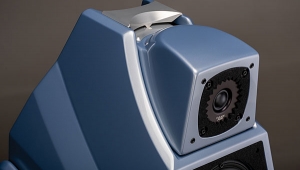
Laminating the acrylic finish to the cabinet adds another 1/8" of thickness to each wall, as well as another layer of dissimilar material for control of resonances. The granite, mitered to a "knife"-edge to minimize sidewall diffraction, attaches to what Eggleston refers to as "the upper torso" of the cabinet. Two different adhesive compounds are used, these chosen to combine strength and dissimilar resonant characteristics.
After the cabinet is assembled, T-nuts are driven through its base. These attach to plastic cups that serve as feet. Milled cones fit into the cups, so that once the speaker is properly placed, it can be spiked firmly to the floor.
Final finish involves the 12-step polishing process that gives the Andra its deep luster.
A wise son maketh a glad father
The Andra is such a completely personal design statement that it would be futile to try to describe it using the typically reductive drivers/loading/crossover model. Better to eavesdrop on its designer as he muses upon its evolution and construction . . .
 "My father taught me that if the midrange isn't right, the speaker isn't right; so our first decision in designing the Andra was the choice of the midrange driver—everything evolves from that. It's a custom version of a 6" polypropylene midbass driver from Morel that incorporates a 3" voice-coil and a double-center magnet.
"I first heard an early version of this driver about 15 years ago, when my father designed a speaker that used four of them. That speaker had about the best midrange I'd ever heard. From that point on, pretty much everything I designed utilized one incarnation or another of this driver.
"Its strengths are threefold. Because it uses a 6" cone and a 3" coil, all the motive force is coming from a point equidistant from the center and the circumference of the cone. This balance results in a more pistonlike action with great rigidity.
"It uses a very large winding out of heavier-gauge wire than would be used in a smaller coil. Obviously, this makes for a stronger motor and, assuming you have the right current, much greater control—greater ability to stop the cone from moving in the opposite direction. The stronger the motor, the more control you have over the extremes of excursion.
"And because the coil's so big, it can handle extremely high current output. Without that, we'd never be able to connect 6" drivers directly to the output of a power amplifier. Not even two of them—our use of two 6" drivers for the midrange was integral to achieving the midrange characteristics I demanded. I find that most speakers can clip on raucous solo piano if they use a single 6" speaker. I wanted no limit on the dynamic capabilities of the midrange, so I knew I needed to use two drivers."
But just because Eggleston knew in advance which driver he was going to employ, don't assume that amounted to a design shortcut. "Once we'd chosen that driver, we spent nine months just developing the crossover and the midrange loading. I didn't even look at woofers or tweeters until I had assured myself that I was getting everything out of the midrange that I could.
"The simplest, purest, most uncolored approach is free-air. Any dynamic speaker with a cabinet has to manipulate the back-wave. In a sealed-box design, you're tuning against a certain air-pressure to obtain a certain response characteristic. In a vented-box, you employ tuning to eliminate certain resonances. The only box where you have the same air pressure behind the driver as in front is the transmission line. In a transmission-line design, the line is equal to a quarter-wavelength of the resonant frequency of the driver. Usually you wrap the line so that the output comes out the front, in-phase with the output of the driver, which reinforces the bass output of the driver. We weren't interested in this characteristic—all we wanted was a free-air characteristic. And we didn't have room for two 5' transmission lines in the small cabinet we intended to build.
"So I re-evaluated the whole approach to transmission lines. I worked with the guy who subcontracts our stuffing material and we came up with "Acousta-Stuff," a polyester strand which is crimped every millimeter. This makes each strand a complex shape, capable of providing greater diffraction to the soundwaves traveling through it. The strands interlock, so it won't settle at all, either. This material seems to slow lower frequencies while attenuating the HFs. After a ton of trial-and-error experiments, I determined the equation of cabinet length to stuffing weight we needed for a quasi-transmission-line loading. I'm not aware of any other speaker that shares this loading system."
NEXT: Page 3 »
 | |||||||||||

|
|
| |||||||||
- Log in or register to post comments













| Loudspeakers Amplification Digital Sources | |
Analog Sources Accessories Featured | |
Music Columns Retired Columns | |
Show Reports | |
Features Latest News Community | |
Resources Subscriptions |
 © 2024 Stereophile
AVTech Media Americas Inc., USA
All rights reserved