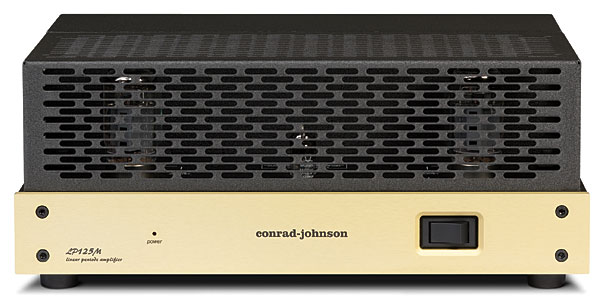
Now everything was fine, and remained so—until what was to be my last listening session with the LP125Ms. I turned on the system, and as soon as the amps came on there was a loud noise, like a persistent cough, from the left speaker. The noise subsided within a minute or so, but when I played a CD it was immediately apparent that something was wrong. There was now a marked channel imbalance, the left being much weaker than the right, and the sound took on a phasey quality. Switching interconnects between channels made no difference, so the problem was not with the signal source. Once again, I followed the ritual of switching tubes between amplifiers one at a time, and when I switched the tubes labeled V2 (a 6922), the right channel went silent. (With the same tube in the left-channel amp, the amp worked, but at a much-reduced volume. Strange.) Lew Johnson must have experienced a degree of trepidation when told I was on the line, but he cheerfully agreed to send me a new 6922 tube. The new tube arrived in a few days, and once again both amps worked properly.
Sound
Soft at the top. Lacking in low bass. A rich, warm sound, with homogenized timbres as a result of high harmonic distortion. If the above description corresponds with your idea of what a tube amplifier sounds like, then listening to the Conrad-Johnson LP125M will play havoc with any such preconceptions. With both the Monitor Platinum PL200 and the Avantgarde Uno Nano speakers, the LP125M sounded extended at the top, with lots of high-frequency "air" with recordings that possess such information, such as the jazz CDs from Chesky Records. The LP125M's highs were sufficiently extended to reveal the top-end peaks in the frequency responses of the microphones used to make old recordings, or the harshness of early digital transfers. Bass was deep and firm, the synthesizer note in track 7 of Mickey Hart's Planet Drum (CD, Rykodisc RCD 10206) falling just short of the room-shaking power evident with the Simaudio Moon Evolution W-7. There was none of the pervasive midbass warmth that, for some people, defines tube sound.
 In fact, judging by more or less standard sonic criteria, the LP125M and Moon W-7 were more similar than different. Just as the LP125M didn't conform to the stereotype of warm/soft/mushy tube sound, the W-7 didn't conform to the stereotype of bright/edgy/clinical solid-state sound. The LP125M was a touch softer on top, but not enough to obscure treble detail. Through the PL200, the slight treble softening was useful in dealing with the extra brightness that this speaker can sometimes exhibit. Soundstage depth and specificity of imaging were excellent with both amps (and both speakers)—José Carreras's tenor in Ariel Ramirez's Misa Criolla, conducted by José Luis Ocejo (CD, Philips 420 955-2), was unambiguously placed in the soundstage. Although I wouldn't describe the W-7 as sounding forward, the sound with the LP125Ms was a little more laid-back, putting more space between me and the musicians.
Switching back and forth between the two amplifiers (matching volume levels within 0.2dB, then "bracketing" the volume settings so that neither amplifier had a consistent volume advantage), my initial impressions suggested that the W-7 sounded more detailed, indicating a higher level of resolution. However, as I continued to listen I was led to conclude that the LP125M was just as detailed, but was a little more subtle in its presentation of those details. The cymbal at 0:55 in track 3 of the Chesky Records Jazz Sampler & Audiophile Test Compact Disc, Vol.1 (JD37) was present with the W-7 in a way that made it easier to follow the attack and decay of the instrument's transients—but the same sound through the LP125M, while less startling, had a timbre that was more authentically cymbal-like.
The LP125M had excellent dynamics, both in the "macro" sense of being able to deliver high volumes without sounding strained, and in the "micro" sense of communicating music's subtle ebb and flow. Last year, when I reviewed the Monitor Platinum PL200s, I tried using them with the Audiopax Model 88 single-ended-triode amps, which put out about 30W. However, it quickly became apparent that the 88s—which sound superb with the Uno Nanos—ran out of steam when trying to drive the PL200s at a high level. The LP125M showed no such limitation. When I turned up the volume to levels higher than I normally listen at, my ears threatened to give up while the LP125M was still going strong. Given the +100dB sensitivity of the Uno Nano, the 125W of the LP125M might seem overkill; but, arguably, just as the Uno Nano is merely coasting at normal playback levels, so is the LP125M—I never had to worry about the amplifier being driven to the clipping point.
Convincing reproduction of the human voice is very important to me—I'm a lover of singing, and a sometime singer myself—and perhaps the greatest strength of the LP125M was its natural-sounding presentation of voices. Piotr Beczala is a tenor I discovered fairly recently on, of all things, YouTube. His voice—it reminds me of those of Fritz Wunderlich and Nicolai Gedda—is primarily a lyric instrument, perfect for Mozart but with enough power and ring for Puccini and Verdi. A stylish and intelligent singer more intent on communicating the music than on merely showing off, Beczala, in his first solo release (accompanied by Ion Marin and the Munich Radio Symphony Orchestra), draws on material from the French and Italian repertoires. Salut! (CD, Orfeo C715081A) is no "World's Favorite Tenor Arias" collection, though it does include some of the expected pieces, such as Verdi's "La donna è mobile" and Donizetti's "Una furtiva lagrima," and Beczala's performances of them bear comparison with those of the great singers of the past. Listening to him singing Puccini's "Che gelida manina," first through the Uno Nanos driven by the Moon W-7, I was impressed by the sound as well as by the performance. When I switched to the LP125Ms, however, Beczala's voice seemed to acquire a more rounded quality, and I had more of a sense of listening to sounds made by an actual human being rather than to a reproduction involving multiple stages of electronics.
Conclusions
In fact, judging by more or less standard sonic criteria, the LP125M and Moon W-7 were more similar than different. Just as the LP125M didn't conform to the stereotype of warm/soft/mushy tube sound, the W-7 didn't conform to the stereotype of bright/edgy/clinical solid-state sound. The LP125M was a touch softer on top, but not enough to obscure treble detail. Through the PL200, the slight treble softening was useful in dealing with the extra brightness that this speaker can sometimes exhibit. Soundstage depth and specificity of imaging were excellent with both amps (and both speakers)—José Carreras's tenor in Ariel Ramirez's Misa Criolla, conducted by José Luis Ocejo (CD, Philips 420 955-2), was unambiguously placed in the soundstage. Although I wouldn't describe the W-7 as sounding forward, the sound with the LP125Ms was a little more laid-back, putting more space between me and the musicians.
Switching back and forth between the two amplifiers (matching volume levels within 0.2dB, then "bracketing" the volume settings so that neither amplifier had a consistent volume advantage), my initial impressions suggested that the W-7 sounded more detailed, indicating a higher level of resolution. However, as I continued to listen I was led to conclude that the LP125M was just as detailed, but was a little more subtle in its presentation of those details. The cymbal at 0:55 in track 3 of the Chesky Records Jazz Sampler & Audiophile Test Compact Disc, Vol.1 (JD37) was present with the W-7 in a way that made it easier to follow the attack and decay of the instrument's transients—but the same sound through the LP125M, while less startling, had a timbre that was more authentically cymbal-like.
The LP125M had excellent dynamics, both in the "macro" sense of being able to deliver high volumes without sounding strained, and in the "micro" sense of communicating music's subtle ebb and flow. Last year, when I reviewed the Monitor Platinum PL200s, I tried using them with the Audiopax Model 88 single-ended-triode amps, which put out about 30W. However, it quickly became apparent that the 88s—which sound superb with the Uno Nanos—ran out of steam when trying to drive the PL200s at a high level. The LP125M showed no such limitation. When I turned up the volume to levels higher than I normally listen at, my ears threatened to give up while the LP125M was still going strong. Given the +100dB sensitivity of the Uno Nano, the 125W of the LP125M might seem overkill; but, arguably, just as the Uno Nano is merely coasting at normal playback levels, so is the LP125M—I never had to worry about the amplifier being driven to the clipping point.
Convincing reproduction of the human voice is very important to me—I'm a lover of singing, and a sometime singer myself—and perhaps the greatest strength of the LP125M was its natural-sounding presentation of voices. Piotr Beczala is a tenor I discovered fairly recently on, of all things, YouTube. His voice—it reminds me of those of Fritz Wunderlich and Nicolai Gedda—is primarily a lyric instrument, perfect for Mozart but with enough power and ring for Puccini and Verdi. A stylish and intelligent singer more intent on communicating the music than on merely showing off, Beczala, in his first solo release (accompanied by Ion Marin and the Munich Radio Symphony Orchestra), draws on material from the French and Italian repertoires. Salut! (CD, Orfeo C715081A) is no "World's Favorite Tenor Arias" collection, though it does include some of the expected pieces, such as Verdi's "La donna è mobile" and Donizetti's "Una furtiva lagrima," and Beczala's performances of them bear comparison with those of the great singers of the past. Listening to him singing Puccini's "Che gelida manina," first through the Uno Nanos driven by the Moon W-7, I was impressed by the sound as well as by the performance. When I switched to the LP125Ms, however, Beczala's voice seemed to acquire a more rounded quality, and I had more of a sense of listening to sounds made by an actual human being rather than to a reproduction involving multiple stages of electronics.
Conclusions
Conrad-Johnson Design is one of the premier makers of audio equipment. All of their products are manufactured in the US and supported by a well-established dealer network, and the company has a reputation for standing behind what they make. I was bothered by the problems I experienced with the review samples of Conrad-Johnson's LP125M. First, there was the difficulty I had getting rid of a ground-loop–induced hum—and the solution involved a cheater plug, which, while often used by audiophiles, doesn't meet US or Canadian electrical codes. (In Canada, hardware stores are forbidden to even carry cheater plugs.) Then there's the fact that two of the tubes (one in each channel) developed problems, and one of them essentially failed. This was not the first time I've had such problems with tubed equipment—you might say that they come with the territory—and they were solved by simply replacing the defective tubes. Maybe it was just the bad luck that seems to plague review samples. (Manufacturers know that if a product is going to fail, it's likely to be in a reviewer's system.) The C-J preamps I've had in the past were all completely reliable. Still, it's disconcerting. Add the need to manually adjust the output tubes' bias potentiometers, and you can understand why many consider tube equipment "fussy."
Having said that, and with the grounding issue solved and the noisy/faulty tubes replaced, the LP125Ms turned in top-notch performance that was better in some respects than that of the similarly powered, similarly priced Simaudio Moon Evolution W-7, a solid-state amplifier that's listed in Class A of Stereophile's "Recommended Components."
I'm no great fan of slogans, but the description that kept occurring to me during my time with the LP125M was the one printed on its shipping carton: "It just sounds right." Putting aside the usual audiophile analytical descriptors, there's something fundamentally right about the sound of this amplifier. It's not a whiz-bang component that tries to impress with scintillating highs and thunderous lows—everything is there in proper proportion. It doesn't exaggerate the harshness present in many recordings, or that originates in other parts of the system—but it also doesn't gloss over those sonic artifacts. And it has enough power to drive all but the least sensitive speakers. The LP125M does indeed "just sound right."
Soft at the top. Lacking in low bass. A rich, warm sound, with homogenized timbres as a result of high harmonic distortion. If the above description corresponds with your idea of what a tube amplifier sounds like, then listening to the Conrad-Johnson LP125M will play havoc with any such preconceptions. With both the Monitor Platinum PL200 and the Avantgarde Uno Nano speakers, the LP125M sounded extended at the top, with lots of high-frequency "air" with recordings that possess such information, such as the jazz CDs from Chesky Records. The LP125M's highs were sufficiently extended to reveal the top-end peaks in the frequency responses of the microphones used to make old recordings, or the harshness of early digital transfers. Bass was deep and firm, the synthesizer note in track 7 of Mickey Hart's Planet Drum (CD, Rykodisc RCD 10206) falling just short of the room-shaking power evident with the Simaudio Moon Evolution W-7. There was none of the pervasive midbass warmth that, for some people, defines tube sound.
In fact, judging by more or less standard sonic criteria, the LP125M and Moon W-7 were more similar than different. Just as the LP125M didn't conform to the stereotype of warm/soft/mushy tube sound, the W-7 didn't conform to the stereotype of bright/edgy/clinical solid-state sound. The LP125M was a touch softer on top, but not enough to obscure treble detail. Through the PL200, the slight treble softening was useful in dealing with the extra brightness that this speaker can sometimes exhibit. Soundstage depth and specificity of imaging were excellent with both amps (and both speakers)—José Carreras's tenor in Ariel Ramirez's Misa Criolla, conducted by José Luis Ocejo (CD, Philips 420 955-2), was unambiguously placed in the soundstage. Although I wouldn't describe the W-7 as sounding forward, the sound with the LP125Ms was a little more laid-back, putting more space between me and the musicians.
Switching back and forth between the two amplifiers (matching volume levels within 0.2dB, then "bracketing" the volume settings so that neither amplifier had a consistent volume advantage), my initial impressions suggested that the W-7 sounded more detailed, indicating a higher level of resolution. However, as I continued to listen I was led to conclude that the LP125M was just as detailed, but was a little more subtle in its presentation of those details. The cymbal at 0:55 in track 3 of the Chesky Records Jazz Sampler & Audiophile Test Compact Disc, Vol.1 (JD37) was present with the W-7 in a way that made it easier to follow the attack and decay of the instrument's transients—but the same sound through the LP125M, while less startling, had a timbre that was more authentically cymbal-like.
The LP125M had excellent dynamics, both in the "macro" sense of being able to deliver high volumes without sounding strained, and in the "micro" sense of communicating music's subtle ebb and flow. Last year, when I reviewed the Monitor Platinum PL200s, I tried using them with the Audiopax Model 88 single-ended-triode amps, which put out about 30W. However, it quickly became apparent that the 88s—which sound superb with the Uno Nanos—ran out of steam when trying to drive the PL200s at a high level. The LP125M showed no such limitation. When I turned up the volume to levels higher than I normally listen at, my ears threatened to give up while the LP125M was still going strong. Given the +100dB sensitivity of the Uno Nano, the 125W of the LP125M might seem overkill; but, arguably, just as the Uno Nano is merely coasting at normal playback levels, so is the LP125M—I never had to worry about the amplifier being driven to the clipping point.
Conrad-Johnson Design is one of the premier makers of audio equipment. All of their products are manufactured in the US and supported by a well-established dealer network, and the company has a reputation for standing behind what they make. I was bothered by the problems I experienced with the review samples of Conrad-Johnson's LP125M. First, there was the difficulty I had getting rid of a ground-loop–induced hum—and the solution involved a cheater plug, which, while often used by audiophiles, doesn't meet US or Canadian electrical codes. (In Canada, hardware stores are forbidden to even carry cheater plugs.) Then there's the fact that two of the tubes (one in each channel) developed problems, and one of them essentially failed. This was not the first time I've had such problems with tubed equipment—you might say that they come with the territory—and they were solved by simply replacing the defective tubes. Maybe it was just the bad luck that seems to plague review samples. (Manufacturers know that if a product is going to fail, it's likely to be in a reviewer's system.) The C-J preamps I've had in the past were all completely reliable. Still, it's disconcerting. Add the need to manually adjust the output tubes' bias potentiometers, and you can understand why many consider tube equipment "fussy."