The B99's dispersion in the vertical plane (fig.5) features a sharp notch at the upper crossover frequency for standing listeners, but the response doesn't change significantly as long as the speaker is auditioned on an axis between the centers of the two midrange units. (Ignore the smooth rise above 15kHz in the second trace from the bottom, which I believe is due to an averaging error when I took the measurement: I measure outdoors, and minuscule differences in path length due to slight breezes can lead to such errors.) At extreme off-axis vertical angles, the ribbon's output is well-suppressed in the top two octaves, due to its radiating dimension in this plane being very much greater than the wavelengths of the sound in this frequency region.  Fig.5 Burmester B99, vertical response family at 50", from back to front: differences in response 20 degrees-5 degrees above tweeter axis, reference response, differences in response 5 degrees-10 degrees below tweeter axis. In the time domain, the B99's impulse response (fig.6) is conventional and clearly shows the unavoidable floor reflection 3ms after the initial pulse. This reflection can also be seen in the step response (fig.7), but more important, this graph reveals that both tweeter and midrange units are connected in inverted acoustic polarity. The woofers, however, whose contribution can barely be made out at the far right of the graph, are connected in positive acoustic polarity.
 Fig.6 Burmester B99, impulse response on tweeter axis at 50" (5ms time window, 30kHz bandwidth).
 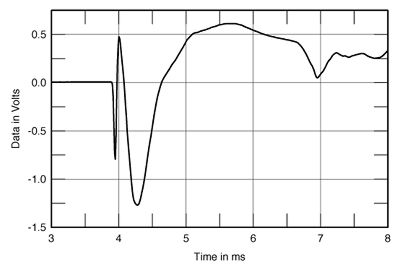 Fig.7 Burmester B99, step response on tweeter axis at 50" (5ms time window, 30kHz bandwidth). Finally, the B99's cumulative spectral-decay plot (fig.8) is superbly clean. Note that the presence of the floor reflection meant that I had to aggressively window the impulse response to produce this graph. The area where this windowing results in invalid data is shown dotted; fortunately, the B99's treble output has already dropped below the graph's floor long before this point.
  Fig.8 Burmester B99, cumulative spectral-decay plot at 50" (0.15ms risetime). Overall, this is superb measured performance for which no excuses need be made.—John Atkinson
Fig.5 Burmester B99, vertical response family at 50", from back to front: differences in response 20 degrees-5 degrees above tweeter axis, reference response, differences in response 5 degrees-10 degrees below tweeter axis. In the time domain, the B99's impulse response (fig.6) is conventional and clearly shows the unavoidable floor reflection 3ms after the initial pulse. This reflection can also be seen in the step response (fig.7), but more important, this graph reveals that both tweeter and midrange units are connected in inverted acoustic polarity. The woofers, however, whose contribution can barely be made out at the far right of the graph, are connected in positive acoustic polarity. Fig.6 Burmester B99, impulse response on tweeter axis at 50" (5ms time window, 30kHz bandwidth). Fig.7 Burmester B99, step response on tweeter axis at 50" (5ms time window, 30kHz bandwidth). Finally, the B99's cumulative spectral-decay plot (fig.8) is superbly clean. Note that the presence of the floor reflection meant that I had to aggressively window the impulse response to produce this graph. The area where this windowing results in invalid data is shown dotted; fortunately, the B99's treble output has already dropped below the graph's floor long before this point. Fig.8 Burmester B99, cumulative spectral-decay plot at 50" (0.15ms risetime). Overall, this is superb measured performance for which no excuses need be made.—John Atkinson