Audioquest’s Diamond USB

Audioquest formally released their current top-of-the-line reference USB cable at CES, the Diamond USB ($650/1.5m). The cable’s conductor is solid-core, perfect-surface silver (100% silver).

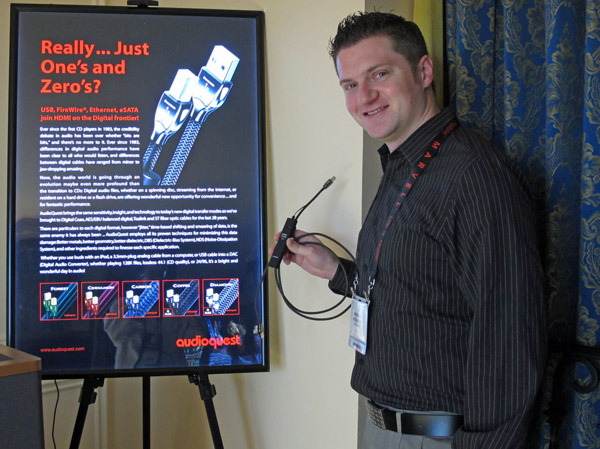
A key feature of the Diamond USB, which is held in the photo by Audioquest’s Andrew Kissinger, is the Audioquest DBS (dielectric bias system). Invented and patented by Richard Vandersteen, with the cable version co-patented by Vandersteen and Audioquest’s Bill Low, the DBS creates an electrostatic field that saturates and polarizes the molecules of the insulation to minimize energy storage in the dielectric. The result is claimed to be much greater dynamic range, lower background noise, and reduced phase distortion.

Steve Silberman, VP of Marketing, explained that all insulators have capacitance. Energy from the conductor enters the insulation and needs to discharge. The DBS’ electrostatic field lowers the discharge, which in turn lowers the amount of phase distortion and makes for a cleaner signal.

In a very short demo, Silberman compared music through a stock USB cable that came with his printer to music through the Diamond. Using the new Arcam R asynchronous USB DAC, Arcam AVR 600 receiver, AQ Niagra interconnects ($1600/1m pair), AQ Redwood speaker cables ($2300/3ft pair), and Vandersteen 2Ce 30th anniversary edition speakers, the difference in transparency and color was striking.

Share | |
Comments
Lazzmatazz's picture
Audioquest’s Diamond USB

I think I know what causes that striking difference in transparency. The Diamond USB cable is lubricated with snake oil, which makes the electrons travel faster and more smoothly, with fewer bumps on the road.

Trevoire520's picture
Just one's and zero's? YES!

Just one's and zero's?

YES! REALLY!

IT'S DIGITAL DATA! IT IS LITERALLY A BUNCH OF ONES AND ZERO'S!
As long as the cable isn't broken then it's not going to make a blind bit of difference in what comes out of the other end.

Also, something in audio being transparent is generally considered the opposite to being coloured. So how can a cable add transparency and colour at the same time?

All this audiophile nonsense is a scam, designed to do nothing more than empty the wallets of those who are daft enough to buy into whatever marketing spiel they read.

Johnny2Bad's picture
No 1's and 0's in digital

The cable may or may not be snake oil, but regardless, it's not because it's "literally a bunch of ones and zero's". There are no 1's and 0's when we store, manipulate, or transmit digital data.

What there is, is some form of signal that represents 1's and 0's.

If we assume the signal is some kind of voltage, there won't be 0 voltage representing the binary zero and there won't be some other maximum voltage representing the binary 1.

A crude analogy ... if the acceptable maximum voltage on a digital transmission protocol is 800 mV, then the 1's may be represented by 600 mV and the 0's may be represented by 300 mV. A zero voltage will never be used ... everything electronic is too non-linear at the minimum and maximum (that's why we bias transistors).

A signal of 450 mV in that case would have to be accepted as one or the other binary number. Errors arrive when the signals stray too close to the threshold where one state becomes another.

If we used a true zero voltage as representing the binary 0, then certain types of noise would be interpreted as 1's. So we don't.

In practical terms, although the above is used, what is more common is the use of states. A signal is transmitted when the state changes. So a signal of some kind indicates "change from whatever state you were on (could have been a 1 state, could have been the 0 state) to the other one, and stay there until I tell you to change again." Whether its within the CPU or via a cable transmitting digital data, all this happens in a stubbornly analog world.

nrostov's picture
RE: My God Someone With a Brain

Dear Johnny2Bad,

Thank you for your very well though out, erudite, response to yet another one of the "it's just one's and zero's" comments.

I don't know what your background is, but I build computers as a hobby, was a science major in college, and groan everytime I hear that same rebuttal over and over again about cables.  

As you said, digital data, on a fundamental level, deals with voltages, and on an even more fundamental level electrons or charged particles.

I sometimes wonder if people picture actual 1's and 0's flying down their cables.

Anyway, great answer!

simontam's picture
CABLE'S DO MAKE A DIFFERENCE!

I used to think that all the hype around cables was snake oil. however i was wrong the switch to the audioquest diamond made a very audible improvement in my system. i switched usb cable back and forth many times over a two month period and there is no doubt that the diamond made a very audible improvement over the wireworld starlight usb cable and the starlight was a big step up from a generic usb cable.

Site Map / Direct Links