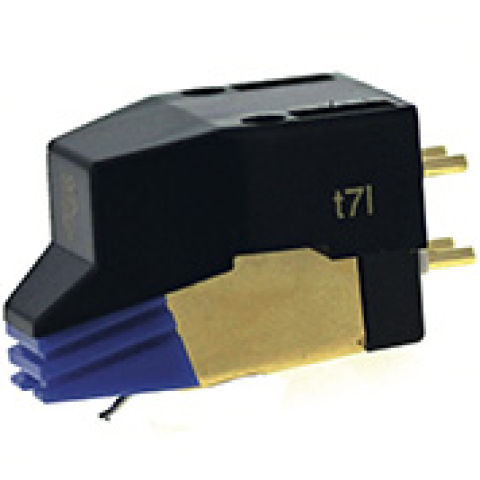
Every now and then an affordable product comes along that's so good, even wealthy shoppers want it. Past examples in domestic audio include the Rega RB300 tonearm, the original Quicksilver Mono amplifier, the Grace F9E phono cartridge—even Sony's unwitting CD player, the original PlayStation. Based on word of mouth alone, one might add the HRT Music Streamer+ to that lauded list.
 Designed by Kevin Halverson and manufactured in the US by High Resolution Technologies, the Music Streamer+ is a $299 outboard device that enables the use of a personal computer as a digital music source in a perfectionist system. The MS+ does so by collecting the music datastream that appears at the computer's Universal Serial Bus—whether originating as an Internet broadcast signal, a downloaded music file, or a CD, the last either ripped to the computer's hard disk or played in real time from its optical drive—and converting it to a stereo pair of line-level analog signals.
The Music Streamer+ isn't the first USB digital-to-analog converter I've written about in these pages, and I hope and presume it won't be the last: I'm not just sold on the concept, I'm enduringly anxious to find out how well it can be realized—and for how small a price!
Description
Designed by Kevin Halverson and manufactured in the US by High Resolution Technologies, the Music Streamer+ is a $299 outboard device that enables the use of a personal computer as a digital music source in a perfectionist system. The MS+ does so by collecting the music datastream that appears at the computer's Universal Serial Bus—whether originating as an Internet broadcast signal, a downloaded music file, or a CD, the last either ripped to the computer's hard disk or played in real time from its optical drive—and converting it to a stereo pair of line-level analog signals.
The Music Streamer+ isn't the first USB digital-to-analog converter I've written about in these pages, and I hope and presume it won't be the last: I'm not just sold on the concept, I'm enduringly anxious to find out how well it can be realized—and for how small a price!
Description
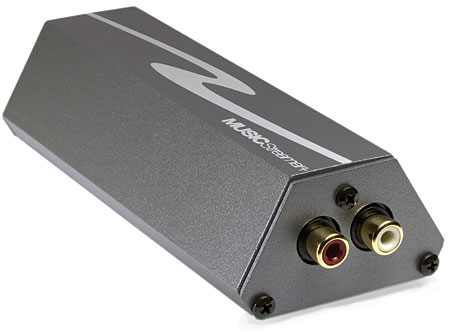
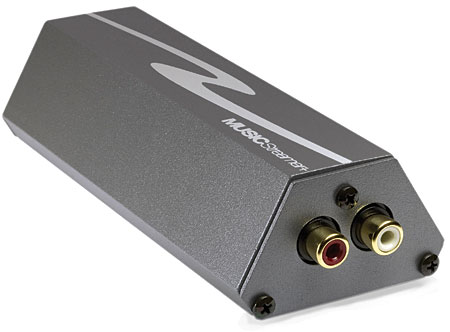
The Music Streamer+ is housed in an extruded-alloy sleeve roughly the size and shape of a remote-control handset. All of its component parts reside on either a 5"-long motherboard or a smaller sub-board, the latter held in place with standoffs and a pair of machine screws. Fit and finish are quite decent—better, in fact, than I would have expected for the price. Happily, neither an AC adapter nor batteries are required: The MS+ gets the power it needs from the computer to which it's connected, via the USB bus itself. (Having consigned to pasture my once-ardent interest in computers, I hadn't realized until now that a USB port can provide peripheral devices with 5V, at up to half an amp of current.) The MS+ uses its own proprietary switch-mode circuitry to create a 10V bipolar supply (swinging from –5 to +5V). According to designer Kevin Halverson, that power supply also provides complete isolation between the product's digital and analog stages. Halverson also offered some insights about the product's digital architecture: near the product's USB input socket is a PCM2706 D/A converter, which is made specifically for USB applications. But that 16-bit chip is used only as a USB transceiver: The actual conversion is done further downstream, by the higher-quality, 24-bit PCM1794—which also applies its own 8x-oversampling digital filtering. Completing the picture are dual-differential NE5534 op-amps for current-to-voltage conversion and a separate dual–op-amp driver, the latter a high-quality Burr-Brown OPA2132.
Setup and installation
I used the HRT Music Streamer+ with my Apple iMac, running the OSX10.5.4 operating system. Various USB cables were called into play (see below), and I made the connection straight-in to one of the computer's Type A USB sockets, as opposed to an external hub. Apple iTunes 8.0.2 was my music software of choice, for playback as well as for ripping CDs to the hard disk. (Most of the music on my computer is in the form of AIFF files.) Sadly, Internet radio isn't yet a viable source for me, given my home's rural setting and its lack of high-speed alternatives to dial-up. Installation was simplicity itself. My iMac recognized the review sample as soon as I connected its USB cable: "Music Streamer+" appeared among the list of sound output devices in the computer's System Preferences window, so all I had to do was click on that name and close the window. Within an hour or two of being selected, the MS+ became very slightly warm to the touch; powering down the computer or selecting a different output device had the effect of powering down the new converter. Incidentally, during the review period I often found myself switching back and forth between the MS+ and other D/A converters, often several times in a given session. In theory, that should pose no difficulties, given that the provision for "hot-swapping" peripherals without needing to reboot is among the advantages of USB over other connection schemes. Still, there were two or three instances when, after several successive swaps, my computer no longer recognized the sound output device to which it was connected—a problem that a hard reboot never failed to solve. In accordance with the USB 1.1 standard employed by HRT, data cables up to 5m long can be used without the risk of signal degradation from digital timing errors. With that in mind, I alternated between an inexpensive 5m cable—from my local RadioShack!—and a 2m Kimber B Bus cable for the trip between the Music Streamer+ and my Apple. I couldn't hear any difference at all between the two. I did, however, hear subtle distinctions between different analog interconnect cables used between the MS+ and my Shindo preamplifier: the same as I'd expect to hear from cables used with any high-quality components. Although using an expensive cable with a $299 product would seem incongruous at best, prospective owners are nonetheless advised to shop carefully.
Listening
Speaking of incongruities, one might also blush at the thought of comparing any budget product with one that costs 12 times as much. For better or worse, that's what happened when I pitted HRT's Music Streamer+ ($299) against the Wavelength Cosecant USB D/A converter ($3500). The motorist whose first car was a Ferrari can be forgiven a certain perspective; happily, the Music Streamer+ proved to be more Mazda Miata than Dodge Neon.
Designed by Kevin Halverson and manufactured in the US by High Resolution Technologies, the Music Streamer+ is a $299 outboard device that enables the use of a personal computer as a digital music source in a perfectionist system. The MS+ does so by collecting the music datastream that appears at the computer's Universal Serial Bus—whether originating as an Internet broadcast signal, a downloaded music file, or a CD, the last either ripped to the computer's hard disk or played in real time from its optical drive—and converting it to a stereo pair of line-level analog signals.
The Music Streamer+ isn't the first USB digital-to-analog converter I've written about in these pages, and I hope and presume it won't be the last: I'm not just sold on the concept, I'm enduringly anxious to find out how well it can be realized—and for how small a price!
The Music Streamer+ is housed in an extruded-alloy sleeve roughly the size and shape of a remote-control handset. All of its component parts reside on either a 5"-long motherboard or a smaller sub-board, the latter held in place with standoffs and a pair of machine screws. Fit and finish are quite decent—better, in fact, than I would have expected for the price. Happily, neither an AC adapter nor batteries are required: The MS+ gets the power it needs from the computer to which it's connected, via the USB bus itself. (Having consigned to pasture my once-ardent interest in computers, I hadn't realized until now that a USB port can provide peripheral devices with 5V, at up to half an amp of current.) The MS+ uses its own proprietary switch-mode circuitry to create a 10V bipolar supply (swinging from –5 to +5V). According to designer Kevin Halverson, that power supply also provides complete isolation between the product's digital and analog stages. Halverson also offered some insights about the product's digital architecture: near the product's USB input socket is a PCM2706 D/A converter, which is made specifically for USB applications. But that 16-bit chip is used only as a USB transceiver: The actual conversion is done further downstream, by the higher-quality, 24-bit PCM1794—which also applies its own 8x-oversampling digital filtering. Completing the picture are dual-differential NE5534 op-amps for current-to-voltage conversion and a separate dual–op-amp driver, the latter a high-quality Burr-Brown OPA2132.
I used the HRT Music Streamer+ with my Apple iMac, running the OSX10.5.4 operating system. Various USB cables were called into play (see below), and I made the connection straight-in to one of the computer's Type A USB sockets, as opposed to an external hub. Apple iTunes 8.0.2 was my music software of choice, for playback as well as for ripping CDs to the hard disk. (Most of the music on my computer is in the form of AIFF files.) Sadly, Internet radio isn't yet a viable source for me, given my home's rural setting and its lack of high-speed alternatives to dial-up. Installation was simplicity itself. My iMac recognized the review sample as soon as I connected its USB cable: "Music Streamer+" appeared among the list of sound output devices in the computer's System Preferences window, so all I had to do was click on that name and close the window. Within an hour or two of being selected, the MS+ became very slightly warm to the touch; powering down the computer or selecting a different output device had the effect of powering down the new converter. Incidentally, during the review period I often found myself switching back and forth between the MS+ and other D/A converters, often several times in a given session. In theory, that should pose no difficulties, given that the provision for "hot-swapping" peripherals without needing to reboot is among the advantages of USB over other connection schemes. Still, there were two or three instances when, after several successive swaps, my computer no longer recognized the sound output device to which it was connected—a problem that a hard reboot never failed to solve. In accordance with the USB 1.1 standard employed by HRT, data cables up to 5m long can be used without the risk of signal degradation from digital timing errors. With that in mind, I alternated between an inexpensive 5m cable—from my local RadioShack!—and a 2m Kimber B Bus cable for the trip between the Music Streamer+ and my Apple. I couldn't hear any difference at all between the two. I did, however, hear subtle distinctions between different analog interconnect cables used between the MS+ and my Shindo preamplifier: the same as I'd expect to hear from cables used with any high-quality components. Although using an expensive cable with a $299 product would seem incongruous at best, prospective owners are nonetheless advised to shop carefully.
Speaking of incongruities, one might also blush at the thought of comparing any budget product with one that costs 12 times as much. For better or worse, that's what happened when I pitted HRT's Music Streamer+ ($299) against the Wavelength Cosecant USB D/A converter ($3500). The motorist whose first car was a Ferrari can be forgiven a certain perspective; happily, the Music Streamer+ proved to be more Mazda Miata than Dodge Neon.