| Columns Retired Columns & Blogs |

RME Digi96/8 Pro computer soundcard
In the early days of digital audio, I remember talking with Dr. Tom Stockham, the developer of the groundbreaking Soundstream system used then by Telarc. As well as using a 50kHz sample rate, the excellent-sounding Soundstream stored its 16-bit data on large drum-shaped Winchester drives connected to a minicomputer. Twenty years later, the advent of ultra-high-density magnetic storage media and fast microprocessor chips has put high-resolution digital audio manipulation and storage within reach of anyone with a modern PC or Mac. And facilitating the transformation of the PC into a high-quality DAW has been a new generation of soundcards, such as the Digital Audio Labs CardDeluxe I reviewed in September 2000 and the subject of this review, the German RME Digi96/8 Pro.
Footnote 1: For details on HPW Works v.2.70.004, which is available in a Lite version for $69, a 16-bit Full version for $200, or a 24-bit Pro version for $300, visit hpw-works.
 Pro Digital Audio
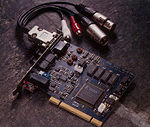
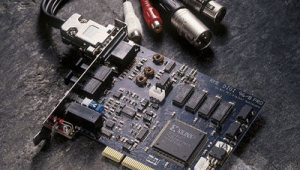
The Digi96/8 Pro is a small printed-circuit card that fits in one of the PCI slots in a PC or a Power Mac. It was recommended to me by a Swiss programmer, Hans-Peter Widmer, who has developed a suite of FFT-based audio measurement tools (footnote 1) that make use of it. As well as using it to evaluate the Widmer software, I found the RME card an excellent way of adding digital audio to my PC.
The Digi96/8 Pro is a development of an earlier RME card, the Digi96 (no longer available), which offered just digital I/O. The Pro adds a 96kHz-capable unbalanced stereo analog output, on a standard tip-ring-sleeve ¼" jack. (The tip is the left channel, the ring the right.) The analog section is specified as using 20-bit DACs, and a rear pushbutton switches between a full-scale output of +4dBu or -10dBV. Additional 6dB attenuation steps are available via the driver program, and the latest version of the card offers a stepless, software-controlled volume control to make it easy to set playback level for headphones.
A full complement of digital inputs and outputs is available—TosLink optical, S/PDIF electrical, and AES/EBU electrical—with the electrical data interfaces transformer-coupled to separate the computer's noisy electrical ground from the ground of the downstream playback gear. Because of the lack of real estate on the slim card panel, the electrical I/O is via a miniature D connector; also supplied is an adapter with short flying leads terminated in RCA in-line jacks and male/female XLRs. The optical I/O can be used to send audio data to and from an 8-track ADAT MDM recorder, and convert between ADAT and S/PDIF formats. The Digi96/8 Pro can also handle a non-audio bitstream, such as a Dolby AC-3-encoded 5.1 soundtrack.
For monitoring while recording, the Digi96/8 Pro offers "zero latency," ie, no time delay, this achieved by hard-switching the digital input data to the output. The card also offers what RME calls "Enhanced Full Duplex" operation, in which simultaneous record and playback are possible, even if the input and output data have different sample rates!
Installation & Setup
Installing the Digi96/8 Pro was painless; Windows 98's plug'n'play wizard recognized the new hardware and installed the driver. It was then just a matter of selecting the RME card's digital I/O as the preferred Record and Playback devices in the Windows Control Panel's Multimedia menu. Every time the computer is turned on, the RME card performs a hardware self-test.
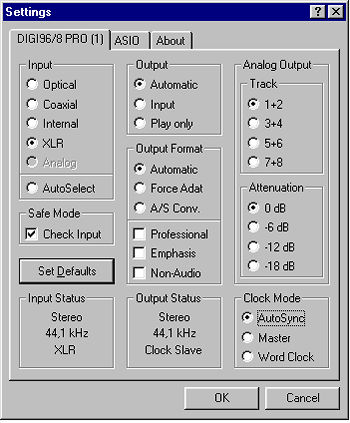
RME Driver software (v4.4) setup screen
On rebooting the computer after installation, a small green icon appears on the task bar; a single click opens the card's control panel, shown in the screen shot. At the top left of the screen is a self-explanatory section for selecting the digital input. When AutoSelect is on, the card switches between its inputs every half-second, stopping when it finds a valid signal. (A red LED on the card's panel lights up until lock is obtained.) The format of the data found on the chosen input is shown at the bottom left of the display. When set to Automatic, the output monitors either the digital input or—if Play is selected on the chosen audio program—the internal data playback. (To us old guys with memories of three-head tape decks, the monitor switching is intuitive.)
Footnote 1: For details on HPW Works v.2.70.004, which is available in a Lite version for $69, a 16-bit Full version for $200, or a 24-bit Pro version for $300, visit hpw-works.
NEXT: Page 2 »
 | |||||||||||

|
|
| |||||||||
- Log in or register to post comments










| Loudspeakers Amplification Digital Sources | |
Analog Sources Accessories Featured | |
Music Columns Retired Columns | |
Show Reports | |
Features Latest News Community | |
Resources Subscriptions |
 © 2024 Stereophile
AVTech Media Americas Inc., USA
All rights reserved