I was stumbling through the Denver Convention Center at CEDIA 2006 when I spotted John Franks, of Chord Electronics, and Jay Rein, of Chord's US importer, Bluebird Music, stranded in the basement purgatory for "niche" products. I couldn't resist asking, "What sin relegated you guys to this little hell?"
"Practicing two-channel without a license," riposted Rein, before going on to describe Chord's new 6TB Media Engine music server. "But we didn't bring it. We brought—this."
 He'd been blocking my view of Chord's table. Now he moved aside and made a flourish toward the Blu, the DAC64, and the 2HIGH, all gleaming there seductively.
My eyes widened. My nostrils flared. I did everything short of snort, paw the ground, and run my trembling hands along these products' well-formed flanks. Gosh, what sexy beasts.
"How . . . how . . . how . . . ," I stammered.
"How much?" Jay asked. "All three components total $17,500."
"No—I mean, how . . . how . . . how . . . " I felt like a teenager asking for the keys to dad's Healey Sprite.
"How do you get to audition one? All you have to do is ask."
What the heck did he think I was trying to do?
I've heard there was a secret chord
He'd been blocking my view of Chord's table. Now he moved aside and made a flourish toward the Blu, the DAC64, and the 2HIGH, all gleaming there seductively.
My eyes widened. My nostrils flared. I did everything short of snort, paw the ground, and run my trembling hands along these products' well-formed flanks. Gosh, what sexy beasts.
"How . . . how . . . how . . . ," I stammered.
"How much?" Jay asked. "All three components total $17,500."
"No—I mean, how . . . how . . . how . . . " I felt like a teenager asking for the keys to dad's Healey Sprite.
"How do you get to audition one? All you have to do is ask."
What the heck did he think I was trying to do?
I've heard there was a secret chord
The Choral Blu and DAC64 are a wee bit different from other transport-DAC combinations. As part of Chord's Choral series of components, each is a lozenge milled from a solid billet of aluminum and measuring a compact 13.1" W by 4.1" H by 6.6" D. My audition samples came anodized and polished in a deep, lustrous black (15% upcharge).
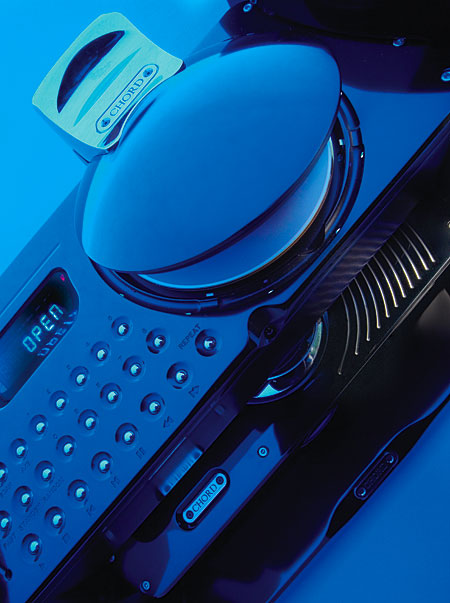
The top-loading Choral Blu ($10,400) has a large, spring-loaded clamshell disc cover dominating its right third, and an illuminated display set above 25 buttons to its left. Mirroring the Blu's look, the Choral DAC64 ($5000) has a "porthole" lens over one of its circuit boards. To the porthole's left, two arcs of six holes each are bored into the chassis like open parentheses. The Choral 2HIGH rack ($2100) holds the Blu and DAC64 stacked, um, two high—and canted at a 30° angle.
As striking as all this is, it's what's inside that's really fancy. The transport is a Philips CD2 powered by a switch-mode power supply that has its own AC filter. The Blu can upsample digital signals to 88.2kHz or 176.4kHz before sending them to a Watts Transient Aligned (WTA) filter. Chord says it has taken them 20 years to develop the WTA filter—and to figure out why higher sampling rates sound better. "It's not ultrasonic information," said John Franks. "If it was that, then 768kHz recordings could not sound better than 384kHz recordings—there's no information above 200kHz that could even be captured by our recording equipment."
There's a problem with upsampling to 176kHz, however: the S/PDIF pipeline can't accommodate a datastream that dense. Chord solves this by outputting each channel on its own BNC-terminated S/PDIF link. There are also AES/EBU and optical outputs. You can set dither to 16 or 24 bits, and there is a word-clock option, should you happen to have one in your system. (I don't either, but Chord sells a lot of gear to recording studios, so it's there if they need it.) The DAC64 can accept digital signals at 44.1kHz, 88.2kHz, or 176.4kHz. (JA reviewed an earlier version of the DAC64 in July 2002.)
So what are the benefits of high sample rates?
"What we're hearing is better resolution of transient information, which is something that human beings have evolved to being very good at detecting," said Franks. "A sampling rate of 1MHz would be ideal for capturing this, but it can be done at 44.1kHz with digital filtering—as long as you have sufficiently long tap lengths."
Beg pardon?
"Reconstruction filters generally have short tap lengths—the longest manufactured is only about 256 taps. We've constructed field-programmable gate-arrays (FPGA) that are 1024 taps long, which suggested that infinite tap length would produce 'indistinguishably perfect' sound quality. More practically, we developed a WTA filter with a 64-bit DSP core."
But wait, isn't there a WTA filter in the Blu, too? Yup—they built it, they're gonna use it. The DAC64 then sends the signal to a pulse-array DAC, which applies 64-bit seventh-order noise shaping and 2048x oversampling with "improved pulse-width modulation elements."
I was reeling at all the information I was downloading from Franks—my mind needs a bigger buffer.
He'd been blocking my view of Chord's table. Now he moved aside and made a flourish toward the Blu, the DAC64, and the 2HIGH, all gleaming there seductively.
The Choral Blu and DAC64 are a wee bit different from other transport-DAC combinations. As part of Chord's Choral series of components, each is a lozenge milled from a solid billet of aluminum and measuring a compact 13.1" W by 4.1" H by 6.6" D. My audition samples came anodized and polished in a deep, lustrous black (15% upcharge).