| Columns Retired Columns & Blogs |

Nagra CDP CD player
Audiophiles are frequently accused of being more in love with gizmos than with music. There may be a kernel of truth in that, but a scant few companies actually exploit the giz factor to give you mo'—a lot mo'.
One manufacturer rises above the rest when it comes to invoking sheer gizmoidal lust: Nagra. Since 1951, the Swiss firm has built the gear that professional recordists in the broadcast and film industries have turned to when they couldn't afford to risk using more temperamental components. Nagras were built to work in the field, and to keep working. Hang out with anthropologists and newsmen and you'll hear tales of Nagra Es and Nagra IVs that survived burial in snowdrifts, artillery near-misses, and being run over by tanks.
As if utility weren't enough, Nagra gear tends to be gorgeous as well. In a review in the January 1996 Stereophile, John Atkinson described the Nagra-D open-reel digital recorder as "a small, elegant, immaculately engineered expression of form-follows-function...[that] works as anyone with any recording experience would wish; nothing is unnecessary; every component is designed with an eye to how well it needs to be engineered to fulfill its function; the result is maximum quality, both physical and sonic."
Nagra's CDP CD player ($13,495) doesn't record, but otherwise, JA's description fits it to a T—a shiny, lust-invoking T.
By concentrating on precision, one arrives at technique...
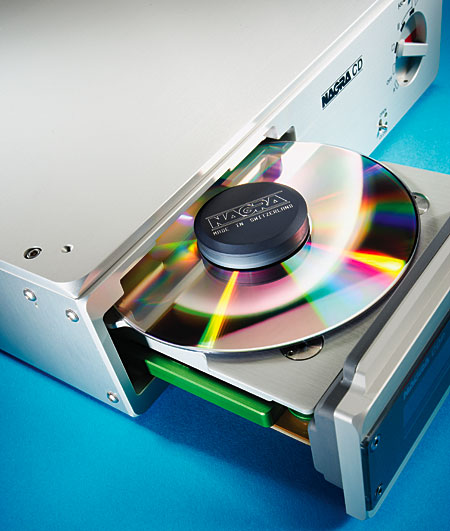
The CDP is a compact (12.2" W by 3" H by 10" D), front-loading player with an outboard power supply that feeds it 12V DC. The brushed-aluminum chassis is almost plain; the main focus is on the front and rear panels. Up front sits what Nagra calls the "mono-block tray," which houses not only the disc drawer but the entire drive mechanism and the backlit LCD display as well. The mechanism slides in and out of the CDP on drawer rails with Swiss horological precision (there, got that out of the way). Also present on the faceplate are three really small switches: display on/off, open/close, and skip. In typical Nagra fashion, there's also a large, mechanical, rotary function switch. This has the usual icons for play, stop, and pause, plus one labeled Off and one cryptically marked "R." That stands for Remote, as I discovered when I finally read the manual in an attempt to discover why the CDP's remote control wasn't working. D'oh!
The rear panel accommodates balanced XLR and RCA analog connections, as well as coaxial S/PDIF, AES/EBU, and TosLink digital. (The outputs can be moved to the traditional Nagra side-mounted position.) The ACPS II power supply connects to the CDP via a three-pin Lemo locking connector. There's also a ground connection, linked directly to the CDP's case.
...but by concentrating on technique one does not arrive at precision
Nagra says they pondered long and hard when deciding which formats their digital front-end products should support. (There are also the CDC CD player-preamplifier, for $14,995, and the CDT transport, for $12,495.) They focused on CD for several reasons, chief among them that they felt universal players "accumulate solutions of compromise and cannot therefore excel in any of the three standards." Furthermore, they say, SACD and DVD-Audio never achieved "the intended success and one could question whether they will truly penetrate the market one day."
In addition to CD enjoying the lion's share of the market, Nagra feels the format has never stopped progressing throughout its 24-year lifespan. "Recordings, often themselves of excellent quality, cover all styles of music, and the number of available titles is always increasing, and represents an important factor in itself for format longevity."
The actual transport module in the CDP's mono-block tray is a Philips CD-Pro2M, which is used stock, other than Nagra's addition of their own suspension system and locking disc weight. The electronics were all developed in-house by Nagra, starting with PLL resynchronization of the signal and low-jitter, high-precision, voltage-controlled crystal oscillators (VCXOs). The resynced signal is fed to an 8x-oversampling Burr-Brown sigma-delta D/A converter and thence to Burr-Brown output devices.
The ACPS II power supply contains not only the AC transformer, but the regulator and smoothing circuits as well. It outputs 12V DC to the CDP via a ferrite-treated cable. The CDP itself has nine discrete power supplies: the digital circuits use decoupling converters, synchronized to the reference clock of the transport module, while the analog boards use additional low-noise regulators.
The program code is stored on flash EPROM and can be updated at the Nagra factory. The bits'n'bobs are all prime quality: the printed-circuit boards are multilayer, with separate power and ground planes. Capacitors are from Wima; the rotary control is from Elma.
Precision: 6" to the right and Lincoln would have seen the end of the play
Setting up the CDP was relatively simple. The mono-block tray glides along its rails with so little friction that the CDP is shipped with four transport bolts locking it in place. These, of course, must be removed before you use the player. (After that, Nagra advises that you just tilt the player's rear panel down while carrying it around the house.) As with all CD players that come with disc clamps, you need to develop good habits for storing and remembering to use that little sucker (probably not much of an issue for folks who don't change gear as much as I do).
One feature that Nagra's literature doesn't mention but that I found quite thoughtful: the three red interior LEDs that illuminate the tray when it opens, making disc placement easier. I found the remote control a bit of a letdown, however; the numeric pad didn't seem to give me direct access to tracks—I had to keep hitting Next to navigate discs. This isn't something that I really need when listening to (as opposed to comparing) CD players, but coupled with the LED display's small letters, it made cross-room navigation hard for this vision-impaired old fogey.
NEXT: Page 2 »
 | |||||||||||

|
|
| |||||||||
- Log in or register to post comments






| Loudspeakers Amplification Digital Sources | |
Analog Sources Accessories Featured | |
Music Columns Retired Columns | |
Show Reports | |
Features Latest News Community | |
Resources Subscriptions |
 © 2024 Stereophile
AVTech Media Americas Inc., USA
All rights reserved