It is so tempting. With just a couple of snips of the scissors and swipes of the paste brush, I could insert the introduction from my April 2000 review of Arcam's FMJ A22 integrated amplifier here, change a detail or two, and be done with it. After all, it's the same story: British manufacturer gives highly praised product a slick new case to entice those who find their Alpha line too downscale in appearance, adds a few internal tweaks to make it a bit more interesting, and kicks the price up by $400. But I won't. 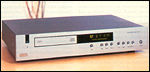 Description
The Arcam FMJ CD23 is the Full Metal Jacket version of the Alpha 9 CD player, much adored by Kalman Rubinson in the January 1999 Stereophile. The FMJ treatment, also applied to the aforementioned integrated amplifier (based on the Alpha 10) and its companion two- or three-channel amplifier, the FMJ P25 (based on the Alpha 10P), is most obviously defined by the new cosmetics. Instead of the Alpha 9's molded-plastic front panel, the FMJ CD23 features an elegant, precision-machined, satin-finished, 8mm-thick slab of aluminum. But the new features are more than skin-deep. The new chassis is made from a tri-laminate material from Swedish vibration-damping specialists Sontech. It consists of two outer layers of steel and a middle layer of special rubber polymer, and is said to lower the transmission of vibrations, both from outside and those borne internally—always a good idea. Also, as with all the FMJ models, the sturdier front panel adds to the unit's overall structural integrity. In other words, the metal jacket is not just for looks. The CD23 also one-ups the Alpha 9 in the power-supply transformer department—yes, it has two toroidals instead of one. Using two allowed a redesign of the analog output stage of Arcam's dCS-designed Ring DAC.
About the Ring DAC: This is the same 24-bit-capable DAC (except for the output-stage rework mentioned above) used in the Alpha 9. Algorithmically, it's virtually identical to what you get in dCS's own Elgar, which earned an A+ rating in Stereophile's "Recommended Components" and would set you back a cool $12,000—without a transport. What makes the Ring DAC unique is that it provides something of a middle ground between multi-bit and single-bit converters. It uses a five-bit DAC (thereby having fewer steps in the resistor ladder, and better precision getting the smallest values right), and 64x oversampling (a lower rate than that of 1-bit DACs, which makes it less prone to timing errors and jitter). The "Ring" in Ring DAC isn't from Wagner—it comes from a process that continually varies the number and positions of the current sources for the DAC for each sample, sort of like a car's rotary distributor—thus "Ring." This randomizes the small variations in the current sources throughout the quantizing range. As a result, these variations are transformed into random white noise, which is then moved out of the audio frequency range (above 100kHz, actually) by fourth-order noise shaping. This high-frequency detritus is then filtered out in the analog domain.
Description The Arcam FMJ CD23 is the Full Metal Jacket version of the Alpha 9 CD player, much adored by Kalman Rubinson in the January 1999 Stereophile. The FMJ treatment, also applied to the aforementioned integrated amplifier (based on the Alpha 10) and its companion two- or three-channel amplifier, the FMJ P25 (based on the Alpha 10P), is most obviously defined by the new cosmetics. Instead of the Alpha 9's molded-plastic front panel, the FMJ CD23 features an elegant, precision-machined, satin-finished, 8mm-thick slab of aluminum. But the new features are more than skin-deep. The new chassis is made from a tri-laminate material from Swedish vibration-damping specialists Sontech. It consists of two outer layers of steel and a middle layer of special rubber polymer, and is said to lower the transmission of vibrations, both from outside and those borne internally—always a good idea. Also, as with all the FMJ models, the sturdier front panel adds to the unit's overall structural integrity. In other words, the metal jacket is not just for looks. The CD23 also one-ups the Alpha 9 in the power-supply transformer department—yes, it has two toroidals instead of one. Using two allowed a redesign of the analog output stage of Arcam's dCS-designed Ring DAC.