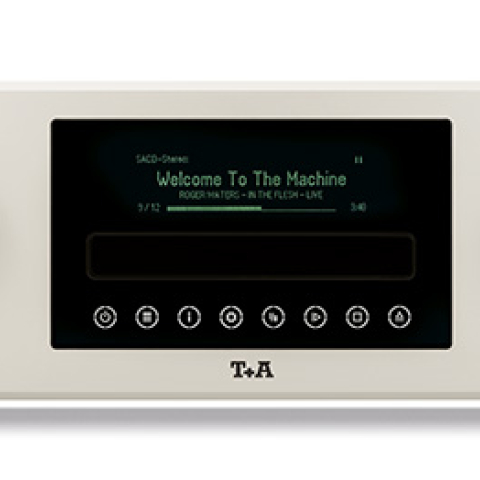
Our long-awaited laser-audio disc player (usually called the CD, for "Compact Disc") finally arrived, along with a real bonanza of software: two discs—a Polygram classical sampler of material from Decca, Deutsche Grammophon and Philips, and a Japanese CBS recording of Bruckner's 4th Symphony, with Kubelik. The player is not the same one we saw in Chicago last summer. That unit was deep and had a square front, played the disc on edge, parallel to the front, and had a minimum of controls. This one is lower and wider, has a horizontal drawer that slides out to accept the disc, and has much more flexibility of control. Audiophiles will however be dismayed to note that there is nothing on it to adjust; there isn't even a knob to diddle. But there are plenty of buttons. After the unit is turned on, a touch of a button opens the loading drawer. The disc goes in label-side up, playing-side down. To close the drawer, you can push the same button again or simply select a band for playing.
There are three fast-forward program-seeking functions in each direction. One (for each direction) moves to the beginning of the next or last (or currently playing) selection or, if the button is pressed 2 or 3 times, to the beginning of the second or third selection in each direction, and so on. A Reset button cancels any selection that is playing and puts the unit back to the start of Band 1, but does not start it playing until told to. Other buttons make it repeat the selection it is playing, repeat the entire disc when finished, or repeat any segment of any program that you have previously "marked" by delimiting its beginning and end via a frontpanel button. Four other buttons provide fast or very fast forward or reverse, in which modes the sound level drops and the music speeds up in tempo but without changing pitch! (This is done by sampling brief bursts of the passing digits; D/A conversion yields the original sounds minus the omitted segments of time.) Also supplied is a cute little remote control module which duplicates the main unit's controls including Play, Pause, and all the program-seeking functions. The remote unit also allows for individual selection of each track, by track number. (For instance, each movement of a symphony constitutes a track; any one can be selected at will.) Track changes take but a few seconds, and in total silence. There are a few other functions on the remote control, such as a beeper and an automatic pause, whose raisons d'etre I have yet to figure out (the unit came without instructions), but I'll try to find out about them by next month. The remote control uses a modulated infrared carrier to communicate with the main player but, unlike some such (the B&O remote, for example), this one is like a typical television remote in that it must be aimed directly at the main unit in order to communicate with it. (The B&O would work when bounced off a wall or ceiling—aiming from any direction and from any part of the same room as the control unit.)
Sony CDP-101 Compact Disc Player

Company Info
ARTICLE CONTENTS
- Log in or register to post comments