More than a decade ago, I bought a new pair of speakers and sought to find the most suitable cables for them. After auditioning a number of borrowed sets, I enlisted my daughter to confirm my selection. She grew up in a household where there was always good music playing on good equipment, but had no active interest in either. To placate Dad, she listened to a few of her own recordings with each of the various cables and then, lo and behold, reached the same conclusion I had. In fact, she described the differences almost exactly as I would have. I was ecstatic. Not only did it confirm my opinions about the cables, but it confirmed to me that any motivated listener can hear what golden-ear audiophiles obsess about. As I tried to express my joy to her, she left the room with this parting shot: "Yes, of course, but who cares?"
 I think she nailed it, guys. The improvements I hear in switching from a good Class C or D component to a similar Class A or B component costing 10 or 20 times more are quite small. However, if I care about these aspects of performance, they are significant to me. Audiophiles can justify their expenses only because small perceived differences are important to our personal enjoyment and satisfaction. Consequently, we choose to assign a high subjective value to such distinctions because we are convinced that they will afford us great joy and happiness.
Extending the issue of subjectivity to the purely monetary, we each assign a personal value to dollars as well. Is a $1000 audio purchase something that you must plan to make but once every few years, or is it something you can do without concern as often as you like? My situation places me somewhere in between the two, but I'm certain there are readers across (or even beyond) that range. Therefore, it's impossible for me to say that improvement "X" is worth expenditure "B" for anyone other than myself; you must interpret my recommendations as being quite personal.
When I was offered the chance to review the mbl DAC (and, subsequently, the Burmester and Mark Levinson DACs that I write about elsewhere in this issue), I did wonder if it was possible to fairly evaluate such expensive pieces. Given what enjoyment is offered by much less costly equipment, could there be such differences in performance as would justify the orders-of-magnitude cost differences between decent, garden-variety DACs and the mbl, Burmester, and (to a degree) Mark Levinson? The products under review here must do exactly the same things that all other DACs do: take a digital datastream, separate the data and clocks, oversample, convert each data word to an analog value, and, finally, drive the output lines. That's it. Can the Burmester 970, for example, possibly do this 100 times better than the MSB LinkDAC? Not only is it unlikely, it's probably impossible.
What cannot be denied is that expectations for these components were high; mere competence would have been disappointing. Not surprisingly, all three DACs performed superbly—but they certainly were not equal.
Who is mbl?
I think she nailed it, guys. The improvements I hear in switching from a good Class C or D component to a similar Class A or B component costing 10 or 20 times more are quite small. However, if I care about these aspects of performance, they are significant to me. Audiophiles can justify their expenses only because small perceived differences are important to our personal enjoyment and satisfaction. Consequently, we choose to assign a high subjective value to such distinctions because we are convinced that they will afford us great joy and happiness.
Extending the issue of subjectivity to the purely monetary, we each assign a personal value to dollars as well. Is a $1000 audio purchase something that you must plan to make but once every few years, or is it something you can do without concern as often as you like? My situation places me somewhere in between the two, but I'm certain there are readers across (or even beyond) that range. Therefore, it's impossible for me to say that improvement "X" is worth expenditure "B" for anyone other than myself; you must interpret my recommendations as being quite personal.
When I was offered the chance to review the mbl DAC (and, subsequently, the Burmester and Mark Levinson DACs that I write about elsewhere in this issue), I did wonder if it was possible to fairly evaluate such expensive pieces. Given what enjoyment is offered by much less costly equipment, could there be such differences in performance as would justify the orders-of-magnitude cost differences between decent, garden-variety DACs and the mbl, Burmester, and (to a degree) Mark Levinson? The products under review here must do exactly the same things that all other DACs do: take a digital datastream, separate the data and clocks, oversample, convert each data word to an analog value, and, finally, drive the output lines. That's it. Can the Burmester 970, for example, possibly do this 100 times better than the MSB LinkDAC? Not only is it unlikely, it's probably impossible.
What cannot be denied is that expectations for these components were high; mere competence would have been disappointing. Not surprisingly, all three DACs performed superbly—but they certainly were not equal.
Who is mbl?
The German mbl company has mounted some of the most arresting demonstrations at the past several Stereophile HI-FI Shows. First, I was attracted and fascinated by the unusual mbl Radialstrahler speakers, one of which, the 111a, has graced the cover of this magazine (April 1997) and lodged itself in "Class A (Restricted Extreme LF)" of "Recommended Components." Second, I was impressed by the glossy black-and-gold styling of the amply proportioned mbl electronics. Finally, I was seduced by the sound of the system, a triumph due in part to the canny selection of demonstration recordings by mbl's president, Wolfgang Meletzky. Over the years, I've written down the information and purchased more than a few of these recordings. Do they sound as good at home? Some do, some don't, and some sound better, but they're generally excellent. I take this as an indication that they were not chosen merely to complement mbl's equipment, but to show how musical that equipment can be.
At the 1999 CES, the mbl demonstration was followed by a surgical tour through the chassis of mbl's new DAC by the company's chief engineer, Jürgen Reis, who seemed positively compelled to point out detail after detail of these very large devices. I wondered, though, why such size is required when other manufacturers manage with less. Reis had lots of answers for that. I also wondered, this time to myself, whether this DAC's performance could justify its cost. As if reading my thoughts, Mr. Meletzky offered the 1611 DAC for review. I felt as if a stranger had tossed me the keys to his Ferrari.
The big DAC day arrives
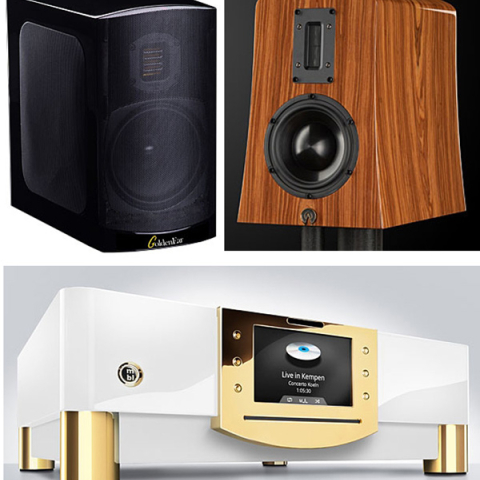
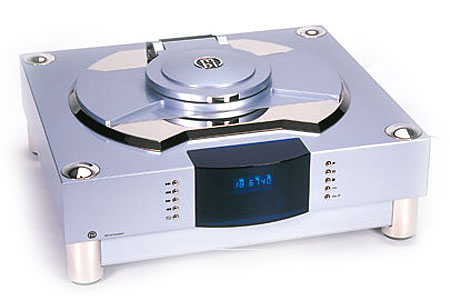
The arrival of the mbl 1611HR DAC (along with the 1621 transport) changed and dominated the appearance of my equipment rack. Finished in polished black with generous gold accents, the mbl's styling is assertive and glamorous. The black enclosure is supported by four gold cylinders (adjustable for leveling, balancing, or stacking) with soft-rubber bottom surfaces. The front panel is dominated by a large, convex, backlit display module that, in turn, is flanked by parallel rows of gold pushbuttons and LED indicators. At the center of the display module is a large gold knob, a completely analog volume control for the variable outputs. The graceful gold domes atop the DAC's corners permit the transport to be securely stacked on the 1611HR if required. The massive element in the center is a plate engraved with the mbl logo. These elements are not gold-toned but, in fact, gold-plated, and many, such as the pushbutton caps, are made in-house by mbl. Any one of the 10 inputs can be selected by pushing the corresponding input button on the upper portion of the front panel. In addition, this simple process powers up only the selected input circuit, ensuring that there's no spurious interference from the others. The button on the lower right disengages the display, the remote control, and the associated crystal oscillator to minimize extraneous signal interference. (The two buttons above that are reserved for future expansion.) The left top button mutes the signal, and the lower one selects the analog input, which bypasses the digital circuitry and is available from both the fixed and variable analog outputs. Thus, with its analog volume control, the 1611HR can function as a preamp control center for multiple digital inputs and one analog source.
The 1611HR's most interesting controls and features are the result of mbl's use of two separate digital receiver chips where most systems use only one. The typical arrangement requires that external signals switch receiver modes, because the same few pins must be used to indicate error levels, sample frequency, and channel status (data type, SCMS, pre-emphasis). mbl reserves one receiver chip for handling the audio signals passed on to the digital filters, DACs, and the listener, and a completely independent chip to monitor data integrity. This means that the second chip constantly scans for data errors and clock accuracy, but the chip handling the signal being heard is not affected by the continual mode switching. A very neat idea, and one that does not increase the unit's cost by much.
When the Error Level button (located between the mute and analog switches) is engaged (LED on), the error threshold is set high and the internal error-correction circuitry in the main signal path is disengaged. This is the recommended starting arrangement for maximum performance with high-quality signals and sources. If, under these conditions, there are excessive errors in the datastream, the error LED on the upper left of the main display is illuminated and the CD should be cleaned or checked for physical damage. If the problem remains, the Error Level switch can be disengaged (ie, error level set low) to permit play, though this results in less than optimum performance. If the main error indicator still lights up, then it's likely that the transport or the connecting cable is defective and should be checked. Just below the error LED on the left of the main display are indicators for pre-emphasis (automatically detected and compensated for) and DVD (currently not implemented).
I think she nailed it, guys. The improvements I hear in switching from a good Class C or D component to a similar Class A or B component costing 10 or 20 times more are quite small. However, if I care about these aspects of performance, they are significant to me. Audiophiles can justify their expenses only because small perceived differences are important to our personal enjoyment and satisfaction. Consequently, we choose to assign a high subjective value to such distinctions because we are convinced that they will afford us great joy and happiness.
Extending the issue of subjectivity to the purely monetary, we each assign a personal value to dollars as well. Is a $1000 audio purchase something that you must plan to make but once every few years, or is it something you can do without concern as often as you like? My situation places me somewhere in between the two, but I'm certain there are readers across (or even beyond) that range. Therefore, it's impossible for me to say that improvement "X" is worth expenditure "B" for anyone other than myself; you must interpret my recommendations as being quite personal.
The German mbl company has mounted some of the most arresting demonstrations at the past several Stereophile HI-FI Shows. First, I was attracted and fascinated by the unusual mbl Radialstrahler speakers, one of which, the 111a, has graced the cover of this magazine (April 1997) and lodged itself in "Class A (Restricted Extreme LF)" of "Recommended Components." Second, I was impressed by the glossy black-and-gold styling of the amply proportioned mbl electronics. Finally, I was seduced by the sound of the system, a triumph due in part to the canny selection of demonstration recordings by mbl's president, Wolfgang Meletzky. Over the years, I've written down the information and purchased more than a few of these recordings. Do they sound as good at home? Some do, some don't, and some sound better, but they're generally excellent. I take this as an indication that they were not chosen merely to complement mbl's equipment, but to show how musical that equipment can be.
The arrival of the mbl 1611HR DAC (along with the 1621 transport) changed and dominated the appearance of my equipment rack. Finished in polished black with generous gold accents, the mbl's styling is assertive and glamorous. The black enclosure is supported by four gold cylinders (adjustable for leveling, balancing, or stacking) with soft-rubber bottom surfaces. The front panel is dominated by a large, convex, backlit display module that, in turn, is flanked by parallel rows of gold pushbuttons and LED indicators. At the center of the display module is a large gold knob, a completely analog volume control for the variable outputs. The graceful gold domes atop the DAC's corners permit the transport to be securely stacked on the 1611HR if required. The massive element in the center is a plate engraved with the mbl logo. These elements are not gold-toned but, in fact, gold-plated, and many, such as the pushbutton caps, are made in-house by mbl. Any one of the 10 inputs can be selected by pushing the corresponding input button on the upper portion of the front panel. In addition, this simple process powers up only the selected input circuit, ensuring that there's no spurious interference from the others. The button on the lower right disengages the display, the remote control, and the associated crystal oscillator to minimize extraneous signal interference. (The two buttons above that are reserved for future expansion.) The left top button mutes the signal, and the lower one selects the analog input, which bypasses the digital circuitry and is available from both the fixed and variable analog outputs. Thus, with its analog volume control, the 1611HR can function as a preamp control center for multiple digital inputs and one analog source.