| Columns Retired Columns & Blogs |

Burmester Reference Line 970 D/A converter & 969 CD transport
My first exposure to Burmester electronics was some years back at a New York Hi-Fi Show, where they were powering a pair of B&W 801s and impressed the hell out of me. But Burmester's distribution seemed sporadic and the prices beyond my consideration, so I put them out of my mind.
More recently, Burmester has been showing up at CES and in my local hi-fi emporium with a mind-boggling array of jewel-finished components and a no-holds-barred approach to design. Demonstrations were as impressive as that first one, and I leaped at the prospect of getting the 970 DAC and 971 transport for review.

While putting the finishing touches on this review, I visited with Dieter Burmester and Udo Besser at their newly expanded premises in Berlin. From the temporary congestion in the offices to the neatly structured assembly and testing areas and the fascinating product-development area, no part of the operation seemed as important to or as representative of Burmester as their combination recording studio and demonstration theater. This large space, acoustically and electrically isolated, has a crisp, immediate sound with very controlled reverberation. (I think that Dieter Burmester, who was very proud to show off his guitar collection, is as eager to play in this space as he is to create an ideal listening room for his components.)
Even though I had seen some of the electronics in the US, I had no idea of the wide range of components and loudspeakers that Burmester produces. Examining them in various stages of completion was fascinating—they revealed clear evidence of meticulous design and scrupulous construction. Overall, there was an air of seriousness and attention to detail in all of Burmester's operations—even in the shipping area, where a dozen 970 DACs sat waiting to go: My Eyes Glazed Over!
Three big boxes
The Burmester DAC, its power supply, and the companion CD transport (see Sidebar) are three of the reasons I recently needed to double my rack space. Initially, Udo Besser sent me a DAC and transport that he said were demo units, and promised to replace with current production units. The demo and production units were pretty much identical except for color, but the first transport lacked a lever on the power switch, so it could not be turned off, and the first DAC (SN 8-10-15) lacked a remote control. Other than that, my comments apply equally to prototype and production units.
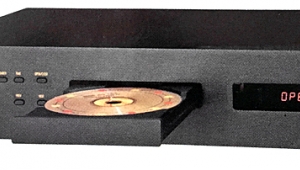
There's a lab quality to the appearance of the 970 itself, but the glistening finish of chrome and brushed metal has more panache than any lab equipment I've used. The 970 is clad like a battleship in heavy metal plates that cover a fully modular design that permits easy modification as future needs demand. It is formidably heavy (especially since the power supply is in a separate chassis), with four large spikes to support it. The spikes are supported in turn by carbon-fiber pucks, themselves seated in machined recesses in a separate and hefty aluminum baseplate.
The 970 DAC has five digital inputs and two digital outputs. There are four analog outputs, balanced and unbalanced, each with fixed or variable volume control. It features a high-precision, thermally stable oscillator that not only determines the timing of the D/A conversion (as in other DACs), but is used to reclock the digital signals at several points in the 970 and, via an independent coax interconnect, control the data decoding in the Burmester transport. The 970 is fully balanced, from the input transformers on through the four independent ladder-type D/A converter modules and the output stages. The 60-step volume control is based on a DAC R2R chain for linearity, and adds another stage when switched into the signal path. The silky-smooth volume knob also selects and stores configurations in the program mode.
The most interesting and characteristic features of the 970 DAC are the number of options it offers for digital and analog processing and the ease with which one can manipulate these options. The complexity is made manageable by the front panel, which is laid out as a flowchart with LEDs indicating the active and/or available paths, and four digital readouts displaying sample rate, word length, volume level, and selected program. Of the approximately 400 possible functional states, any combination can be stored in one of 20 memory locations. (The program indicator shows you the index number of the selected configuration.) Of course, the flowchart LEDs also delineate the configuration.
Beginning at the inputs and reading the flowchart from left to right, each active input is indicated by an illuminated LED to its left and, when selected, by another to its right. (Those are the first five options.) When sync lock with an input is achieved, the next LED is illuminated and the clock and bit-resolution windows are updated. If one runs the 970 master clock to a Burmester 969 or 979 transport, the clock window should indicate "SNC" rather than the specific sample rate when the two are locked. (Use of the master clock or not doubles our options.) Next in the path is the choice of digital filter and filter characteristics. There is a PMD-100 HDCD-capable filter (with one LED to indicate the presence of an HDCD signal, another to indicate the decoding of HDCD when the PMD-100 is selected), a regular 8x-oversampling digital filter, and a MAXimum RESOlution digital filter to accommodate up to 24 bits and 96kHz sampling. Although implemented with an eye toward DVDs and other possible media, the MaxRez filter will handle all lesser signals. The latter two filters are available with selectable Sharp and Slow cutoff options. (I count that as offering a range of five filter options.)
In addition, the analog filter characteristics, Soft or Linear, can also be selected, which doubles our options again. Add or, rather, multiply the options for absolute phase (2) and for fixed vs variable volume (2), and you can see why having the option of storing your preferences from the 400 possibilities is more a necessity than a luxury. I must admit, however, that beyond exercising the programming functions a bit, I tended to use the front-panel buttons or the remote rather than the preset combinations. Users less neurotic than the typical reviewer will probably opt for pre-programming.
Oh yes—there's a front-panel On/Off switch.
Listening to the Burmester
Bracingly clean in chrome and matte silver, the three Burmester units (DAC, PS for DAC, and transport) were initially hooked up together with the DAC master clock fed back to the transport, the STD filter selected, and the unbalanced, fixed-volume output connected to the rest of the system. This was done to let me become familiar with Burmester's sound, as well as with the many intricacies of the Burmester DAC.
It was instantly apparent that this was no garden-variety CD player. The sound was dynamic and smooth, with a sense of great relaxation and ease. Switching from the S/PDIF connection to the AES/EBU afforded little if any advantage, but removing the clock link seemed to make the sound a bit less "airy"—an observation I've made before when comparing better transport/DAC links (like I2S) with standard ones. Changing the digital and analog filter configurations was intriguing in that, depending on program content, the differences varied from unnoticeable (sometimes) to inconsequential (often) to significant (rare). However, there was less consistency than I had expected; I found it impossible to predict exactly what combination would suit a particular CD. I can see a user stepping through stored configurations to find an optimum configuration for a particular disc and writing the preferred program number on the CD case for easy selection.
At Burmester's suggestion, I did my critical listening with my system fully balanced throughout. The CAL CL-20's AES/EBU output fed the 970 DAC, its fixed-volume balanced outputs feeding the Sonic Frontiers Line 3. I started out with the PMD-100 as the filter, since I have auditioned many DACs with this same chip. On both HDCD and normal CDs, the 970 sounded absolutely superb. Depending on the source material, the CL-20/970 combination reminded me of various other transports, players, and DACs I have used before. In the bass, the Burmester sounded like the Theta Miles or the Arcam 9, both of which have great extension and slam. With its natural midrange and smooth, extended treble, the 970 recalled the eminent dCS Elgar. Switching from any of the other devices on hand to the output of the 970 always had the effect of convincing me that the Burmester was "right" in its soundstage presentation, even though it was sometimes broader and deeper, sometimes less so.
NEXT: Page 2 »
 | |||||||||||

|
|
| |||||||||
- Log in or register to post comments







| Loudspeakers Amplification Digital Sources | |
Analog Sources Accessories Featured | |
Music Columns Retired Columns | |
Show Reports | |
Features Latest News Community | |
Resources Subscriptions |
 © 2024 Stereophile
AVTech Media Americas Inc., USA
All rights reserved