Just about any consumer-electronics product that needs to generate voltage gain can be made with a vacuum tube. It isn't hard to do. It's no big deal.
 That in itself is cause to wonder if some contemporary audio products were designed around tubes for cynical reasons, for tubes' cachet more than for their inherent technological or musical worth. The answer is Yes, probably.
There are kinder, gentler bad reasons, one of which I see in the mirror every day: Tubes are easier than discrete transistors for the novice to understand and to use. I've just about memorized the circuits for Don Garber's direct-coupled Fi 2A3 amplifier and Peter Walker's push-pull Quad II amplifier, the latter by using the schematic as a screen saver for the past three months; I could probably build one or the other if I had to, in the same sense that a person of no particular talent or inspiration could recite one of Shakespeare's sonnets.
All right, so there are cynical builders and there are simple builders. Whom does that leave?
Irony
That in itself is cause to wonder if some contemporary audio products were designed around tubes for cynical reasons, for tubes' cachet more than for their inherent technological or musical worth. The answer is Yes, probably.
There are kinder, gentler bad reasons, one of which I see in the mirror every day: Tubes are easier than discrete transistors for the novice to understand and to use. I've just about memorized the circuits for Don Garber's direct-coupled Fi 2A3 amplifier and Peter Walker's push-pull Quad II amplifier, the latter by using the schematic as a screen saver for the past three months; I could probably build one or the other if I had to, in the same sense that a person of no particular talent or inspiration could recite one of Shakespeare's sonnets.
All right, so there are cynical builders and there are simple builders. Whom does that leave?
Irony
There's an irony at the heart of my approach to this hobby: Whenever I hear an impressive bit of technology, old or new—a low-impedance moving-coil phono cartridge, a single-ended amplifier, a DSD processor—it replenishes my enthusiasm for domestic audio. Sadly, the mechanism by which it does so is to make me disproportionately enthused about that technology rather than about the overarching art of the accomplishment. Let alone the end result. In my defense, there's a lot of that going around. Just look at what we've done with class-A amplifiers—or single-ended amplifiers, or cathode followers, or alnico magnets, or low-torque turntable motors, or high-torque turntable motors, or single-bit converters, or literally everything else: We've turned them all into hobbyhorses that individual people either ride or don't.
To suggest, for instance, that an amplifier has to operate in class-A in order to be good is like suggesting that a symphony must be written in C minor in order to sound serious, just because that's the home key of Mahler's "Resurrection" symphony: It's crazy—but one encounters that attitude all the time in perfectionist audio. For some strange reason, the road from zeal to single-mindedness is a short and appealing one; from there to marketplace demagoguery is shorter still.
I'm learning. Nowadays, when I hear about an audio designer whose palette contains more than just a few different colors—ideas, not axioms—I pay attention. Ken Shindo is at the top of that list.
 Shindo-san is a Japanese electronics engineer who spent the first part of his professional life designing television sets for Matsushita. (Legend has it that the Shindo household had one of the first color TVs in Japan.) Early on, Shindo began to devote spare time to designing and building audio amplifiers, and he began the slow, cumulative process of learning how various circuits, parts, and even wiring techniques could be used to re-create the musical sounds he was interested in.
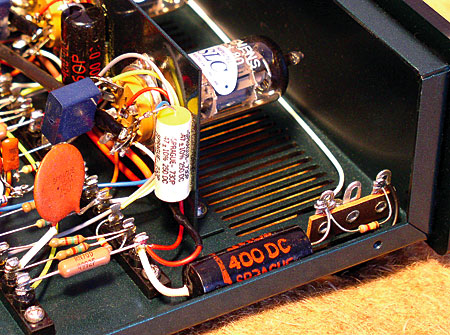
Shindo began doing something else during that time that he's continued right up to the present: Whenever he discovered that certain parts had a unique sound, and that those parts would be useful in some applications (there are no audiophile dogmas in the world of Shindo), he began, quietly, to stockpile them: Western Electric transformers, Allen-Bradley carbon-composite resistors, and all those colorfully named Sprague capacitors of the 1950s and '60s: the Orange Drop, the Vitamin Q, the Black Beauty, the Bumblebee.
And tubes—from Mullard, Western Electric, RCA, Siemens, and Telefunken. Shindo laid in a big supply of the ever-popular Western Electric 300B, but he also stockpiled tubes you've never heard of, which he discovered during his many years of experimenting and listening: the 349A, the 6CA4, and the lovely F2a from Germany. Nor does Ken Shindo hesitate to use tubes that are uncool, such as the RCA 6L6 and the Telefunken EL84, as long as they can give him what he wants.
And what Ken Shindo wants more than anything else is tone. The tone of real instruments. The tone of the concert hall. The tone that spells the difference between a person who's making an effort and a machine that isn't.
That in itself is the number-one reason why Ken Shindo doesn't use transistors. He's tried them on many occasions—especially MOSFETs, when they first came out in the 1960s—but has never succeeded in getting from them the tone he wants.
Science
Shindo-san is a Japanese electronics engineer who spent the first part of his professional life designing television sets for Matsushita. (Legend has it that the Shindo household had one of the first color TVs in Japan.) Early on, Shindo began to devote spare time to designing and building audio amplifiers, and he began the slow, cumulative process of learning how various circuits, parts, and even wiring techniques could be used to re-create the musical sounds he was interested in.
Shindo began doing something else during that time that he's continued right up to the present: Whenever he discovered that certain parts had a unique sound, and that those parts would be useful in some applications (there are no audiophile dogmas in the world of Shindo), he began, quietly, to stockpile them: Western Electric transformers, Allen-Bradley carbon-composite resistors, and all those colorfully named Sprague capacitors of the 1950s and '60s: the Orange Drop, the Vitamin Q, the Black Beauty, the Bumblebee.
And tubes—from Mullard, Western Electric, RCA, Siemens, and Telefunken. Shindo laid in a big supply of the ever-popular Western Electric 300B, but he also stockpiled tubes you've never heard of, which he discovered during his many years of experimenting and listening: the 349A, the 6CA4, and the lovely F2a from Germany. Nor does Ken Shindo hesitate to use tubes that are uncool, such as the RCA 6L6 and the Telefunken EL84, as long as they can give him what he wants.
And what Ken Shindo wants more than anything else is tone. The tone of real instruments. The tone of the concert hall. The tone that spells the difference between a person who's making an effort and a machine that isn't.
That in itself is the number-one reason why Ken Shindo doesn't use transistors. He's tried them on many occasions—especially MOSFETs, when they first came out in the 1960s—but has never succeeded in getting from them the tone he wants.
Science
As early as 1974, Ken Shindo began selling preamplifiers and power amps from his home. Then, in 1977, while still in his mid-30s, he decided to leave Matsushita and start his own audio company. Today, Shindo Laboratory has a showroom and warehouse in Tokyo, while the products themselves are still built at home, in the suburban city of Saitama. Ken's wife, Harumi, works at his side, along with their two sons and two helpers from outside the family. In addition to a few other interesting products, which I hope to describe in next month's column, the Shindo range comprises seven preamplifiers and nine amplifiers; the latter run the gamut from 8 to 40Wpc, using various tubes and topologies: a stereo, push-pull 6L6 here, a monoblock, single-ended F2a there. Everything is built to order—the warehouse is for parts, not products—and every model is a limited edition; Shindo's supplies of parts determine the total number made of each model. For example, if Shindo has 100 pieces of a vintage part in stock, and a certain model of amp needs one of them, then he'll make 40 amps, and keep the remaining 60 parts on hand for repairs and replacements.
 Shindo's amplifiers throw more than just audiophile conventions out the window; the conventions of pricing wind up in the yard as well. Of the nine amplifiers in the line, each has a somewhat different voice, and one or the other will suit a particular listener, almost irrespective of price—and each is priced only in accordance with how difficult it was to build, and how rare or difficult it was to obtain its component parts. That's not to say that people who buy the $9500 Cortese aren't getting a better amp than those who buy the $3895 Montille—but the latter may be a better fit with some systems and to some people's ears.
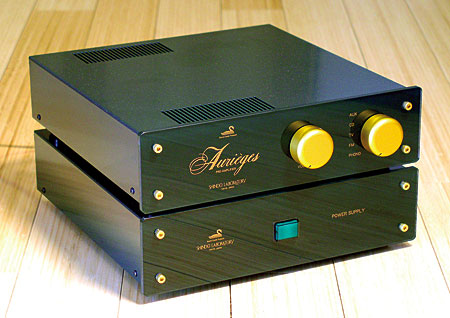
There are no dogmas, but there are a few constants: All Shindo preamps and amps are built into steel enclosures, because Ken Shindo dislikes the sound of aluminum. All are beautifully finished, inside and out, in the same proprietary metallic-green lacquer (footnote 1). All use transformers designed by Ken Shindo, and manufactured in Japan to his very exacting specifications—except, that is, for the occasional high-end piece that uses new-old-stock (NOS) trannies.
Another constant: All Shindo Laboratory electronics run their tubes extremely conservatively—not a bad idea when a product is designed around something that hasn't been made in 40 years, backup supplies notwithstanding.
Shindo's amplifiers throw more than just audiophile conventions out the window; the conventions of pricing wind up in the yard as well. Of the nine amplifiers in the line, each has a somewhat different voice, and one or the other will suit a particular listener, almost irrespective of price—and each is priced only in accordance with how difficult it was to build, and how rare or difficult it was to obtain its component parts. That's not to say that people who buy the $9500 Cortese aren't getting a better amp than those who buy the $3895 Montille—but the latter may be a better fit with some systems and to some people's ears.
There are no dogmas, but there are a few constants: All Shindo preamps and amps are built into steel enclosures, because Ken Shindo dislikes the sound of aluminum. All are beautifully finished, inside and out, in the same proprietary metallic-green lacquer (footnote 1). All use transformers designed by Ken Shindo, and manufactured in Japan to his very exacting specifications—except, that is, for the occasional high-end piece that uses new-old-stock (NOS) trannies.
Another constant: All Shindo Laboratory electronics run their tubes extremely conservatively—not a bad idea when a product is designed around something that hasn't been made in 40 years, backup supplies notwithstanding.
Footnote 1: A note to all male American baby boomers: Remember Aurora's scale-model kit of the Creature from the Black Lagoon? It was molded in plastic that was precisely the same shade of metallic green. Next issue: a treatise on how Aurora's Godzilla kit was molded in the same shade of magenta as the Rega Elys phono cartridge.
That in itself is cause to wonder if some contemporary audio products were designed around tubes for cynical reasons, for tubes' cachet more than for their inherent technological or musical worth. The answer is Yes, probably.
There are kinder, gentler bad reasons, one of which I see in the mirror every day: Tubes are easier than discrete transistors for the novice to understand and to use. I've just about memorized the circuits for Don Garber's direct-coupled Fi 2A3 amplifier and Peter Walker's push-pull Quad II amplifier, the latter by using the schematic as a screen saver for the past three months; I could probably build one or the other if I had to, in the same sense that a person of no particular talent or inspiration could recite one of Shakespeare's sonnets.
There's an irony at the heart of my approach to this hobby: Whenever I hear an impressive bit of technology, old or new—a low-impedance moving-coil phono cartridge, a single-ended amplifier, a DSD processor—it replenishes my enthusiasm for domestic audio. Sadly, the mechanism by which it does so is to make me disproportionately enthused about that technology rather than about the overarching art of the accomplishment. Let alone the end result. In my defense, there's a lot of that going around. Just look at what we've done with class-A amplifiers—or single-ended amplifiers, or cathode followers, or alnico magnets, or low-torque turntable motors, or high-torque turntable motors, or single-bit converters, or literally everything else: We've turned them all into hobbyhorses that individual people either ride or don't.
Shindo-san is a Japanese electronics engineer who spent the first part of his professional life designing television sets for Matsushita. (Legend has it that the Shindo household had one of the first color TVs in Japan.) Early on, Shindo began to devote spare time to designing and building audio amplifiers, and he began the slow, cumulative process of learning how various circuits, parts, and even wiring techniques could be used to re-create the musical sounds he was interested in.
As early as 1974, Ken Shindo began selling preamplifiers and power amps from his home. Then, in 1977, while still in his mid-30s, he decided to leave Matsushita and start his own audio company. Today, Shindo Laboratory has a showroom and warehouse in Tokyo, while the products themselves are still built at home, in the suburban city of Saitama. Ken's wife, Harumi, works at his side, along with their two sons and two helpers from outside the family. In addition to a few other interesting products, which I hope to describe in next month's column, the Shindo range comprises seven preamplifiers and nine amplifiers; the latter run the gamut from 8 to 40Wpc, using various tubes and topologies: a stereo, push-pull 6L6 here, a monoblock, single-ended F2a there. Everything is built to order—the warehouse is for parts, not products—and every model is a limited edition; Shindo's supplies of parts determine the total number made of each model. For example, if Shindo has 100 pieces of a vintage part in stock, and a certain model of amp needs one of them, then he'll make 40 amps, and keep the remaining 60 parts on hand for repairs and replacements.
Shindo's amplifiers throw more than just audiophile conventions out the window; the conventions of pricing wind up in the yard as well. Of the nine amplifiers in the line, each has a somewhat different voice, and one or the other will suit a particular listener, almost irrespective of price—and each is priced only in accordance with how difficult it was to build, and how rare or difficult it was to obtain its component parts. That's not to say that people who buy the $9500 Cortese aren't getting a better amp than those who buy the $3895 Montille—but the latter may be a better fit with some systems and to some people's ears.
There are no dogmas, but there are a few constants: All Shindo preamps and amps are built into steel enclosures, because Ken Shindo dislikes the sound of aluminum. All are beautifully finished, inside and out, in the same proprietary metallic-green lacquer (footnote 1). All use transformers designed by Ken Shindo, and manufactured in Japan to his very exacting specifications—except, that is, for the occasional high-end piece that uses new-old-stock (NOS) trannies.
Another constant: All Shindo Laboratory electronics run their tubes extremely conservatively—not a bad idea when a product is designed around something that hasn't been made in 40 years, backup supplies notwithstanding.
Footnote 1: A note to all male American baby boomers: Remember Aurora's scale-model kit of the Creature from the Black Lagoon? It was molded in plastic that was precisely the same shade of metallic green. Next issue: a treatise on how Aurora's Godzilla kit was molded in the same shade of magenta as the Rega Elys phono cartridge.