"Men must eat, though angels be their guests."
—William Laird, "Träumerei at Ostendorff's" A few months ago, when an audio newcomer asked what I use for a music source at home, my first, casual answer fell short. When I responded by saying "a Linn"—which to me is the same thing as saying "a small Scottish record player"—my young friend was no less in the dark. I hadn't considered that, to an audiophile who came of age after the 1980s, "a Linn" could mean just about anything, ranging from a music server to an in-wall loudspeaker.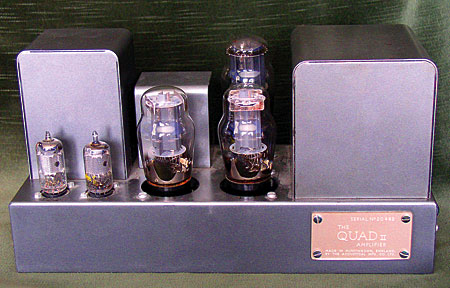 At least one precedent comes to mind: To many of us, "a Quad" is an electrostatic loudspeaker; yet to the audiophile who was active before 1957, a Quad is an amplifier, and always will be.
The distinction is more than merely semantic: It affects our understanding of how we got here, as a hobby—and, more to the point, who it was that led the way.
It's unlikely that Peter J. Walker, O.B.E., comes to many minds when people set about naming the greatest amplifier designers—generous though those folks may be with credit to Walker as a speaker designer, for his full-range electrostatics. I daresay the designers who do get the nod are, for the most part, not designers at all but merely rehashers: people who do little more than build—or, quite often, overbuild—modern-spec examples of original designs from such people as D.T.N. Williamson, Gordon Gow, David Hafler, Herbert Keroes, and Matti Otala.
Yet Peter Walker himself gave domestic audio one of its few original amp designs: the Quad II monoblock of 1953, arguably the first truly great domestic amplifier.
The class-A, push-pull Quad II amp used six capacitors, 13 resistors, one choke, two transformers, and five vacuum tubes to convert a line-level monophonic audio signal into 15W of output power, with virtually flat frequency response between 10Hz and 20kHz and no more than 0.1 % of harmonic distortion. The tubes were cannily chosen—a pair of EF86 miniature pentodes for voltage gain and phase splitting (in a single stage), a pair of KT66 "kinkless tetrodes" for output power, and a GZ32 full-wave rectifier—and the output transformer was designed and made with painstaking care.
The latter is especially important in Walker's littlest wonder: Eschewing both the triode operation mode preferred by his friend D.T.N. Williamson, and the so-called ultralinear output design of David Hafler and Herbert Keroes, Walker connected the screen grids of his KT66s to the same high-tension source as their plates—thus running his tetrodes as tetrodes—and split the primary of his output transformer between windings for the plates and the cathodes. (The Quad II is an auto-bias design, with a common cathode resistor for both output tubes, tied to a center tap in the above-mentioned transformer winding.) Walker's innovation accomplished two things in one stroke: It applied voltage feedback to the output tube, for lower distortion (the Quad II also used a small amount of global negative feedback); and, by allowing the KT66s to run at a lower plate voltage, it provided a boost in efficiency—and, consequently, lengthened the lives of the output tubes and other bits. So I suppose that's three things.
Jones and his plug
At least one precedent comes to mind: To many of us, "a Quad" is an electrostatic loudspeaker; yet to the audiophile who was active before 1957, a Quad is an amplifier, and always will be.
The distinction is more than merely semantic: It affects our understanding of how we got here, as a hobby—and, more to the point, who it was that led the way.
It's unlikely that Peter J. Walker, O.B.E., comes to many minds when people set about naming the greatest amplifier designers—generous though those folks may be with credit to Walker as a speaker designer, for his full-range electrostatics. I daresay the designers who do get the nod are, for the most part, not designers at all but merely rehashers: people who do little more than build—or, quite often, overbuild—modern-spec examples of original designs from such people as D.T.N. Williamson, Gordon Gow, David Hafler, Herbert Keroes, and Matti Otala.
Yet Peter Walker himself gave domestic audio one of its few original amp designs: the Quad II monoblock of 1953, arguably the first truly great domestic amplifier.
The class-A, push-pull Quad II amp used six capacitors, 13 resistors, one choke, two transformers, and five vacuum tubes to convert a line-level monophonic audio signal into 15W of output power, with virtually flat frequency response between 10Hz and 20kHz and no more than 0.1 % of harmonic distortion. The tubes were cannily chosen—a pair of EF86 miniature pentodes for voltage gain and phase splitting (in a single stage), a pair of KT66 "kinkless tetrodes" for output power, and a GZ32 full-wave rectifier—and the output transformer was designed and made with painstaking care.
The latter is especially important in Walker's littlest wonder: Eschewing both the triode operation mode preferred by his friend D.T.N. Williamson, and the so-called ultralinear output design of David Hafler and Herbert Keroes, Walker connected the screen grids of his KT66s to the same high-tension source as their plates—thus running his tetrodes as tetrodes—and split the primary of his output transformer between windings for the plates and the cathodes. (The Quad II is an auto-bias design, with a common cathode resistor for both output tubes, tied to a center tap in the above-mentioned transformer winding.) Walker's innovation accomplished two things in one stroke: It applied voltage feedback to the output tube, for lower distortion (the Quad II also used a small amount of global negative feedback); and, by allowing the KT66s to run at a lower plate voltage, it provided a boost in efficiency—and, consequently, lengthened the lives of the output tubes and other bits. So I suppose that's three things.
Jones and his plug
It haunted me like a wood sprite for years: always borrowed, never bought, always loved, never possessed. Finally, I decided to take the plunge and buy a Quad II. In fact, being a modern sort of audiophile, I decided to buy two of them, for stereo. I began with an eBay search on the words Quad II. Sorry to say, most of my hits pertained to an eye-makeup product from a company called Bare Escentuals (sic), whose Quad II eyeliner kit contains the colors aquamarine, coffee bean, and firefly. I can't imagine why anyone would want eyelids the color of a mating insect.
I persevered, and wound up buying two Quad IIs from two different sellers. Both were said to be in mostly original condition—albeit minus the original tubes—and in good working order. Unlike my earlier experience buying Quad ESL loudspeakers (see my columns in Stereophile's June and July 2006 issues), it turned out that both of my new old Quads had been accurately described by their sellers. In a further sign that This Was Meant To Be, both arrived here on the same day, and their serial numbers were remarkably close to one another—an important characteristic when you're talking about amplifiers that were in production for a remarkable 18 years, with inevitable changes in part suppliers and specifications. Total expenditure so far: under $1000.
 Now we come to the technical bits. The Quad II amplifier, whether sold singly or in pairs, was meant to be used with a Quad preamplifier, which had no power supply of its own, and took its DC plate voltage and AC heater voltage from the power amp. (This is why, anecdotally, Quad II amplifiers with the greatest need for power-supply servicing tend to be those that have been in service with Quad preamplifiers and other Quad ancillaries for the longest times.) Thus, any Quad II in original condition has an input socket not of the usual sort, but rather a thing called a Jones socket, intended to mate with a corresponding Jones plug. This was and is a six-tab connector, apportioned here among two 6.3V AC conductors, one 340V DC conductor, one line-level audio signal conductor, and one ground—the last connected by jumper to the remaining unused tab.
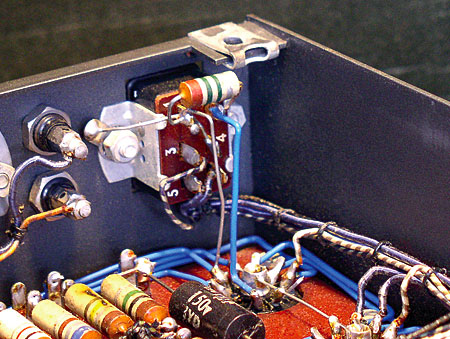 There is such a thing as a Jones adapter, in which the audio signal is connected to the center conductor of a phono socket, the ground is connected to the sleeve, and the high- and low-tension voltages go nowhere and are kept as far from one another and from ground as a small piece of plastic can manage. (One of my Quad IIs even came with such a thing free of charge: Merci, Jean-Pierre!) But because I'm an audiophile, and because the vestigial high-tension line made me nervous, I decided to get rid of Mr. Jones altogether and do a bit of rewiring.
Of course, I dispensed with the two 6.3V AC heater lines as well: They were the easiest to locate, running from terminals 5 and 6 of the Jones socket all the way toward the other end of the amp, to the secondary taps on the mains transformer. I removed those two wires from the socket, then traced them within the bundle that runs along the amplifier's front (Quad II nameplate) side, occasionally using a hobbyist's knife to slice into the quaint fabric lacing holding the bundle together. (Having been dressed in the same position for several decades, none of those wires was in danger of moving out of place.) Once I'd separated those two wires from the rest, I clipped rather than desoldered them from the secondaries, mindful of the risk of applying too much heat to a vintage trannie.
There is such a thing as a Jones adapter, in which the audio signal is connected to the center conductor of a phono socket, the ground is connected to the sleeve, and the high- and low-tension voltages go nowhere and are kept as far from one another and from ground as a small piece of plastic can manage. (One of my Quad IIs even came with such a thing free of charge: Merci, Jean-Pierre!) But because I'm an audiophile, and because the vestigial high-tension line made me nervous, I decided to get rid of Mr. Jones altogether and do a bit of rewiring.
Of course, I dispensed with the two 6.3V AC heater lines as well: They were the easiest to locate, running from terminals 5 and 6 of the Jones socket all the way toward the other end of the amp, to the secondary taps on the mains transformer. I removed those two wires from the socket, then traced them within the bundle that runs along the amplifier's front (Quad II nameplate) side, occasionally using a hobbyist's knife to slice into the quaint fabric lacing holding the bundle together. (Having been dressed in the same position for several decades, none of those wires was in danger of moving out of place.) Once I'd separated those two wires from the rest, I clipped rather than desoldered them from the secondaries, mindful of the risk of applying too much heat to a vintage trannie.
—William Laird, "Träumerei at Ostendorff's" A few months ago, when an audio newcomer asked what I use for a music source at home, my first, casual answer fell short. When I responded by saying "a Linn"—which to me is the same thing as saying "a small Scottish record player"—my young friend was no less in the dark. I hadn't considered that, to an audiophile who came of age after the 1980s, "a Linn" could mean just about anything, ranging from a music server to an in-wall loudspeaker.
At least one precedent comes to mind: To many of us, "a Quad" is an electrostatic loudspeaker; yet to the audiophile who was active before 1957, a Quad is an amplifier, and always will be.
The distinction is more than merely semantic: It affects our understanding of how we got here, as a hobby—and, more to the point, who it was that led the way.
It haunted me like a wood sprite for years: always borrowed, never bought, always loved, never possessed. Finally, I decided to take the plunge and buy a Quad II. In fact, being a modern sort of audiophile, I decided to buy two of them, for stereo. I began with an eBay search on the words Quad II. Sorry to say, most of my hits pertained to an eye-makeup product from a company called Bare Escentuals (sic), whose Quad II eyeliner kit contains the colors aquamarine, coffee bean, and firefly. I can't imagine why anyone would want eyelids the color of a mating insect.
Now we come to the technical bits. The Quad II amplifier, whether sold singly or in pairs, was meant to be used with a Quad preamplifier, which had no power supply of its own, and took its DC plate voltage and AC heater voltage from the power amp. (This is why, anecdotally, Quad II amplifiers with the greatest need for power-supply servicing tend to be those that have been in service with Quad preamplifiers and other Quad ancillaries for the longest times.) Thus, any Quad II in original condition has an input socket not of the usual sort, but rather a thing called a Jones socket, intended to mate with a corresponding Jones plug. This was and is a six-tab connector, apportioned here among two 6.3V AC conductors, one 340V DC conductor, one line-level audio signal conductor, and one ground—the last connected by jumper to the remaining unused tab.
There is such a thing as a Jones adapter, in which the audio signal is connected to the center conductor of a phono socket, the ground is connected to the sleeve, and the high- and low-tension voltages go nowhere and are kept as far from one another and from ground as a small piece of plastic can manage. (One of my Quad IIs even came with such a thing free of charge: Merci, Jean-Pierre!) But because I'm an audiophile, and because the vestigial high-tension line made me nervous, I decided to get rid of Mr. Jones altogether and do a bit of rewiring.