| Columns Retired Columns & Blogs |

The Fifth Element #8
Ah me. Victoria's Secret underwear (sorry; lingerie) model Rebecca Romijn-Stamos' publicist politely declined my request for an interview with her. An interview with the model, not the publicist. But you already knew that, and you are (best Claude Rains voice) shocked—shocked!
Footnote 1: There exists an Audio Engineering Society (AES) standards publication, "Recommended Practice for Professional Audio, AES20-1996, on the Subjective Evaluation of Loudspeakers," which includes listening-room criteria. Single copies are available for free download. To me, it looks like the product of a diligent committee that valued consensus over individuality. Dr. Peter D'Antonio, of RPG Inc., has covered critical-listening rooms in several articles for Surround Professional magazine, and I find his approach intriguing. The fly in that ointment is that D'Antonio posits room dimensions unlikely to be found in any but a purpose-built room.
This is too bad—not your state of shock, but my not interviewing Rebecca. Too bad, because one little-known fun fact about Ms. RR-S is that when she was discovered as a model, she was studying music at the college level. (I delight in envisioning Birkenstock-clad Becca towering over preschoolers as she student-teaches pentatonic recorder, or Orff's Schulwerk.) I suspect that she has retained some of her interest in music, and that it would be diverting to find out what she listens to, and through what components.
Had the interview eventuated, and had Ms. RR-S wanted my advice about buying stereo equipment, I was (of course) prepared to make recommendations. Now I might as well share those recommendations with you, though I imagine your eyebrows and cheekbones have launched far fewer ships.
Absent that interview, I know nothing of Ms. Romijn-Stamos' tastes in music or what her listening room is like, and these are obviously important considerations in selecting a system. So I'll fudge a bit and assume that her tastes are both catholic and eclectic, and that her room is "average" (footnote 1). We will also take a great leap of faith and assume that Ms. R-S is sane, and further that she just wants to listen to music, and does not want to own her own soldering iron.
On to the list. These recommended systems, ranging in approximate cost from $2500 to $90,000, consist of components I have heard at length, in most cases in the recommended combinations. In almost every case, careful setup will be necessary if the components are to sound their best as a system. I recommend vibration control by Symposium Acoustics, Room Optimizer software and acoustical treatments by RPG, power conditioning by Marigo, and power cords by Custom Power Cord Company (or similar items of equivalent quality).
I'm sure that if Ms. Romijn-Stamos wanted to lay out very long green for a stereo system, she could. But I will keep you in suspense by starting at the bottom of the price ladder. (Ms. R-S is not in suspense. She is not reading this.)
System 1: A Good Beginning: $2500
Opera Prima 1.5 loudspeaker: $995/pair
Audio Analogue Puccini integrated amplifier: $695
Marantz 4000 OSE CD changer: $450
van den Hul D-102 III Hybrid interconnect: $155/1m pair
van den Hul CS-122 Hybrid speaker cable: $93/3m pair
Show it off with: Geirr Tveitt's One Hundred Folk Songs from Hardanger orchestrations
Within its limitations in bass extension and volume, this system can provide an emotionally involving window into a musical performance. Audio Analogue keeps the price down by making remote control an option. The Puccini SE is also available, with more power. (But opting for more power and remote control almost doubles the price.) The Puccini's essential geniality meshes well with the articulate, extended sound of Opera's ported two-way loudspeaker. The Prima 1.5 features solid hardwood construction and a level of overall craftsmanship rare at this price. Marantz has discontinued its one-disc Original Special Edition CD player, but the remaining 5-disc carousel sounds nearly as good. Van den Hul's carbon-shielded cables are grain-free and unfussily relaxing to listen to.
System 2: Little Jewels: $5600
Diapason Karis loudspeaker: $1995/pair (stands: $299)
Plinius 8100 integrated amplifier: $2000
Marantz Professional PMD 340 CD player: $789
Nordost Solar Wind interconnect: $110/1m pair
Nordost Solar Wind speaker cables: $400/3m pair
Show it off with: Milladoiro: Castellum Honesti
At this price point we begin to close in on what I think of as real high-end sound. Naturally, this system is going to give up bushels of bass extension, dynamic range, and soundstage finesse compared to a cost-no-object rig, but its reproduction of smaller-scaled music is at least on the threshold of why we all don't buy a nationally advertised one-box solution and have done with it.
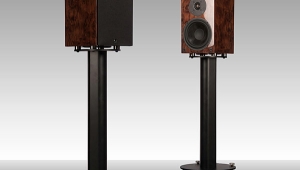
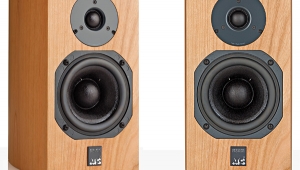
Diapason's Karis has a driver complement eerily reminiscent of the celebrated BBC LS3/5A's, but the design similarities end just about there. A rear-ported design with a simple crossover, the Karis is quick and lively, with dynamics and frequency extension quite surprising for its size. No veneered shoebox, the Karis is a smaller version of the famous Adamante, with the same solid Caneletto walnut construction and elegantly faceted front panel.
Footnote 1: There exists an Audio Engineering Society (AES) standards publication, "Recommended Practice for Professional Audio, AES20-1996, on the Subjective Evaluation of Loudspeakers," which includes listening-room criteria. Single copies are available for free download. To me, it looks like the product of a diligent committee that valued consensus over individuality. Dr. Peter D'Antonio, of RPG Inc., has covered critical-listening rooms in several articles for Surround Professional magazine, and I find his approach intriguing. The fly in that ointment is that D'Antonio posits room dimensions unlikely to be found in any but a purpose-built room.
NEXT: Page 2 »
 | |||||||||
|

| ||||||||
- Log in or register to post comments









| Loudspeakers Amplification Digital Sources | |
Analog Sources Accessories Featured | |
Music Columns Retired Columns | |
Show Reports | |
Features Latest News Community | |
Resources Subscriptions |
 © 2024 Stereophile
AVTech Media Americas Inc., USA
All rights reserved